Installation guide
 Owner’s manual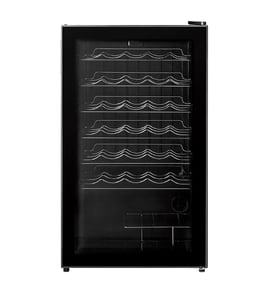



How do I reset my wine cooler?
To reset your Kenmore Elite beverage center model 79513483500, disconnect power, then restore power and set the control panel back to your preferred temperature. After a power outage or restart, the display typically defaults to 57°F, so you will usually need to reselect your setting (within the 46°F to 64°F range). See the owner's manual for the exact control steps.
Quick reset steps (power cycle)
- Unplug the wine cooler from the wall outlet.
- Wait at least 10 minutes (longer is fine if the control seems unresponsive).
- Plug it back in.
- Confirm the display is on and showing a set temperature.
- Re-enter your desired temperature setting.
- Let the unit run several hours to stabilize after changes or heavy loading.
How to set temperature again after reset
Your control uses a “Temp Adjust” function and then warmer/colder buttons.
- Press and hold Temp Adjust for 3 seconds until the temperature indicator blinks.
- Press the warmer or colder button to change the setpoint in 1°F steps.
- Wait about 10 seconds for the display to stop flashing and lock in the setting.
| Item | What to expect on this model |
|---|---|
| Factory default setpoint | 57°F |
| Adjustable range | 46°F to 64°F |
| Step size | 1°F |
If you are resetting because it is not cooling well
A reset helps the control reboot, but cooling performance usually depends on airflow and loading.
- Avoid frequent door openings right after a reset.
- Do not overload it; adding a large amount of wine takes longer to pull down to temperature.
- Make sure the door closes fully and seals evenly.
- Keep ventilation space clear (especially if installed in a tight spot).
- Use a dedicated, grounded outlet; avoid extension cords.
Why it matters
This model can show the set temperature, which can differ from the actual bottle temperature. Resetting and then re-setting the control correctly helps the unit return to stable storage conditions and prevents unnecessary temperature swings.
Last updated: February 2026
How many cubic feet is the Kenmore 79513483500?
The Kenmore Elite 79513483500 wine and beverage cooler has a 4.7 cu. ft. capacity, based on the product specifications in the owner's manual.
Where to confirm the capacity
We list capacity in the specifications section so you can match the correct appliance size when planning installation, ventilation clearance, or shelf loading.
- Look for “Product specifications” in the owner's manual
- Confirm you are reading the specs for model 795.13483500 (same model family as 79513483500)
- Use capacity (cu. ft.) to compare to other beverage centers and wine cellars
Quick specs snapshot (model 79513483500)
| Spec | Value |
|---|---|
| Capacity | 4.7 cu. ft. |
| Bottle storage | 41 bottles |
| Width | 23.4 in |
| Depth | 25 in (with handle) |
| Height | 32.3 in |
Why it matters
Capacity is the best single number for understanding how much the beverage center can hold overall. It also helps when you are deciding whether the unit will fit your space and meet your storage needs for wine bottles and canned beverages.
Last updated: February 2026
What is the difference between a wine cooler and a beverage cooler?
A wine cooler is built to hold wine at stable, wine-friendly temperatures with minimal vibration and shelving that supports bottles; a beverage cooler is built to chill a wider mix of drinks colder and faster with more flexible shelving. Your Kenmore Elite 79513483500 is designed around wine-style temperature control and storage.
Key differences that matter day to day
- Temperature range and stability: Wine coolers focus on steady, moderate temps; beverage coolers often run colder for cans and bottles.
- Shelving design: Wine coolers commonly use bottle-friendly shelves; beverage coolers prioritize adjustable shelves for different container sizes.
- Vibration control: Wine storage benefits from reduced vibration; beverage storage is less sensitive.
- Humidity and door design: Many wine-focused units emphasize conditions that help protect corks and flavor; beverage units emphasize quick access and capacity.
- How you use it: Wine coolers are for consistent storage; beverage coolers are for frequent opening and rapid chilling.
How this applies to Kenmore Elite 79513483500
Our documentation for this model describes it as a “wine cellar” with wine temperature control. The control range is 46°F to 64°F, adjustable in 1°F increments, with a factory default of 57°F. For operating environment, we install it where the surrounding room temperature stays roughly 55°F to 110°F for best performance. See the owner's manual and installation guide for the full operating and setup details.
Quick comparison
| Feature | Wine cooler (wine cellar) | Beverage cooler |
|---|---|---|
| Typical set temps | Moderate, stable | Colder, more flexible |
| Best for | Wine bottles | Cans, beer, water, mixers |
| Shelves | Bottle-friendly | Adjustable for mixed sizes |
| Door openings | Less frequent | More frequent |
Why it matters
Using a wine cooler like the Kenmore Elite 79513483500 as a “beer fridge” can feel limiting because it is tuned for wine-range temperatures and stability. Using a beverage cooler for long-term wine storage can be frustrating because frequent door openings and colder targets can work against consistent wine conditions.
Last updated: February 2026
What is the most common problem with wine coolers?
The most common problem we see with wine coolers like the Kenmore Elite 79513483500 is inefficient or inconsistent cooling (the cabinet does not reach or hold the set temperature). It is usually caused by door sealing, ventilation clearance, room conditions, or loading habits before it is a failed component.
Quick checks that fix most cooling complaints
- Confirm the door closes tightly and the gasket seals all the way around.
- Make sure the unit has proper clearance from surrounding items for ventilation.
- Keep it out of direct sunlight and away from heat sources.
- Avoid frequent door opening, especially in hot or humid conditions.
- If you just loaded a large amount of bottles, allow extra time for temperature to stabilize.
- After a power outage, reset the temperature if needed (this model can default to 57°F).
Symptoms and the most likely causes
| What you notice | Most likely cause | What to do first |
|---|---|---|
| Temperature swings | Door opened often; warm room; heavy loading | Reduce door openings; verify room conditions; allow stabilization time |
| Runs a lot but stays warm | Poor ventilation; heat source nearby | Improve clearance; move away from heat |
| Moisture inside | Hot/humid air entering | Wipe dry; open door less |
| Door will not close tightly | Shelves mispositioned; cabinet not level | Re-seat shelves; level the cabinet |
When it points to a repair
If the basics check out and cooling is still weak, the issue is often in the compressor start circuit or the sealed system. Use the troubleshooting checklist in the owner's manual to narrow the symptom before ordering parts.
Parts that may be involved (when symptoms match)
- Drier ADH73150210 (sealed-system component; typically replaced during refrigerant system service)
Why it matters for wine storage
Sudden temperature changes are a fast way to impact wine flavor. Stable temperature, a tight door seal, and proper airflow around the cabinet prevent most cooling complaints and help the unit recover quickly after door openings.
Last updated: February 2026