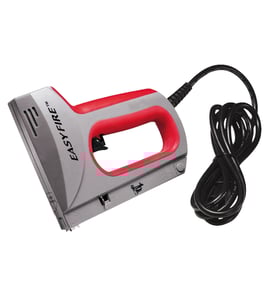

Is an electric stapler worth it?
Yes, an electric stapler is worth it when you need faster, more consistent staple driving with less hand strain, especially on larger projects. For a Craftsman electric staple tacker like model 193684231, it is a strong choice for repetitive work where a manual staple gun would be tiring or hard to squeeze.
When an electric stapler is the better choice
- You are stapling a lot of fasteners in one session (speed and consistency matter).
- Your hands fatigue easily using a manual staple gun.
- You need to drive staples into tougher materials (dense wood, layered fabric, some trim).
- You need to staple at awkward angles where a strong squeeze is difficult.
- You want more uniform staple depth for a cleaner finish.
When a manual stapler may be a better fit
- You work in very tight spaces where a bulkier nose cannot reach.
- You only staple occasionally (small crafts, quick fixes).
- You need maximum portability with no cord or battery to manage.
Quick comparison
| Feature | Electric stapler | Manual staple gun |
|---|---|---|
| Speed for big jobs | High | Medium to low |
| Hand effort | Low | High |
| Staple depth consistency | More consistent | Varies by grip strength/material |
| Tight-space access | Sometimes limited | Often better |
| Best use cases | Upholstery, insulation, screens, repetitive fastening | Light-duty, quick tasks, tight corners |
Why it matters
If you are doing flooring underlayment, carpet padding, insulation, screen installation, or upholstery, the time savings and reduced hand strain usually outweigh the higher cost. For occasional light-duty stapling, a manual tool can be the more practical value.
Helpful DIY reference
If your stapler has power issues (won’t fire, intermittent firing), basic electrical checks can pinpoint common problems like a damaged cord, loose connection, or failed switch: how to use a multimeter to test electrical parts video.
Last updated: February 2026
How to load a Craftsman stapler gun?
To load the Craftsman 193684231 electric staple tacker, unplug it first, open the staple magazine (usually a bottom or rear sliding track), place a full strip of staples in the channel with the legs facing down, then close and latch the magazine until it clicks.
Safe loading steps (recommended)
- Unplug the stapler gun before touching the magazine or nose.
- Point the tool away from you and keep fingers clear of the firing nose.
- Locate the magazine release (often a latch or spring-loaded pusher at the bottom/rear).
- Pull the pusher/track fully back to open the staple channel.
- Drop the staples into the channel so they sit flat; staple legs face down toward the nose.
- Slide the pusher forward and lock it; you should feel or hear a click.
- Plug in and test-fire into scrap wood or cardboard.
If the magazine will not close
Most “won’t shut” issues come from staple fit or orientation.
- Staples are upside down: reload with legs down.
- Wrong staple size: use the staple size the magazine is designed for (common sizes are narrow-crown tacker staples in the 1/4 to 9/16 inch leg-length range).
- Strip is not seated: make sure the staple strip is fully down in the channel and not riding on the side rails.
- Jam at the nose: unplug, open the magazine, and clear any bent staple from the driver path.
Quick checklist: what to verify
| What to check | What “correct” looks like | What happens if it’s wrong |
|---|---|---|
| Power | Unplugged while loading | Accidental firing risk |
| Staple direction | Legs down, crown up | Magazine won’t latch, jams |
| Staple size | Fits channel without force | Won’t close or misfires |
| Pusher latch | Fully forward and locked | Staples won’t feed |
Why it matters
Correct loading keeps the driver blade aligned with the staple crown, which prevents jams, protects the magazine spring, and helps the tool sink staples consistently.
For more DIY safety guidance before working on powered tools, use are diy appliance repairs safe.
Last updated: February 2026
Do all staple guns take the same staples?
No. Staple guns are not universal; each tool is designed for specific staple types and sizes (crown width, wire gauge, and leg length). For your Craftsman 193684231 electric staple tacker, you need to match the staple format the magazine and driver are built to feed.
What has to match for staples to work
Staples that “almost fit” often jam, misfire, or won’t drive flush. Match these basics:
- Crown width (the width across the top of the staple)
- Wire gauge/thickness (light duty vs heavy duty)
- Leg length (how deep the staple can penetrate)
- Staple series/type (the tool’s required format)
- Material (galvanized, stainless, etc., based on your project)
Quick compatibility guide
Use this as a practical way to think about it when shopping:
| Staple factor | If it’s wrong | What you’ll notice |
|---|---|---|
| Crown width | Too wide or too narrow | Staples won’t feed, skew, or jam |
| Wire gauge | Too thick | Driver stalls, staples crush or don’t seat |
| Leg length | Too long | Jams, staples bend, tool won’t cycle |
| Leg length | Too short | Weak hold, staples pull out easily |
How we recommend choosing staples for model 193684231
Because staple tackers vary by design, we recommend selecting staples by tool fit first, then by job needs.
- Start with the staple type/series specified for the tool (packaging often lists compatible tool series)
- Choose leg length based on material thickness (long enough to bite, not so long it bottoms out)
- Use stainless for damp locations; use galvanized for general indoor work
- If you get frequent jams, switch to the exact staple series and avoid mixed-brand “universal” packs
Why it matters
Using the correct staples protects the magazine, driver blade, and internal feed parts in your Craftsman 193684231. The wrong crown or gauge is one of the most common causes of repeated jamming and inconsistent driving depth.
For general DIY safety and best practices before troubleshooting a jam or electrical issue, we recommend reviewing are diy appliance repairs safe.
Last updated: February 2026
What size staples does the Craftsman 193684231 take?
The Craftsman 193684231 electric staple tacker uses light-duty staples in multiple leg lengths: 1/4 inch, 5/16 inch, 3/8 inch, 1/2 inch, 17/32 inch, and 9/16 inch. Using the correct staple length for your material helps prevent jams and misfires.
Staple sizes that fit
Use these staple leg lengths with your Craftsman 193684231:
- 1/4 inch
- 5/16 inch
- 3/8 inch
- 1/2 inch
- 17/32 inch
- 9/16 inch
How to choose the right length
Pick a staple length that penetrates the base material without poking through the back.
| Staple length | Best for | If you choose wrong |
|---|---|---|
| 1/4 inch to 5/16 inch | Thin fabric, paper, light insulation | Too short: pulls out; too long: pokes through |
| 3/8 inch to 1/2 inch | Layered fabric, light fastening into soft wood | Too long: proud staples or occasional jams |
| 17/32 inch to 9/16 inch | Thicker stacks into soft wood | Too long: frequent jams, bent staples |
Loading and use tips (to avoid jams)
- Unplug the tool before loading or clearing a jam.
- Load a straight, undamaged staple strip; don’t force the magazine.
- If staples don’t seat fully, reduce pressure on the nose and try a shorter length.
- If staples buckle, switch to a shorter length or a lighter material.
- Keep the nose area clear of broken staple fragments.
Why it matters
Staple tackers are sensitive to staple length and material thickness. Matching the staple to the job protects the driver mechanism, improves fastening strength, and reduces repeated jamming.
For general electrical troubleshooting steps if the tool won’t fire, use how to tell if a fuse is blown.
Last updated: February 2026
How to use an electric stapler?
To use the Craftsman electric staple tacker model 193684231, install a charged 19.2V battery pack, load the correct staples or brads, then press the safety nose firmly against the work and squeeze the trigger. Use the depth adjust knob to control how deep fasteners drive.
Safe setup and loading steps
- Remove the battery pack before loading, clearing a jam, or making adjustments.
- Open the magazine and pull the pusher back.
- Load a strip of staples (legs down) or brads (pointed end forward) in the magazine track.
- Close the magazine until it latches; confirm the pusher moves freely.
- Reinstall the battery pack and test-fire on scrap material.
Adjusting drive depth (key for consistent results)
Most inconsistent stapling is depth-related. Use the tool’s depth adjust knob:
- Turn the depth adjust knob clockwise for more driving force.
- Turn the depth adjust knob counterclockwise for less driving force.
- Keep the nose flat and fully pressed down before pulling the trigger.
Staple sizes to use (model 193684231)
Use the staple lengths specified for this tool; common supported lengths include 3/8 in., 1/2 in., 17/32 in., and 9/16 in.
| Material and task | Best practice | What to change if staples sit proud |
|---|---|---|
| Thin materials (fabric, light insulation) | Start with shorter staples and lower force | Increase force slightly or move to the next length |
| General fastening to wood backing | Keep tool square; steady pressure | Increase force or use a longer staple |
| Harder wood | Pre-test on scrap | Increase force; keep nose fully depressed |
If it won’t fire or it keeps jamming
- Confirm the battery pack is fully charged and seated.
- Make sure the magazine is fully latched and fasteners are oriented correctly.
- Remove the battery pack, then clear bent fasteners from the nose channel.
- If you suspect a switch, wiring, or battery contact issue, use how to use a multimeter to test electrical parts video to check electrical parts safely.
Why it matters
Correct fastener length plus proper depth adjustment prevents jams, improves holding strength, and reduces wear on the driver and magazine.
Last updated: February 2026