Owner’s manual
 Error Codes




Where is the model number on a Kenmore upright freezer?
On a Kenmore upright freezer like model 25322402100, the model and serial number plate is typically inside the cabinet on the upper left wall. We also commonly see it on an interior side wall; check the inside walls first before looking elsewhere. See the owner's manual for the exact label locations used on this series.
Quick places to check (upright freezer)
- Upper left interior wall (most common)
- Left interior wall (side wall inside the freezer)
- Near the temperature control area inside the freezer
- Behind the lower kick plate area (if your unit has one)
- On the back exterior panel (less common, but worth a quick look)
What the label looks like and what to write down
The plate lists both numbers; record both so we can match parts correctly.
| Item on the plate | Why it matters for parts and service |
|---|---|
| Model number (example format: 253.XXXXXXX) | Identifies the exact Kenmore design and parts list |
| Serial number | Helps confirm production run and compatible revisions |
| Purchase date (if you wrote it in) | Useful for maintenance and troubleshooting history |
Why it matters
Kenmore model numbers can look similar, but small differences change which parts fit (for example, a freezer door gasket or electronic control components). Using the exact model number from the plate helps us show the right diagrams and replacement parts for 25322402100.
Last updated: February 2026
What size is a Kenmore freezer by model number 25322402100?
The Kenmore upright freezer model 25322402100 is a full-size upright freezer; its exact capacity (cubic feet) and exterior dimensions are listed in the product specifications section of the owner's manual. Most Kenmore uprights in this style are commonly in the mid-to-high teens (cu. ft.) range.
How to find the exact size for model 25322402100
Use these quick checks so you get the right number for planning space, baskets, and storage:
- Look for “Capacity” (cubic feet) in the specifications section
- Check overall height, width, and depth (sometimes listed with and without the handle)
- Confirm clearance requirements for ventilation; the manual calls for 3 inches on all sides for air circulation
- Verify electrical requirements and placement guidance (grounded outlet, no extension cord)
- If you are measuring a cutout or tight spot, measure your actual unit and compare to the spec sheet
Typical upright freezer size ranges (for planning)
These ranges help you estimate fit and storage when you do not have the spec page in front of you.
| What you mean by “size” | What to look for | Typical range for upright freezers |
|---|---|---|
| Storage capacity | Cubic feet (cu. ft.) | About 14 to 20 cu. ft. |
| Footprint | Width x depth | About 28 to 33 in. wide, 28 to 32 in. deep |
| Height | Overall height | About 60 to 72 in. tall |
Why it matters
Capacity tells you how much food you can store, but dimensions and required airflow clearance determine whether the freezer will cool efficiently and whether the door will seal and close properly.
Related setup tip for this model
For best performance, we follow the manual guidance to leave 3 inches (75 mm) of space on all sides and keep the freezer level so the door closes and seals correctly.
Last updated: February 2026
How long does a Kenmore upright freezer last?
A Kenmore upright freezer typically lasts 10 to 15 years with normal household use. For your Kenmore 25322402100, keeping the door sealing tightly, maintaining good airflow around the cabinet, and using the correct temperature settings are the biggest factors in reaching that lifespan (and beyond). See the owner's manual for model-specific care and operating guidance.
Typical lifespan and what affects it
Most upright freezers land in the same general range, but these factors move the needle:
- Door seal condition (air leaks make the compressor run longer)
- Room temperature and ventilation (hot spaces and blocked airflow shorten life)
- How often the door is opened and how long it stays open
- Cleaning and basic care (dust and grime increase run time)
- Power quality (low voltage or wiring issues can stress electrical components)
Quick care checklist to help it last 10 to 15 years
We recommend these habits for the Kenmore 25322402100:
- Place the freezer on a proper grounded outlet (avoid extension cords and adapters)
- Keep the freezer where surrounding temps stay below about 110°F (43°C)
- Clean the cabinet and interior with mild detergent and warm water; dry thoroughly
- Avoid abrasive cleaners and do not dishwasher-wash removable parts
- Keep the door closed during outages; food can stay frozen about 24 hours if unopened
Common “end-of-life” symptoms vs. fixable issues
Some problems are maintenance-related and worth repairing; others point to major system wear.
| Symptom | Often fixable? | What to check first |
|---|---|---|
| Frost buildup, warm temps, door hard to close | Yes | Door seal and alignment; consider freezer door gasket 5304507201 |
| Runs constantly, poor cooling | Sometimes | Airflow around cabinet; condenser area cleanliness; temperature setting |
| No cooling at all, clicking, won’t start | Sometimes | Start components and controls; use the owner's manual troubleshooting section |
| Refrigerant system issue (sealed system) | Usually major | Professional diagnosis recommended |
Why it matters
A freezer that seals well and runs efficiently cycles less, which reduces wear on the compressor and electrical parts. That is the difference between a freezer that struggles at 8 to 10 years and one that reaches the full 10 to 15 year lifespan.
Last updated: February 2026
Is there a reset button on a Kenmore upright freezer?
Kenmore upright freezers such as model 25322402100 typically do not have a single dedicated “reset” button. Most “reset” situations are handled by cycling power (unplugging briefly) and then re-setting features like the temperature alarm; the temperature control itself is a knob inside the cabinet.
What you can reset on this model
On the 25322402100, the controls described in the documentation are feature switches and indicators rather than a reset button.
- Temperature control knob: inside the freezer; adjust toward COLDEST and wait several hours between changes.
- Temp alarm buzzer: press ALARM OFF to silence the buzzer if the red alarm light is blinking.
- High-temp alarm ON/OFF switch (some models): inside the freezer; shipped OFF, then set ON after the freezer reaches safe temperature.
- Quick Freeze (some models): runs continuously and turns off automatically after about 72 hours.
- Flash Defrost (some models): uses a plunger; pull out to defrost, push in to restart cooling.
For the exact control layout and which features your unit has, use the owner's manual.
Recommended “reset” steps (safe, practical)
- Unplug the freezer (or switch off the breaker) for 2 to 5 minutes.
- Plug it back in and confirm the Power On light is on (if equipped).
- Set the temperature control back to your normal setting.
- If the Temp Alarm is sounding, press ALARM OFF; the light can keep blinking until temperature is safe again.
- Allow several hours for temperatures to stabilize after any adjustment.
Quick reference: symptom to action
| What you notice | What it usually means | What to do |
|---|---|---|
| Red temp alarm light blinking | Warm temperature after first plug-in or power outage | Press ALARM OFF to silence; wait for safe temp |
| Freezer runs a long time after start | Normal cool-down | Let it run; avoid loading unfrozen food for about 4 hours |
| Want colder temps | Normal adjustment needed | Turn knob slightly toward COLDEST; wait several hours |
Why it matters
A true “reset” is rarely needed on an upright freezer; most issues are temperature stabilization after a power interruption, a door left ajar, or alarm settings. Using the correct alarm and temperature controls prevents unnecessary food thawing and nuisance alarms.
Last updated: February 2026
What causes an upright freezer to stop freezing?
An upright freezer like Kenmore model 25322402100 usually stops freezing because cold air is leaking out (door not sealing), the temperature control is set too warm, airflow around the cabinet is restricted, or a cooling-system/electrical component is failing. Use the troubleshooting steps in the owner's manual to narrow it down.
Quick checks we recommend first
- Confirm the temperature control is not set too warm; move it slightly toward COLDEST and wait several hours for temperatures to stabilize.
- Make sure the door closes easily and fully; a freezer that is out of level can leave the door misaligned.
- Inspect the door seal for gaps, tears, or dirt; air leaks cause warm air intrusion and heavy frost.
- Verify the freezer has enough space for air circulation around the cabinet, especially in hot rooms.
- If the unit was just plugged in or recently off, allow about 4 hours to cool down completely before judging performance.
Most common causes and what they look like
| Symptom | Likely cause | What to do next |
|---|---|---|
| Freezer runs a lot but temps are warm | Door not sealing, frequent openings, warm room | Clean/inspect gasket; reduce door openings; improve ventilation |
| Heavy frost buildup, poor cooling | Air leak at door, door not closing square | Check leveling and gasket fit; defrost if frost is 1/4 to 1/2 inch |
| No cooling and compressor will not start | Start components or electrical issue | Check power, breaker/fuse; consider a start device/capacitor diagnosis |
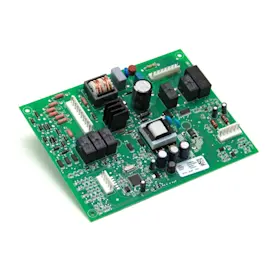
| Temps swing or seem inaccurate | Sensor/control issue | Check for error codes and control-related faults |
Parts that commonly relate to “not freezing” complaints
If you find a clear door air leak, the gasket is a frequent fix for warm temperatures and frost problems: freezer door gasket 5304507201. If the compressor is struggling to start, a failed start component can be involved; this model has a listed capacitor 218909912.
Why it matters
A freezer that is slightly out of level or has a leaking gasket can run longer, build frost faster, and still fail to hold safe food-storage temperatures. Correcting sealing and airflow issues often restores normal freezing without deeper repairs.
Last updated: February 2026