Owner’s manual
 Error Codes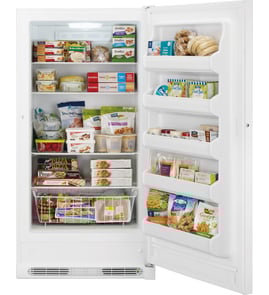


What is the life expectancy of a Frigidaire upright freezer?
A Frigidaire upright freezer like model FFU17F5HWE typically lasts 10 to 15 years. With good care (proper leveling, airflow around the cabinet, and routine cleaning), it’s common for an upright freezer to reach the high end of that range.
- Ventilation and room temperature: Hotter spaces require more airflow around the freezer so it can reject heat efficiently.
- Door seal condition: A poor seal forces longer run times and can lead to frost and moisture problems.
- Leveling: If the freezer is not level, the door can misalign and not close tightly.
- Defrost and frost control: Heavy frost buildup reduces efficiency and stresses the cooling system.
- Cleaning habits: Mild detergent cleaning helps protect surfaces and keeps odors and residue from building up.
Use the owner's manual for model-specific care steps and feature details.
- Keep enough clearance around the cabinet for air circulation, especially in warm climates.
- Make sure the freezer is level so the door closes easily and seals properly.
- Clean interior and removable parts with mild detergent and warm water; wipe dry.
- Defrost and clean when frost reaches about 1/4 to 1/2 inch (manual-defrost models).
- Never use sharp tools to remove frost; use a plastic scraper.
| What you notice | Often normal | Often needs attention |
|---|---|---|
| Longer run times in summer | Yes | If temps rise or alarms occur |
| Light frost film | Sometimes | Thick frost buildup (1/4 to 1/2 inch) |
| Door needs a gentle push to shut | Sometimes | Door not sealing or misaligned |
| Occasional alarm beeps | Sometimes | Repeated alarms with warm temps |
A freezer that seals well, stays level, and can breathe runs fewer hours per day. That reduces wear on major components like the compressor and helps your Frigidaire upright freezer maintain safe food temperatures longer.
Last updated: January 2026
How can I tell how many cubic feet my freezer is?
To tell how many cubic feet your Frigidaire FFU17F5HWE upright freezer is, we calculate the interior volume: measure the usable inside length, width, and depth in inches, multiply them, then divide by 1,728 to convert cubic inches to cubic feet. Confirm shelf and bin layout details in the owner's manual.
- Empty the freezer enough to measure the inside walls.
- Measure the usable interior:
- Length (L): left-to-right across the back wall
- Width (W): front-to-back (door opening to back wall)
- Depth/height (H): bottom-to-top usable height
- Use this formula:
- Cubic feet = (L x W x H) / 1,728
- 20 in x 18 in x 50 in = 18,000 cubic inches
- 18,000 / 1,728 = 10.4 cubic feet
For the most accurate “usable capacity,” measure the space you can actually fill with food.
- Include the main cavity space between interior walls
- Measure around fixed interior shapes as best you can
- Ignore door bins if you want “main compartment” capacity only
- Exclude bulky non-storage areas (like large interior housings)
- Use the same unit (inches) for all measurements
Cubic feet helps us plan food storage and freezing loads. The FFU17F5HWE manual also recommends freezing up to 3 pounds of fresh food per cubic foot at one time, which makes capacity useful for day-to-day use and safe freezing practices.
| What you want to estimate | What to do |
|---|---|
| Storage capacity (cubic feet) | Measure inside L x W x H, divide by 1,728 |
| Safe fresh-freeze load | Use 3 lb per cubic foot per batch |
| Cool-down planning | Allow about 4 hours to fully cool before loading unfrozen food |
Last updated: January 2026
Why is my Frigidaire upright freezer not freezing?
If your Frigidaire FFU17F5HWE upright freezer is running but not freezing, the most common causes are poor airflow (dirty condenser area or blocked vents), a door that is not sealing, or a defrost system problem that lets frost choke off cooling. Use the FFU17F5HWE owner's manual troubleshooting and setup guidance to confirm temperature and installation basics.
- Confirm the temperature control is not set to OFF and allow 24 hours after any adjustment for temperatures to stabilize.
- Make sure the door closes and seals fully; a slightly open door quickly warms the cabinet.
- Check that the freezer is level so the door aligns and seals properly (an unlevel cabinet can cause cooling and moisture problems).
- Reduce door openings and avoid loading large amounts of warm food at once.
- Verify there is enough space around the freezer for air circulation, especially in hotter rooms.
| What you notice | Most likely cause | What to do next |
|---|---|---|
| Runs a lot, temps still warm | Door not sealing, frequent openings, hot room | Check gasket contact, level the cabinet, improve airflow |
| Frost or ice buildup inside | Defrost system issue | Inspect defrost components; consider defrost heater 216730700 and refrigeration appliance defrost bi-metal thermostat 297216600 |
| Warm spots, poor circulation | Evaporator fan not moving air | Listen for fan; inspect fan area and airflow paths |
Heavy frost buildup can block airflow across the evaporator and stop freezing performance. If you see frost accumulating, defrost and clean the freezer as described in the manual, and avoid using sharp tools on interior surfaces.
A freezer that is not sealing, not level, or restricted for airflow can run longer, waste energy, and still fail to hold safe frozen temperatures. Fixing the root cause protects food quality and helps prevent repeat icing and cooling problems.
Last updated: January 2026