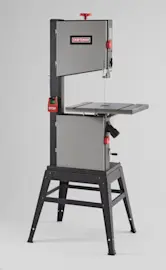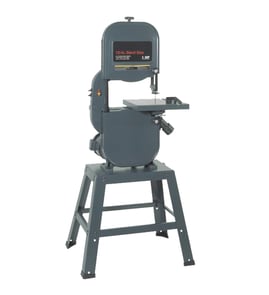

How do I tell what size bandsaw blade I need?
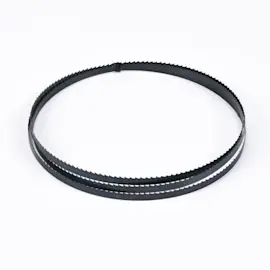
For your Craftsman 10822921 band saw, the correct blade size is defined by the saw’s wheel spacing and guide design. The most reliable way to confirm it is to measure your current blade (length, width, thickness) and match those measurements when you shop for a replacement.
Measure the blade you have now
If the old blade is intact, measuring it is the fastest way to get an exact match.
- Unplug the saw before touching the blade or opening covers.
- Look for printed blade specs on the blade (often includes length and width).
- Measure blade width (back edge to tooth tip) with a ruler or caliper.
- Measure blade thickness (gauge) if your guides are sensitive to thickness.
- If the blade is broken, lay it flat and measure end-to-end, then add the pieces together.
How to determine blade length when you cannot measure the old one
You can estimate blade length by measuring the saw’s geometry, then confirming with a test fit.
Common approach
- Measure wheel diameter (center-to-edge across the wheel).
- Measure center-to-center distance between the upper and lower wheels.
- Use those measurements to narrow down the likely blade length range.
Quick reference table (what each measurement affects)
| What you’re choosing | What it changes | What to measure/check |
|---|---|---|
| Blade length | Whether it fits and tensions correctly | Wheel diameter, wheel spacing, tension travel |
| Blade width | Curve-cut ability vs straight tracking | Guide capacity, wheel crown, intended cuts |
| Tooth count (TPI) | Cut speed and finish | Material thickness and type |
Choose width and TPI based on what you cut
- Wider blades track straighter for ripping and resawing.
- Narrower blades turn tighter for curves.
- Higher TPI for thin stock and smoother cuts.
- Lower TPI for thicker stock and faster cutting.
Why it matters
A blade that is the wrong length will not tension correctly, and the wrong width or thickness can cause poor tracking, guide wear, and rough cuts. Getting the size right improves safety and cut quality.
For help finding the correct model number format and using it to search compatible blades, use how to find your appliance model number (and what it means for parts).
Last updated: February 2026
What is the 3-tooth rule for bandsaws?
The 3-tooth rule means your blade pitch must keep at least three teeth in contact with the workpiece at all times. On the Craftsman 10822921 continuous-blade power hacksaw (metal-cutting), this prevents tooth stripping, grabbing, and broken teeth by matching teeth-per-inch (TPI) to the metal’s thickness.
How to apply it on a metal-cutting saw
- Measure the material thickness in the direction the blade travels through.
- Pick a blade TPI that puts 3 or more teeth in the cut.
- If the blade chatters or snags, increase TPI; if chips pack in the gullets, decrease TPI.
Quick TPI starting points for metal (by thickness)
Use these as practical starting ranges; then adjust for hardness, feed pressure, and cut quality.
| Metal thickness | Typical TPI range | What it helps with |
|---|---|---|
| Under 1/8 in. | 18 to 32 TPI | Prevents tooth snagging on thin stock |
| 1/8 to 1/4 in. | 14 to 24 TPI | Balanced cutting speed and control |
| 1/4 to 1/2 in. | 10 to 18 TPI | Better chip clearing in thicker cuts |
| Over 1/2 in. | 6 to 14 TPI | Reduces heat and gullets loading up |
Signs the blade pitch is wrong
- Teeth “hook” or grab at the start of the cut
- Chatter, vibration, or a wandering cut line
- Blueing or overheating of the blade or workpiece
- Chips weld or pack into the gullets (especially on softer metals)
- Frequent tooth breakage on thin-wall tubing or angle
Why it matters
With fewer than three teeth engaged, each tooth takes too large a bite. That overloads the tooth tips, increases vibration, and shortens blade life. Keeping three or more teeth in the cut spreads the load and stabilizes the cut.
Related help
- If you need to confirm you are matching blades and parts to the correct Craftsman model number, use how to find your appliance model number (and what it means for parts).
Last updated: February 2026
What is the most common cause of a ruined band saw blade?
The most common cause of a ruined blade on a Craftsman 10822921 band saw is normal wear: the cutting teeth dull over time and the blade stops cutting cleanly. The next most common “ruin” causes are using the wrong blade for the material, incorrect blade tension, and forcing the cut.
Quick signs the blade is ruined (and what they usually mean)
- Cuts slow or burns the work: teeth are dull or the blade pitch is wrong for the material
- Wanders or won’t track straight: tension is off, guides are misadjusted, or teeth are unevenly worn
- Chips teeth quickly: too aggressive feed pressure, wrong TPI, or cutting hardened stock
- Cracks near the weld: fatigue from age, over-tensioning, or repeated flexing
- Blade breaks suddenly: damage from kinks, misaligned wheels, or guide bearing issues
Most common root causes (ranked)
| Cause | What you’ll notice | What to do next |
|---|---|---|
| Normal tooth wear (end of life) | Dull cutting, more push needed | Replace blade; match blade width and TPI to the job |
| Wrong blade for the job (width or TPI) | Chatter, tooth stripping, rough cut | Choose a blade suited to wood vs metal and the thickness |
| Incorrect tension | Wandering, squeal, frequent breakage | Set tension to the saw’s scale as a starting point; fine-tune tracking |
| Guide/bearing misadjustment | Blade twists, uneven wear | Re-set side guides and thrust bearing with minimal clearance |
| Forcing the cut | Overheating, tooth loss | Let the blade do the work; reduce feed pressure |
How we prevent premature blade failure
- Use the correct TPI: thin stock needs higher TPI; thick stock needs lower TPI
- Avoid tight-radius cuts with a blade that is too wide
- Set tracking first, then adjust guides and thrust bearing
- Keep wheels and tires clean so the blade seats consistently
- Break in a new blade with light feed pressure for the first few cuts
Why it matters
A blade that is dull or mis-set makes the Craftsman 10822921 work harder, increases heat, and can damage guides, tires, and bearings. Fixing the setup early usually extends blade life and improves cut accuracy.
For general repair safety practices before servicing wiring, switches, or the motor circuit, follow are diy appliance repairs safe.
Last updated: February 2026