 Error Codes



Where is the model number on a Kenmore series 100 washer?
On a Kenmore Series 100 washer, the model number is printed on a rating label attached to the washer cabinet. For Kenmore model 1105801100, check the back of the control console, under the lid opening along the top rim, or low on the cabinet side near the base.
Common label locations to check
- Back of the control panel/console (often easiest to see with a flashlight)
- Under the lid, around the tub opening or top rim
- Left or right cabinet side near the bottom front edge
- Rear panel of the main cabinet
- Inside the lid area near the hinge (on some top-load designs)
Quick tips to find it faster
- Unplug the washer first if you need to reach behind the console.
- Use your phone camera and zoom to read small print.
- Wipe dust off the label; the ink can be faint.
- Write down the full model number and the serial number.
- Match every digit; Kenmore 110-prefix models often look similar.
What the label usually looks like
| What you see | What it means | Why you need it |
|---|---|---|
| Model number (example: 1105801100) | Exact design version | Ensures correct parts fit |
| Serial number | Production identifier | Helps confirm manufacturing run |
| Electrical info | Volts/amps | Useful for safe troubleshooting |
Why it matters
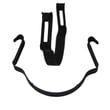
We use the exact model number to pull the correct parts diagrams and compatible replacement parts (for example, a hose or motor clamp). Even one wrong digit can point to a different Kenmore washer platform.
If you are already troubleshooting an issue after you find the model number, our Kenmore 110 vmax top load washer error codes guide is a fast next step.
Last updated: February 2026
How to identify a Kenmore washer model?
To identify your Kenmore washer model, we look for the model number tag on the machine itself. For Kenmore model 1105801100, the tag is typically under the lid on top-load washers or around the door opening on front-load washers; it’s the fastest way to match the correct parts.
Where to look on the washer
- Top-load Kenmore washers: lift the lid and check the rim under the lid, the lid underside, or the top edge of the tub opening
- Front-load Kenmore washers: check the door opening, door frame, or behind the door
- All styles: check the back panel near the power cord, or the side of the cabinet near the control console
What the model tag looks like
Most Kenmore washer tags include:
- The word MODEL followed by a number (often starting with 110)
- A serial number (useful for age and production run)
- Electrical ratings (volts/amps) and sometimes a barcode
Quick ID checklist
| What you find | What it means | What to do next |
|---|---|---|
| Model number starts with 110 | Common Kenmore format | Use the full number for parts lookup |
| Only partial digits are readable | Model is incomplete | Clean the tag and re-check under bright light |
| Tag is missing or damaged | ID is harder | Use the washer’s style and key parts to narrow it down |
Tips to read a worn or dirty label
- Wipe the label with a damp cloth and a drop of mild dish soap; dry it fully
- Use a flashlight at an angle to make faint printing stand out
- Take a close-up photo and zoom in to read small characters
- Write the model number exactly as shown (no spaces)
Why it matters
Kenmore washers often share similar cabinets and controls across different series, so the exact model number is what keeps you from ordering the wrong lid switch, drain pump, hose, or clamp.
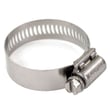
If you’re already working on a leak or hose connection, a common related part is the clamp WP285655, which is used to secure certain washer hoses.
Last updated: February 2026
What is the average lifespan of a Kenmore washer?
A Kenmore washer typically lasts 10 to 15 years with normal household use; that’s the average we see for most washers, including the Kenmore 1105801100. Consistent care (proper loading, routine cleaning, and fixing small leaks early) helps you reach the longer end of that range.
What affects washer lifespan most
- Overloading or washing heavy items too often (stresses the drive system and tub)
- Poor leveling (increases vibration and wear on suspension and bearings)
- Hard water and detergent buildup (can affect valves, pump, and seals)
- Small leaks left uncorrected (can damage components and wiring)
- Frequent unbalanced loads (accelerates wear and can trigger error conditions)
Maintenance habits that add years
- Keep loads balanced; mix large and small items.
- Use the right amount of HE detergent (even on many top-loaders, less is usually better).
- Leave the lid open between loads to reduce moisture and odors.
- Check hoses and clamps for seepage; a worn hose connection clamp like the clamp WP285655 can contribute to leaks.
- Address repeated error symptoms using a Kenmore guide such as Kenmore 110 vmw top load washer error codes.
Common “end-of-life” symptoms and what they usually mean
| Symptom | What it often points to | What we recommend |
|---|---|---|
| Loud rumbling in spin | Tub bearing or drive wear | Stop heavy use; plan repair vs. replace |
| Won’t drain or slow drain | Drain pump or blockage | Check for clogs; inspect pump |
| Won’t fill or fills slowly | Water inlet valve or screens | Clean screens; test valve |
| Leaks underneath | Hose, clamp, tub seal, pump | Find source; replace leaking part |
Why it matters
Knowing the typical 10 to 15 year lifespan helps you decide whether a repair is cost-effective. If your Kenmore 1105801100 is near that age and showing multiple issues (leaks plus noise plus draining problems), planning a targeted repair or replacement usually saves time and repeat service.
Last updated: February 2026
How many cubic feet is a Kenmore Model 1105801100 washer?
Kenmore washer model 1105801100 is a compact, portable-style top-load washer; washers in this class run about 1.5 to 2.5 cubic feet. Use the model/serial tag and the tub dimensions to match your unit to the correct capacity range.
What capacity range to expect for this model type
Portable and compact Kenmore top-load washers are built for smaller loads and tighter spaces, so their tubs are much smaller than standard 27-inch top-loaders.
- Portable/compact top-load: typically 1.5 to 2.5 cu. ft.
- Standard top-load: typically 3.0 to 4.0+ cu. ft.
- If your washer connects to a sink faucet and rolls on casters, it is in the portable range
- If it uses standard hot/cold wall hookups and a standpipe drain, it is usually standard-size
Quick size check (helps confirm you have a portable unit)
Use these common physical cues to estimate which capacity class fits your 1105801100.
| Washer class | Typical width | Typical capacity |
|---|---|---|
| Portable/compact top-load | 18 to 24 in. | 1.5 to 2.5 cu. ft. |
| Standard top-load | 26 to 28 in. | 3.0 to 4.0+ cu. ft. |
Why it matters
Capacity affects load size, wash performance, and spin balance. Loading a portable tub like a full-size washer causes poor agitation, out-of-balance spinning, and extra wear on the drive and suspension.
Related help if you are seeing balance or stopping issues
If you are checking capacity because the washer shakes or stops during spin, use: Kenmore 110 vmax top load washer error codes.
Last updated: February 2026
Is it worth repairing a Kenmore washing machine?
Yes; repairing a Kenmore washer is worth it when the fix restores reliable operation for less than the cost of replacing the machine. For Kenmore model 1105801100, repairs are usually a smart choice when the problem is a single, serviceable failure and the tub, cabinet, and drive system are still in solid shape.
Quick way to decide (repair vs. replace)
Use these checkpoints before you spend money on parts or labor:
- Repair when the washer still fills, drains, and spins but has one clear symptom (leak, noise, vibration, won’t start).
- Repair when the issue is a wear item or connection point (hose joint, clamp, mounting hardware).
- Repair when the repair is straightforward and parts are available for your exact model.
- Replace when there is major tub damage, severe rust/corrosion, or repeated major failures.
- Replace when a major drive component is leaking oil heavily or has caused secondary damage.
Common “worth repairing” fixes we see
These are typical, cost-effective repairs that often restore full performance.
| Symptom | What to check | Example fix |
|---|---|---|
| Water leak underneath | Hose connections and joints | Tighten or replace a clamp |
| Rattling or vibration | Motor mounting area | Inspect and secure motor clamp |
| Oil residue near drive area | Drive/gearcase area | Inspect for a loose or missing plug |
If you’re chasing a leak at a hose connection, the clamp WP285655 is a common small part that solves drips when the original clamp is weak, distorted, or won’t hold tension.
Why it matters
A targeted repair prevents secondary damage (flooring, wiring moisture, bearing wear) and usually costs far less than replacing the washer. Matching the symptom to the right component also avoids replacing good parts.
Helpful troubleshooting resources
If your Kenmore washer is displaying an error code, use a Kenmore top-load error code reference to narrow the cause before ordering parts:
Last updated: February 2026


