Error Codes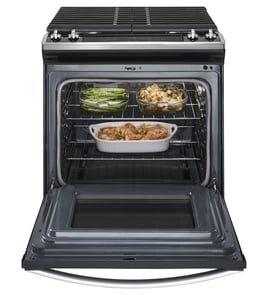




How to find whirlpool gas range model number?
For a Whirlpool gas range like model WFG505M0MB0, the model number is printed on a rating label on the range body, not on removable parts. On many freestanding Whirlpool ranges, you can find it by pulling out the bottom warming drawer and looking on the frame behind it.
Check these common label locations (in order):
- Behind the warming drawer or storage drawer (pull the drawer out and look on the frame)
- On the oven door frame area (open the oven door and look around the front frame)
- On the lower front frame behind the kick area
- On a side frame just inside the drawer opening
- Make sure the range is cool and the oven is off.
- Pull the warming drawer or storage drawer fully open.
- Lift the front slightly (if needed) and slide the drawer out.
- Look for a sticker or metal plate that lists MODEL and SERIAL.
The rating label usually includes these fields:
- Model number (example: WFG505M0MB0)
- Serial number
- Gas type (natural gas or LP)
- Electrical rating
| What you need | Why you need it | Example |
|---|---|---|
| Model number | Ensures parts diagrams match your exact range | WFG505M0MB0 |
| Serial number | Helps confirm production series for some parts | (varies) |
Whirlpool ranges often have similar-looking versions with different burner parts, knobs, and control components. Using the exact model number helps us match the correct parts the first time, whether you are replacing an igniter, oven sensor, or door seal.
If your label is damaged or missing, use our guide: how to find your appliance model number (and what it means for parts).
Last updated: February 2026
What size gas line for Whirlpool gas range?
For the Whirlpool WFG505M0MB0 freestanding gas range, we recommend a 3/4-inch rigid gas supply pipe to the range location; for LP (propane) installations, 1/2-inch minimum piping is commonly used. Using undersized pipe on long runs can cause weak burner flames and poor oven performance.
- Natural gas: 3/4-inch rigid pipe to the range location
- LP (propane): 1/2-inch minimum (larger may be needed for long runs)
- Long pipe runs: size up to prevent pressure drop
- Final connection: use an approved flexible connector and shut-off valve as required by local code
| Fuel type | Typical supply pipe size to range location | When to go larger |
|---|---|---|
| Natural gas | 3/4-inch | Long run, multiple appliances on same branch |
| LP (propane) | 1/2-inch minimum | Long run, regulator limitations, low inlet pressure |
Gas ranges need steady gas volume and pressure. If the supply line is too small, the cooktop may light but burn weakly, and the oven burner can struggle to reach or hold temperature, especially when other gas appliances are running.
If you have correct gas supply but the oven still heats poorly, these model-matched parts are common checks:
- Igniter, hot surface W11590294 (weak igniter can prevent the oven burner from opening fully)
- Oven burner W11220387 (burner damage or clogging can affect flame)
- Range oven temperature sensor WPW10181986 (bad sensor can cause temperature problems)
Last updated: February 2026
Why is my Whirlpool gas oven not getting hot?
If your Whirlpool WFG505M0MB0 gas range oven is not getting hot, the most common cause is a weak hot-surface igniter that glows but does not pull enough current to open the gas safety valve. Start by watching for igniter glow during bake, then test the igniter and temperature sensing circuit.
- Confirm the oven is set to BAKE (not Delay Start or Sabbath mode).
- Make sure the gas supply valve is fully open.
- Verify the range has power (display on, clock set); the igniter needs electricity.
- Start a bake cycle and look for igniter glow within 30 to 90 seconds.
- If you smell gas with no ignition, stop the cycle and ventilate the area.
In a gas oven, heat depends on the igniter, burner, and temperature feedback. These parts are common fixes for “won’t heat” symptoms:
| Symptom you see | Most likely cause | What we typically replace |
|---|---|---|
| No igniter glow at all | Open igniter circuit, wiring issue, or control problem | Igniter, hot surface W11590294 |
| Igniter glows but no flame | Weak igniter (common) or gas valve issue | Igniter, hot surface W11590294 |
| Flame lights but temp is wrong or swings | Sensor out of range | Range oven temperature sensor WPW10181986 |
| Flame is uneven or delayed ignition | Dirty/warped burner, poor flame carryover | Oven burner W11220387 |
Turn off power at the breaker before accessing wiring.
- Igniter test: Check continuity and inspect for cracks or white hot spots. A glowing igniter can still be too weak to open the valve.
- Sensor test: If the oven lights but does not reach or hold temperature, test the sensor resistance at room temperature and compare to typical range-sensor behavior.
- Wiring check: Look for loose connectors or heat-damaged wires at the igniter and sensor.
For safe meter use and basic electrical checks, follow how to use a multimeter to test electrical parts video.
When the igniter is weak, the oven can look like it is “trying” to heat (glow present) but never actually lights the burner, so preheat times become extremely long or the oven stays cold. Fixing the correct part restores normal ignition and stable baking temperatures.
Last updated: February 2026