View engine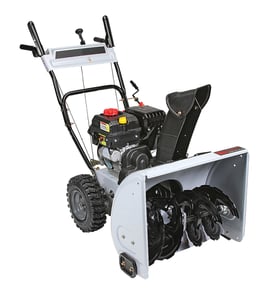

How much does a 30 inch snowblower weigh?
Most 30-inch two-stage gas snow blowers weigh about 200 to 260 lb. For the Poulan PP10530ES-96192000400, the exact weight depends on the specific build (engine, electric start, tires, and chute hardware), so we use that typical range when planning lifting, transport, and storage.
A 30-inch clearing width usually means a heavier frame, larger auger/impeller, and a stronger drive system.
- 200 to 230 lb: lighter-duty 30-inch two-stage units
- 230 to 260 lb: heavier-duty 30-inch two-stage units (more robust drivetrain and housing)
- Add weight if equipped with electric start, headlight, or heavier wheel assemblies
| Snowblower type | Clearing width | Typical weight |
|---|---|---|
| Single-stage gas | 18 to 22 in. | 60 to 110 lb |
| Two-stage gas | 24 to 28 in. | 150 to 220 lb |
| Two-stage gas | 30 in. | 200 to 260 lb |
Weight affects traction, how easily the machine climbs ramps, and whether you can safely load it into a truck or onto a trailer.
- Use a rated loading ramp and keep the machine in a low drive speed
- Plan for two-person handling if you must lift any end of the unit
- For storage, roll it into place; avoid lifting by the chute or control panel
- If the machine feels unusually heavy to push, inspect the drive system and wheels
If your snowblower is hard to maneuver, these model-matched parts are common checkpoints:
- Wheel assembly 583244001 (dragging, wobble, poor rolling)
- Control arm 532419877 (drive control not engaging smoothly)
- Snowblower clutch slide 581644901 (stiff or inconsistent drive engagement)
Last updated: February 2026
How much oil do you put in a snow blower?
For the Poulan gas snow blower model PP10530ES-96192000400, we fill engine oil to the FULL mark on the dipstick (not to a fixed “ounces” number). Most snow blower engines take about 18 to 28 oz total, but the correct level is always the dipstick reading on a level surface.
- Park the snow blower on a flat, level surface and let the engine cool.
- Remove the dipstick, wipe it clean, then reinsert fully (per the dipstick style on your engine).
- Add oil in small amounts (a few ounces at a time).
- Recheck the dipstick until the oil reaches the FULL mark.
- Do not overfill; too much oil can cause smoking, hard starting, or leaks.
Most 4-cycle snow blower engines run best with oil matched to temperature:
| Outdoor temperature | Common oil choice | Why it’s used |
|---|---|---|
| Consistently below freezing | SAE 5W-30 | Easier cold starts and faster lubrication |
| Mild winter conditions | SAE 10W-30 | Good all-around option |
| Warmer conditions (above ~40°F) | SAE 30 | Stable viscosity in warmer temps |
We use these ranges to set expectations; the dipstick level is what matters.
- Small engines: 12 to 18 oz
- Mid-size engines: 18 to 28 oz
- Larger engines: 20 oz and up
Correct oil level protects the crankshaft, piston, and bearings. Low oil accelerates wear; overfilling can aerate oil and reduce lubrication, which hurts performance and engine life.
If you are doing a seasonal service and notice loose hardware while checking the machine over, replace missing fasteners with the correct OEM-style parts such as the lock nut 596322601.
Last updated: February 2026
Is sae 30 the same as 5W30 for snowblower?
No. SAE 30 and 5W-30 are different oils, and for a Poulan gas snow blower like model PP10530ES-96192000400, 5W-30 is the better choice for winter use because it flows faster during cold starts. SAE 30 is thicker in the cold and can make starting harder and increase wear.
| Oil type | Cold-start flow | Best use case | What you may notice in a snowblower |
|---|---|---|---|
| SAE 30 | Thick when cold | Warm-weather small engines | Hard starting, sluggish cranking, delayed lubrication |
| 5W-30 | Flows well when cold | Winter operation | Easier starts, faster lubrication, smoother running |
- Use 5W-30 for typical winter temperatures; it protects better at startup.
- Avoid straight SAE 30 for snow blowing in freezing weather.
- If you already filled SAE 30 and it is cold outside, drain and refill before running the engine.
- Check the oil level before every use; low oil can damage the engine quickly.
- Store oil in a place that stays above freezing so it pours and measures accurately.
These checks help separate an oil-viscosity issue from a fuel or ignition issue:
- Confirm you used fresh gasoline and the fuel shutoff (if equipped) is on.
- Make sure the choke is fully on for a cold start, then open it gradually.
- Verify the spark plug wire is firmly seated.
- Inspect for ice-packed snow around the recoil starter or belt/auger area.
- If the engine cranks slowly only when cold, switch from SAE 30 to 5W-30.
Most snowblower engine wear happens in the first seconds after startup. In cold weather, 5W-30 reaches critical engine surfaces faster than SAE 30, which helps starting and reduces scuffing and premature wear.
For parts that support safe operation and repairs on this model, match your hardware exactly; for example, a replacement fastener like the lock nut 596322601 should be the correct size and type for the assembly.
Last updated: February 2026