Owner’s manual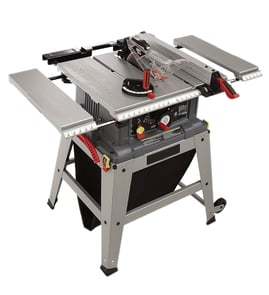

What are the parts of a table saw?
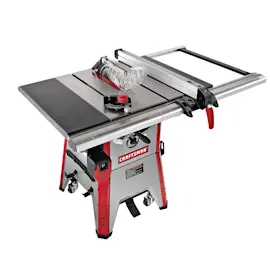
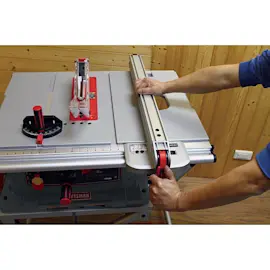
On the Craftsman 113221770 10-inch benchtop table saw, the main parts you work with most are the table (top), rip fence, miter gauge, blade guard and spreader, and the blade insert (throat plate). These parts control cut accuracy and help keep the blade area safer during use.
- Table (top): Flat surface that supports the workpiece.
- Rip fence: Guides long rip cuts parallel to the blade.
- Miter gauge: Guides crosscuts and angled cuts using the miter slots.
- Blade insert (table insert/throat plate): Surrounds the blade opening and supports the workpiece near the cut.
- Blade guard and spreader: Helps shield the blade and helps reduce pinching and kickback.
The 113221770 owner's manual lists these loose parts included with the saw:
| Part | What you use it for | Typical adjustment/use |
|---|---|---|
| Rip fence | Straight rip cuts | Set parallel to blade, lock in place |
| Miter gauge | Crosscuts and miters | Set angle, slide in miter slot |
| Blade guard and spreader | Blade-area protection and kerf control | Install for through-cuts |
| Blade insert | Supports stock at blade opening | Keep flush with table |
Accurate cuts depend on alignment. The manual specifically calls out tools used to align the saw:
- Combination square (must be accurate)
- Straight 3/4-inch thick board edge (must be straight)
- #2 Phillips screwdriver
- Medium screwdriver
- Adjustable wrench
Knowing the names of the table saw parts helps you diagnose problems faster (for example, a fence that will not lock, a worn blade insert, or a misaligned miter gauge). It also helps you match the correct replacement parts when you search by model number.
We recommend using the model number 113221770 when you look up diagrams and part lists. You can also search by model number on Sears PartsDirect if you are shopping for additional Craftsman table saw parts.
Last updated: February 2026
Does Craftsman make a good table saw?
Yes. Craftsman table saws are a solid choice for DIYers and hobbyists who want dependable cutting power at a reasonable price; the key is setting them up carefully and keeping the fence, blade, and safety gear properly adjusted. For your Craftsman model 113221770 (10-inch benchtop table saw), our 113221770 owner's manual is the best reference for safe operation and tune-up steps.
A table saw is “good” when it delivers repeatable, accurate cuts and stays safe and stable during use. For most Craftsman saws, that comes down to setup and maintenance more than raw motor power.
Common strengths many owners like:
- Good value for the money
- Sturdy enough for typical home projects
- Straightforward controls (bevel and elevation adjustments)
- Parts diagrams and repair parts lists in the manual
Common limitations to plan for:
- Fence alignment can require extra attention for precision work
- Vibration or drift shows up if the saw is not leveled and bolted down
- Accuracy depends heavily on blade quality and feed technique
Use these steps to get better results from your 10-inch benchtop saw:
- Use a sharp, clean 10-inch blade matched to the cut (rip vs. crosscut)
- Set the fence parallel to the blade and lock it firmly before every cut
- Feed slower if the motor bogs down; the manual notes overload can happen when you cut too fast
- Wax the fence rail surfaces if the fence does not slide smoothly (paste wax is commonly used)
- Confirm the guard and anti-kickback parts are installed and moving freely
| User type | Typical expectation | Craftsman table saw fit |
|---|---|---|
| DIY / hobby | Weekend projects, home repairs, learning | Strong fit when tuned and used safely |
| Advanced woodworker | Tight tolerances, jigs, repeatability | Good base saw; benefits from careful calibration |
| Pro / daily use | High throughput, jobsite abuse | Often better served by heavier-duty setups |
A table saw can feel “bad” when the real issue is alignment, a dull blade, or feeding too aggressively. Dialing in the fence, blade, and safety system improves cut quality and reduces kickback risk.
For parts lookup and diagrams for model 113221770, start with the parts list on this model page; for broader parts searching by model number, use Sears PartsDirect.
Last updated: February 2026
Where is the reset button on a Craftsman table saw?
On the Craftsman 113221770 10-inch benchtop table saw, the reset is the motor overload relay reset button. If the motor stops or will not start after a heavy cut, turn the switch OFF, unplug the saw, let the motor cool 3 to 5 minutes, then press the reset button to restore power. See the 113221770 owner's manual for the overload protection location and steps.
The reset button trips when the motor overload device senses overheating or excessive load. Use it after:
- Feeding the workpiece too fast
- Making repeated start/stop cycles in a short time
- Cutting with a dull blade
- Running on low voltage or an undersized extension cord
Follow this sequence every time to prevent accidental starting:
- Turn the ON/OFF switch to OFF
- Unplug the power cord from the outlet
- Wait 3 to 5 minutes for the motor to cool
- Press the reset button on the overload device
- Plug back in and test with no load before cutting again
Repeated overload trips usually mean the saw is working too hard or airflow is restricted.
| Symptom | Most common cause | What to do next |
|---|---|---|
| Trips during thick/ripping cuts | Feed rate too fast | Feed slower; let the blade do the work |
| Trips on normal cuts | Dull or dirty blade | Clean or replace the blade |
| Trips after a few minutes | Sawdust buildup near motor | Blow out sawdust; keep dust collection working |
| Won’t restart even after cooling | Power supply issue | Try a different circuit; avoid long/light extension cords |
The overload reset protects the motor windings from heat damage. Resetting without fixing the cause can lead to repeated shutdowns, poor cut quality, and shortened motor life.
For model-specific diagrams and operating notes, use the 113221770 owner's manual. For parts lookup by model number, we also recommend searching through Sears PartsDirect.
Last updated: February 2026
What are the common table saw mistakes?
Common mistakes on the Craftsman 113221770 10-inch benchtop table saw include cutting without a proper guide (rip fence or miter gauge), standing in the kickback line, setting the blade too high, and skipping push devices on narrow rips. These errors drive kickback, binding, and hand contact.
- Freehand cutting: Guide the work with a rip fence, miter gauge, or a fixture so it cannot twist or bind.
- Using the miter gauge while ripping: For rip cuts, use the rip fence; do not use the miter gauge for ripping.
- Standing directly behind the cut: Keep your face and body to one side of the blade, out of line with kickback.
- Blade set too high: Set the cutting tool as low as practical for the cut you are planning.
- Hands too close to the blade: Use a push stick or push block when the fence is close to the blade.
- Reaching behind the blade: Never reach behind the cutting tool to support, hold down, or clear scraps.
- Clear the table of everything except the workpiece and needed supports
- Confirm the switch is OFF before plugging in
- Use the blade guard, spreader, and anti-kickback device as designed
- Check for debris between the workpiece and its supports
- If the saw vibrates or makes an unfamiliar noise, shut it off and unplug it
| Mistake | Safer practice |
|---|---|
| Cutting without a guide | Use rip fence or miter gauge to control the workpiece |
| Feeding from the rear | Start and finish the cut from the front of the saw |
| Confine the cutoff piece | Keep the cutoff free to move so it cannot wedge |
Kickback happens fast and can pull hands into the blade path. Using the correct guide, staying out of the kickback line, and using push devices on narrow cuts prevents the most serious injuries.
For model-specific setup, alignment, and operating procedures, follow the 113221770 owner's manual. For parts lookups by model number, search on Sears PartsDirect.
Last updated: February 2026