Installation guide
 Owner’s manual
 Error Codes




How long should a Kenmore gas stove last?
A Kenmore gas range like model 79074232311 typically lasts 15 years with normal household use. Keeping burners clean, using the right flame size, and addressing ignition or temperature issues early helps you get the full life out of the range; see the 79074232311 owner's manual for care and operating details.
Typical lifespan and what affects it
Most gas ranges reach their expected service life when these basics are consistent:
- Burners ignite quickly and burn with a steady blue flame
- Oven reaches set temperature without long preheat times
- Door seals well and hinges close smoothly
- Controls respond normally (no intermittent heating)
- Spills and grease are cleaned before they bake on
Maintenance that helps you reach 15 years
Use these habits to reduce wear on igniters, valves, and controls:
- Wipe up boilovers promptly; keep ports and burner heads clear
- Clean burner caps and heads so gas flow stays even
- Use proper cookware and match pan size to burner size
- Avoid slamming the oven door; it stresses hinges and alignment
- If flames look orange, let the burner run a few minutes; persistent orange flames can indicate a fuel conversion or supply issue (details are covered in the manual)
When a “simple part” can extend the range’s life
If the range is otherwise in good shape, replacing a common wear part often restores normal operation.
| Symptom | Common cause | Example part on this model page |
|---|---|---|
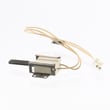
| Oven will not heat or takes too long to heat | Weak igniter | Tappan range oven burner igniter 316489403 |
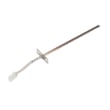
| Oven temperature is inaccurate | Failing sensor | Frigidaire range oven temperature sensor 316490000 |
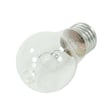
| Oven light is out | Burned-out bulb | Appliance light bulb, 40-watt 316538904 |
Why it matters
A gas range that is heating correctly and lighting reliably runs more efficiently and puts less strain on components like the igniter switch, spark module, and oven gas valve. That directly supports reaching the typical 15-year lifespan.
Last updated: February 2026
What was the size of the Kenmore 79074232311 oven?
The Kenmore gas range model 79074232311 is part of the 790.7423* series; the exact oven and overall range dimensions vary by configuration and are listed in the product literature for your specific unit. For the most accurate size details for your appliance, use the dimensions and cutout requirements shown in the installation guide.
What “size” can mean for this model
When customers ask for oven size, they usually mean one of these:
- Overall range dimensions (width, height, depth)
- Oven cavity capacity (cubic feet)
- Cabinet cutout/clearance requirements (space needed around the range)
- Interior usable space (rack positions and usable depth)
Where to find the correct dimensions
For Kenmore model 79074232311, we use these sources first:
- The dimension diagram and cutout/clearance section in the installation guide
- The model series details in the owner's manual
- The rating plate (model tag) to confirm the exact 790.7423* variant
Quick check: typical freestanding range sizing
Most Kenmore freestanding gas ranges in this family are built to fit a standard kitchen opening.
| Measurement | Typical for this style of range | What to use for final confirmation |
|---|---|---|
| Width | About 30 inches | Installation guide |
| Height (to cooktop) | About 36 inches (often adjustable) | Installation guide |
| Depth (front to back) | Often 25 to 28 inches (varies with handle) | Installation guide |
Why it matters
Using the correct dimensions prevents installation problems like a range that will not slide fully into the opening, incorrect anti-tip bracket placement, or insufficient clearance to combustibles. The installation guide is the right reference for safe fit and spacing.
Last updated: February 2026
Are all stove igniters universal?
No. Stove igniters are not universal; the correct igniter for your Kenmore 79074232311 gas range must match the mounting style, electrical connector, and the amperage needed to open the gas valve reliably. “Universal” igniters can work, but only when they fit and are wired correctly per the owner's manual.
What “universal” really means
Many “universal” oven igniters are a generic hot-surface igniter with extra brackets and wire nuts. They can heat up and glow, but that does not guarantee proper ignition timing or safe operation.
Common differences between igniters include:
- Mounting bracket shape and screw locations
- Connector type (plug-in vs. bare leads)
- Lead length and heat shielding
- Igniter current draw (amps) needed to open the oven gas valve
- Intended use (bake igniter vs. broil igniter)
How to choose the right igniter for model 79074232311
For the best fit, we recommend matching to the model-specific part listing rather than guessing by appearance.
Good options to compare on this model include:
- Tappan range oven burner igniter 316489403 (commonly used for bake ignition)
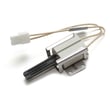
- Range oven igniter 5304506545 (often used for broil ignition on similar designs)
Quick comparison
| What you see | Most likely issue | What to do next |
|---|---|---|
| Igniter glows but burner will not light | Weak igniter (not enough current) | Replace with the correct igniter for the model |
| Clicking at cooktop but no flame | Surface ignition or gas/air issue | Verify burner cap placement and ignition steps |
| Burner lights after a long delay | Igniter aging or poor connection | Inspect wiring and replace igniter if needed |
Why it matters
On this range design, the oven igniter must heat up enough for the gas valve to open; the installation guide notes a normal 30 to 60 second delay before the oven burner flame appears. A mismatched or weak igniter can glow but still fail to open the valve consistently, causing no-heat or delayed ignition.
Safety and install notes we follow
- Shut off power to the range before servicing igniter wiring.
- Shut off the gas supply before removing burner/oven components.
- After any gas work, check all connections for leaks.
- For cooktop ignition checks and burner cap placement, follow the installation guide.
Last updated: February 2026
How to tell if a gas igniter is bad?
A bad gas igniter on your Kenmore 79074232311 gas range usually shows up as a long preheat time, no ignition, or an igniter that glows but never opens the gas valve. In normal operation, the igniter should glow and the burner should light within about 30 to 60 seconds. See the installation guide for the expected ignition sequence.
Quick signs the igniter is failing
- Oven takes longer than normal to light (often over 60 seconds)
- Igniter glows dimly, flickers, or never glows
- You smell gas briefly but the burner does not light (stop and follow safety steps)
- Burner lights sometimes, then fails on the next cycle
- Broil works but bake does not (or the opposite), pointing to one igniter circuit
How to test it (safe, practical checks)
- Watch the ignition sequence: Set Bake to 300°F and look for the igniter glow; flame should appear after the warm-up delay.
- Listen and look: A healthy igniter glows bright and steady; weak glow often means it cannot draw enough current to open the valve.
- Meter test (best confirmation): With power disconnected, check igniter continuity; an open circuit indicates a failed igniter. If you have a clamp meter and know how to use it safely, many round-style igniters need roughly 3.2 to 3.6 amps to open the gas valve (typical range guidance).
Parts that commonly fix “won’t heat” on this model
If your symptoms match, these are the most common repair parts we see for ignition and heat complaints:
| Symptom | Most likely part | Example part on this model page |
|---|---|---|
| No bake ignition, slow bake ignition | Oven burner igniter | Tappan range oven burner igniter 316489403 |
| Oven temperature swings, error or poor baking | Oven temperature sensor | Frigidaire range oven temperature sensor 316490000 |
| Surface burners click but do not light consistently | Spark/ignition system issue | Range spark module 5304508269 |
Why it matters
A weak igniter can glow but still fail to open the gas valve, which causes delayed ignition, inconsistent baking, and repeated no-heat cycles. Confirming the ignition timing and glow strength helps you replace the right part the first time.
Last updated: February 2026