




How to tell the year of a Craftsman lawn mower?
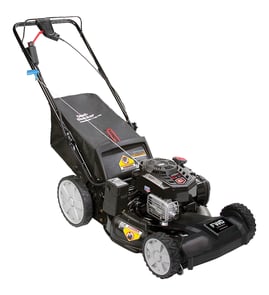
For the Craftsman walk-behind mower model CMXGMAM1125503, the exact build year usually is not printed as a plain “YYYY” on the mower. Instead, you typically determine the year by decoding the date code on the product label or by using the model and serial information to identify the manufacturing date range.
Where to find the date information
On most Craftsman walk-behind mowers, the model/serial label is commonly found in one of these spots:
- On the rear deck near the bagging door
- On the top of the mower deck near the engine mounting area
- Near the height-adjustment bracket or rear wheel area
- On the handle support or frame (less common)
If you are replacing missing bagging hardware while you check the label, the lawn mower grass bag 664P05322A is a model-matched part for CMXGMAM1125503.
How date codes are commonly formatted
Many mower labels use a 6-digit date code format that reads as:
| Code positions | Meaning | Example |
|---|---|---|
| 1-2 | Month (MM) | 07 = July |
| 3-4 | Day (DD) | 28 = 28th |
| 5-6 | Year (YY) | 11 = 2011 |
So a code like 072811 typically indicates July 28, 2011.
Quick checks to avoid misreading the code
- Confirm you are reading a date code, not the model number (CMXGMAM1125503) or a serial number.
- Look for separators, prefixes, or nearby text like “DATE” or “DOM”.
- If multiple number strings exist, the date code is often the shorter one.
Why it matters
Knowing the year helps us match the correct parts and specs (deck components, bagging parts, and hardware) because manufacturers sometimes revise designs mid-series even when the mower looks the same.
Last updated: January 2026
Should I use 87 or 91 gas for lawn mower?
For the Craftsman CMXGMAM1125503 gas walk-behind mower, we recommend using regular unleaded 87-octane gasoline for normal mowing. Using 91-octane typically does not improve performance; fuel freshness and ethanol content matter more than higher octane in most small mower engines.
What to use (and what to avoid)
- Use: Fresh, clean 87-octane unleaded gasoline
- Avoid: Old gas (more than about 30 days without stabilizer)
- Avoid: Gasoline with high ethanol content (it can cause hard starting and rough running)
- Avoid: Mixing in additives “for power” unless the engine manufacturer specifically calls for it
- Do not use: Diesel or E85 (flex-fuel)
Why 91-octane usually is not better
Octane is mainly about resistance to knock in high-compression engines. Most walk-behind mower engines are designed to run correctly on regular fuel, so higher octane generally does not add power or “clean” the carburetor by itself.
Quick comparison
| Fuel choice | OK to use? | What you’ll notice | Best use case |
|---|---|---|---|
| 87 octane (regular) | Yes | Normal starting and power | Everyday mowing |
| 91 octane (premium) | Usually yes | Typically no benefit | Only if required by the engine maker |
| Fresh 87 + stabilizer | Yes | Better storage reliability | Seasonal storage |
If your mower runs rough or won’t start
Fuel issues are a top cause. Before replacing parts, we suggest these checks:
- Drain old fuel and refill with fresh 87-octane
- Inspect the fuel cap vent (if equipped) for blockage
- Check the air filter for heavy dirt buildup
- Confirm the spark plug is not fouled
- If the mower has been stored, consider cleaning the carburetor bowl and jets
Why it matters
Using the right fuel helps prevent hard starting, surging, and varnish buildup in the carburetor, which can shorten engine life and lead to avoidable repairs.
If you need a replacement for the bagging system on this model, use the compatible lawn mower grass bag 664P05322A.
Last updated: January 2026
What are the common problems with Craftsman lawn mowers?
Common problems we see on Craftsman walk-behind mowers like model CMXGMAM1125503 include hard starting, stalling, uneven cutting, poor bagging, and excessive vibration. The exact root cause varies by engine condition, fuel quality, blade/deck wear, and how the mower is maintained.
Most common symptoms and what usually causes them
- Won’t start or is hard to start: old fuel, dirty spark plug, restricted air flow, or a fuel delivery issue
- Starts then dies (stalling): clogged carburetor passages, dirty air filter, or fuel cap venting problem
- Runs rough or surges: partially clogged carburetor, stale fuel, or air leak at intake
- Uneven cut or scalping: dull/bent blade, deck buildup, or incorrect cutting height/wheel setting
- Poor bagging or clumping: wet grass, clogged deck discharge, worn blade, or a damaged bag
- Excessive vibration: bent blade, loose blade bolt, or debris wrapped around the blade adapter area
Quick checks we recommend first (safe, fast, and common fixes)
- Turn the engine OFF, let it cool, and disconnect the spark plug wire.
- Drain and replace old fuel; use fresh gasoline.
- Inspect and clean/replace the air filter and check the spark plug condition.
- Tip the mower only in a safe direction (typically with the air filter/carburetor side up) to inspect for packed grass under the deck.
- Check the blade for bends, cracks, or heavy nicks; tighten hardware to spec.
Bagging-related issues on CMXGMAM1125503
If the mower runs fine but leaves clippings behind, the bagging system is often the bottleneck. Inspect the bag for tears, clogged mesh, or a poor seal at the rear door.
| Symptom | Likely cause | What to do |
|---|---|---|
| Bag won’t fill | Clogged deck/discharge | Clean underside and chute |
| Clippings blow out | Bag torn or not sealing | Inspect and replace if needed |
| Clumps in bag | Grass too wet or blade dull | Mow drier, sharpen/replace blade |
If your bag is damaged or missing, use the model-matched replacement lawn mower grass bag 664P05322A.
Why it matters
Catching these issues early helps prevent deck damage, reduces engine strain, and improves cut quality. A simple fuel refresh and airflow check solves a large share of “won’t start” and “runs rough” complaints.
Last updated: January 2026