Owner’s manual
 Error Codes


What is the capacity of the Samsung rfg237aars?
The Samsung RFG237AARS has a total capacity of 23 cu. ft., with about 15.9 cu. ft. in the fresh food (refrigerator) section and 6.7 cu. ft. in the freezer. For feature and compartment details, use the RFG237AARS owner's manual.
Capacity breakdown (what those numbers mean)
- Total capacity: 23 cu. ft.
- Refrigerator (fresh food): 15.9 cu. ft.
- Freezer: 6.7 cu. ft.
- Capacity is measured as interior storage volume, not exterior size.
- Shelves, bins, and the ice maker can reduce usable space compared to the raw volume.
Quick reference table
| Section | Capacity | Typical use |
|---|---|---|
| Fresh food compartment | 15.9 cu. ft. | Everyday refrigerated items, produce drawers, door bins |
| Freezer drawer | 6.7 cu. ft. | Frozen foods, upper drawer storage |
| Total | 23 cu. ft. | Combined interior storage |
Why it matters
Capacity helps you compare refrigerators and plan storage, but day-to-day usability also depends on layout (shelves, drawers, and door storage). The RFG237AARS layout and features are shown in the RFG237AARS owner's manual.
Last updated: February 2026
What are the dimensions of the Samsung RFG237AARS?
For the Samsung RFG237AARS, the cabinet dimensions are about 35 6/8 inches wide, 28 inches deep, and 68 1/2 inches high. The manual also lists an overall depth of about 30 1/2 inches and an overall height of about 69 6/8 inches (these “overall” numbers typically include doors and hinges). See the RFG237AARS owner's manual for the exact measurement chart and clearance notes.
Dimension chart (from the manual)
| Measurement | Approx. size |
|---|---|
| Cabinet width | 35 6/8 in |
| Cabinet depth | 28 in |
| Cabinet height | 68 1/2 in |
| Overall depth | 30 1/2 in |
| Overall height | 69 6/8 in |
How to measure it correctly at home
To avoid fit issues, we recommend measuring your refrigerator the same way installers do:
- Measure width at the widest point (often the doors).
- Measure depth from the back to the front of the doors; include handles if they stick out.
- Measure height to the top hinge cover (not just the cabinet).
- Measure your doorways and hallways before moving the unit.
- Plan for door swing space, especially next to a fixed wall.
Clearance you should plan for
The manual calls out installation space for airflow and door swing. In most kitchens, that means:
- Leave space on the right, left, back, and top for air circulation.
- If installed next to a fixed wall, allow about 3 3/4 inches (95 mm) so the door can swing open.
- If you have an ice maker, allow extra space behind for the water line connection.
Why it matters
Correct dimensions and clearances help prevent poor cooling, noisy operation, and doors that cannot open fully. They also reduce the chance of damaging flooring or cabinets during installation.
Last updated: February 2026
Why is my Samsung fridge not making ice in the bottom freezer?
If your Samsung RFG237AARS isn’t making ice in the bottom freezer, the most common causes are the freezer ice maker being turned off, the freezer temperature being too warm, or the water supply not reaching the ice maker (shutoff valve closed, kinked line, or a restricted filter). Use the steps in the owner's manual to confirm settings and restore normal ice production.
Quick checks that fix most “no ice” problems
- Make sure Freezer Ice Off is not enabled; if it is, the freezer will not produce ice.
- Confirm the water line is connected and the shut-off valve is fully open.
- Look for a crushed or kinked water supply tube behind the refrigerator.
- If the unit was just installed or the water line was just connected, wait at least 12 hours for ice production.
- Set the freezer colder; the recommended freezer setting is typically -2°F.
- Close the freezer drawer fully; poor sealing can warm the compartment and slow ice making.
Step-by-step troubleshooting (in order)
- Check the control panel setting: verify the freezer ice function is on (not “Ice Off”).
- Check freezer temperature: if it is warm, lower the set temperature and avoid frequent door openings.
- Verify water supply: confirm the shutoff valve is open and the line is not kinked.
- Rule out a restricted filter: if water flow at the dispenser is slow, replace the filter.
- Reset the refrigerator: unplug for about 10 minutes, then plug back in and allow time for the ice maker to cycle.
Parts that commonly solve “no ice” on this model
| Symptom | What it points to | Part to consider |
|---|---|---|
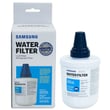
| Slow water at dispenser and little or no ice | Restricted water filter | Samsung refrigerator water filter DA29-00003G |
| Ice maker area frosts up, fan noise changes, ice production drops | Defrost or airflow issue in fresh food section (can affect overall cooling) | Refrigerator fresh food evaporator cover and fan assembly DA97-11772B |
| Ice production is inconsistent and temperatures seem off | Temperature sensing issue | Refrigerator temperature sensor DA32-00033C |
Why it matters
The ice maker depends on two things: cold enough freezer temperatures and steady water flow. If either is interrupted (Ice Off enabled, warm freezer, closed valve, kinked line, clogged filter), the ice maker stops or produces very slowly.
Last updated: February 2026