Error Codes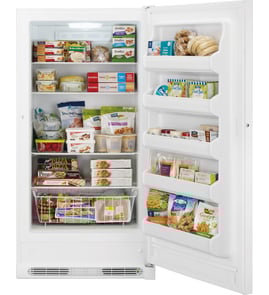


Where to find model number on upright freezer?
On the Kenmore upright freezer model 25321201100, the model number is printed on a rating label (data plate) attached to the cabinet. We most often see it inside the freezer compartment, but it can also be on the exterior cabinet depending on the design.
Most common label locations on an upright freezer
Check these spots in order; they are the most likely places manufacturers use for the rating label:
- Inside the freezer on a side wall (upper area is common)
- Inside the freezer on the ceiling (near the light or air vents)
- Along the door opening (door jamb area)
- Behind the lower front kick plate or toe grille
- On the back of the cabinet near the bottom
What the label looks like (and what to write down)
The label is usually a white or silver sticker with multiple fields. Record these items so we can match parts correctly:
- Model number (for example: 25321201100)
- Serial number
- Electrical rating (volts/amps)
- Sometimes a type or production code
| Field | Why it matters when ordering parts |
|---|---|
| Model number | Ensures diagrams and parts match your exact freezer |
| Serial number | Helps confirm version changes within the same model |
| Production code (if shown) | Can narrow down correct revisions for controls and wiring |
Tips if the label is hard to read
- Wipe frost or residue off with a damp cloth, then dry it
- Use your phone camera and zoom in (flash helps)
- If the sticker is torn, look for the model number stamped into the metal near the label
Why it matters
Kenmore freezer parts can vary by revision, even within the same model family. Using the exact model number (and serial number when available) helps prevent ordering the wrong door gasket, temperature control, or electrical parts.
If you are troubleshooting cooling or a no-start issue after you find the model number, our Kenmore electronic control module freezer error codes guide can help you narrow down the failure.
Last updated: January 2026
How do I know how many cubic feet my upright freezer is?
To find the cubic feet of your Kenmore upright freezer model 25321201100, measure the usable interior width, depth, and height in inches, multiply them together, then divide by 1,728. This gives you the freezer’s approximate storage capacity in cubic feet.
How to measure it (quick steps)
- Unplug the freezer for safety, or keep the door open only as long as needed.
- Measure the interior width (left wall to right wall).
- Measure the interior depth (back wall to the inside front edge).
- Measure the interior height (floor to the underside of the top interior surface).
- Multiply: W x D x H (in inches).
- Divide by 1,728 to convert cubic inches to cubic feet.
Cubic feet formula
| What you measure | What to do | Example |
|---|---|---|
| Interior W x D x H (inches) | Multiply to get cubic inches | 20 x 18 x 50 = 18,000 |
| Cubic inches | Divide by 1,728 | 18,000 / 1,728 = 10.4 cu ft |
Tips to get a more accurate number
- Measure inside the liner, not the outside cabinet.
- If shelves or bins block your tape, measure in sections and add them.
- Don’t include door shelves unless you want a “total usable space” estimate.
- If the door doesn’t seal well, capacity and performance can suffer; inspect the gasket for gaps or tears.
Why it matters
Knowing cubic feet helps us match the right freezer size for your space, estimate energy use, and compare storage capacity across Kenmore and other brands. It also helps when organizing food to reduce door-open time and temperature swings.
Related help: freezer common questions
Last updated: January 2026
What's the average lifespan of an upright freezer?
Most upright freezers, including Kenmore model 25321201100, typically last 12 to 15 years; a realistic overall range is 10 to 20 years. Keeping airflow clear, cleaning the condenser area, and maintaining a tight door seal are the biggest factors that help an upright freezer reach the high end of that range.
Typical lifespan range (what to expect)
| Upright freezer condition | Typical lifespan | What usually limits life |
|---|---|---|
| Well maintained, stable room temp | 15 to 20 years | Normal compressor wear |
| Average use and maintenance | 12 to 15 years | Dirty condenser area, door leaks |
| Hot/garage location, heavy use | 10 to 12 years | Overworked compressor, moisture issues |
What extends the life of a Kenmore upright freezer
- Keep the door closed as much as possible; frequent openings add moisture and frost load.
- Make sure the cabinet is level so the door closes consistently (a worn appliance leveling leg 216396900 can cause sealing problems).
- Check the door seal for gaps, tears, or hardening; replace if it is not sealing (see freezer door gasket 5304507202).
- Leave space around the freezer for ventilation; restricted airflow makes the compressor run hotter.
- Avoid overpacking; good air circulation helps maintain even temperatures.
Signs your freezer is nearing end-of-life
- Runs almost constantly or struggles to hold 0°F
- Excessive frost buildup or recurring ice around the door
- Loud clicking or repeated start attempts (often tied to the start device, such as an upright freezer start relay 5304492198)
- Warm spots, thawing food, or temperature swings
Why it matters
A freezer that is running hot or leaking air uses more electricity and puts extra stress on the sealed system (compressor and condenser). Fixing simple issues like a weak gasket or leveling problem often restores normal run time and helps the freezer last years longer.
Last updated: January 2026