Owner’s manual
 Error Codes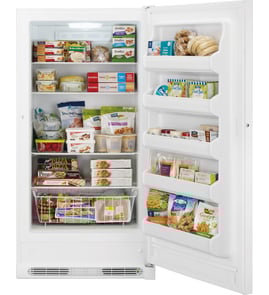

What is the average lifespan of an upright freezer?
Most upright freezers last 10 to 15 years. With proper installation, good airflow clearance, and routine cleaning, many units (including the Wc V20WB upright freezer) reach the high end of that range and can run longer.
Typical lifespan and what changes it
Here is what we see most often for freestanding upright freezers:
| Situation | Typical outcome |
|---|---|
| Normal indoor use, basic maintenance | 10 to 15 years |
| Excellent care, stable room temperature, clean condenser area | Often 15+ years |
| Hot garage, poor airflow, dirty coils, frequent door openings | Shorter lifespan |
Maintenance that helps your freezer last longer
We recommend these habits because they reduce compressor run time and prevent warm-air leaks:
- Keep the freezer indoors and away from heat sources (radiators, ovens) as outlined in the owner's manual.
- Maintain airflow clearances: 3 inches at the top and sides, 1 inch at the back.
- Clean the cabinet, door liner, and door gasket with mild detergent; rinse and dry thoroughly.
- Keep the freezer level; the manual notes adjusting the front leveling legs so the front is slightly higher.
- Avoid overloading with unfrozen food; a common guideline is no more than 2 to 3 lb per cubic foot at one time.
- Keep the door closed during outages; if power is out longer than 24 hours, move food to cold storage.
Why it matters
A freezer that runs hotter than intended forces the compressor to run longer, which increases wear and can shorten service life. Good placement, airflow, and a tight door seal help the unit hold around 0°F under normal conditions.
Last updated: February 2026
What is the disadvantage of an upright freezer?
An upright freezer like the Wc V20WB is convenient to organize, but its main disadvantages are higher cold-air loss when the door opens (which can raise energy use), less usable space for bulky items, and more frost management on manual-defrost models. Details vary by features listed in the owner's manual.
Common disadvantages (upright vs. chest)
- More temperature swing when opened: Cold air spills out of an upright more easily than a chest.
- Less room for bulky items: Shelves and door bins can limit large, awkward packages.
- Potentially higher operating cost: More air exchange can mean the compressor runs more often.
- More parts to maintain: Door gasket sealing and door alignment matter more because the door is vertical.
- Frost and airflow issues if overloaded: Packing items tightly against vents or shelves can reduce circulation.
What to watch for on the Wc V20WB
The manual emphasizes installation and setup that directly affect performance and efficiency:
- Use a dedicated 115V, 60 Hz, 15 or 20 amp grounded circuit.
- Do not use an extension cord.
- Leave clearance for airflow: 3 inches on top and each side, and 1 inch at the back.
- Level the freezer so the door swings shut from about 10 inches open.
Quick comparison table
| Topic | Upright freezer | Chest freezer |
|---|---|---|
| Organization | Easier (shelves/bins) | Harder (stacking) |
| Door-open losses | Higher | Lower |
| Bulky item storage | Often tighter | Often better |
| Footprint | Taller, smaller floor area | Wider, more floor area |
Why it matters
Most “upright disadvantages” show up as warmer temps after frequent door openings, higher energy use, or uneven freezing when airflow is blocked. Proper clearances, leveling, and a good door seal reduce those issues and help protect frozen food quality.
Last updated: February 2026
What is the most common problem on a freezer?
The most common freezer problem is poor cooling caused by restricted airflow and moisture getting where it should not, which leads to frost buildup and unstable temperatures. On the Wc V20WB upright freezer, this often shows up as the compressor running constantly, warmer-than-normal temps, or heavy frost on interior surfaces (manual-defrost models).
Most common symptoms you will notice
- Freezer not reaching about 0°F under normal use
- Thick frost or ice buildup on walls or shelves
- Compressor seems to run all the time (especially after frequent door openings)
- Food softening, ice cream getting “scoopable,” or freezer burn increasing
- Cabinet exterior feels warm (this can be normal during heat removal)
Quick checks that fix many “common” freezer problems
Start with these basics before replacing parts:
- Confirm the control setting: the manual notes a typical setting of 4 to maintain near 0°F under normal conditions.
- Give it time after changes: allow 6 to 8 hours to cool before loading; cool overnight before adding large amounts.
- Avoid overloading with unfrozen food: keep it to 2 to 3 lb per cubic foot at a time; use the coldest setting (Fast Freeze on some models) only 24 to 48 hours.
- Reduce warm air entry: limit door openings and make sure the door closes fully.
- If it is a manual-defrost unit: defrost and clean when frost reaches about 1/4 inch (6 mm).
Manual defrost vs. no-frost: what “common problem” looks like
| Freezer type | Most common issue pattern | What you do first |
|---|---|---|
| Manual defrost | Frost builds up and blocks airflow | Defrost at 1/4 inch frost; dry and restart |
| No-frost | Defrost system or airflow issue causes warming/frost | Check vents are not blocked; monitor temps |
Why it matters
Airflow and frost control directly affect temperature stability. When airflow is restricted, the freezer works harder, temperatures rise above safe storage levels, and food quality drops faster.
Where to confirm settings and features for V20WB
We recommend using the owner's manual to confirm whether your V20WB is manual-defrost or no-frost, where the temperature control is located, and whether your model includes features like Fast Freeze or a temperature alarm.
Last updated: February 2026
Is it worth repairing an upright freezer?
Yes, it’s worth repairing a Wc V20WB upright freezer when the problem is a common, serviceable issue (door sealing, defrost drain, power supply, controls) and the freezer is otherwise in good condition; it’s usually not worth it when the sealed system has failed or repair cost approaches the price of a replacement.
Quick decision checklist
- Repair it if the freezer still runs, but has temperature swings, frost buildup, or a door that will not seal.
- Repair it if the issue is electrical supply related (loose plug, blown fuse, tripped breaker).
- Repair it if the fix is maintenance-level (cleaning, leveling, defrost drain clearing).
- Replace it if the compressor will not start and a technician confirms a sealed-system failure.
- Replace it if the cabinet is badly rusted, warped, or the door will not align even after leveling.
Common “worth repairing” problems (and what to check first)
Before spending money, we recommend these quick checks:
- Power and outlet: The manual recommends a dedicated 115V, 60 Hz, 15 or 20 amp grounded circuit; do not use an extension cord.
- Airflow and placement: Leave clearance around the freezer (top, back, and sides) so it can cool efficiently.
- Leveling: Adjust the front leveling legs so the front is slightly higher; this helps the door close and seal.
- Defrost drain (if equipped): During manual defrost, make sure the drain plug is reinstalled tightly and sealed.
Repair vs. replace: simple cost and risk guide
| Situation | Typical best choice | Why |
|---|---|---|
| Door not sealing, light frost, minor temp rise | Repair | Low-cost parts and labor; big efficiency gain |
| Power interruptions, indicator light off | Repair | Often outlet, breaker, or cord connection |
| Frequent warm alarms after loading food | Repair/adjust | Often normal behavior or control setting issue |
| Compressor not running or confirmed sealed-system issue | Replace | High cost, specialized labor |
Why it matters
A freezer that seals well, has proper clearance, and is on the right electrical supply runs colder with less runtime. That protects food quality and reduces energy waste, so small repairs and setup fixes often pay back quickly.
For model-specific setup and electrical requirements, follow the V20WB owner’s manual.
Last updated: February 2026
What is the most reliable brand of upright freezer?
The most reliable upright freezer brand is the one that maintains a steady 0°F, seals tightly, and matches your installation environment (kitchen vs. garage). Brand-to-brand reliability varies by model and usage; your Wc V20WB stays dependable when it is installed and maintained exactly as outlined in the V20WB owner's manual.
What “reliable” means in real use
Reliability comes from temperature stability and low strain on the sealed system (compressor, condenser, evaporator).
- Holds food-safe temperatures consistently (target 0°F)
- Door gasket seals tightly; door aligns and closes fully
- Adequate airflow around the cabinet to prevent overheating
- Proper electrical supply (grounded outlet, correct circuit)
- Features that help you catch problems early (power light, temperature alarm on some models)
How to choose a reliable upright freezer brand
Instead of picking a brand name alone, we recommend comparing these decision points across the specific models you are considering:
| What to compare | What to look for | Why it helps reliability |
|---|---|---|
| Temperature control | Stable temps, clear settings | Reduces thaw cycles and compressor stress |
| Door sealing | Strong gasket, good hinge alignment | Prevents warm air leaks and frost buildup |
| Environment rating | “Garage ready” if needed | Avoids performance issues in cold or hot spaces |
| Serviceability | Parts availability, clear diagrams | Makes repairs faster and more cost-effective |
Setup basics that improve reliability on the Wc V20WB
These installation practices directly reduce breakdowns and temperature swings:
- Use a dedicated, grounded 115V, 60 Hz circuit (15 or 20 amp); do not use an extension cord
- Allow ventilation clearance (commonly 3 inches at top and sides, 1 inch at the back)
- Level the freezer so the door closes on its own from a partially open position
- Keep it away from heat sources and in a suitable indoor location
Why it matters
Most “reliability” complaints trace back to poor airflow, weak door sealing, or improper power. Getting those right helps any upright freezer run colder with less compressor run time and fewer temperature alarms.
Last updated: February 2026