Installation guide
 Owner’s manual
 Error Codes



What does er if mean on Kenmore Elite refrigerator?
On Kenmore Elite refrigerator model 25357102600, the ER IF code points to an ice fan problem in the freezer area. That fan pushes cold air through the door ducting to keep the ice maker compartment cold; when airflow drops, the control reports ER IF.
- Power reset: unplug the refrigerator for 5 minutes, then restore power.
- Make sure freezer vents and the ice chute area are not blocked by packages.
- Look for frost or ice buildup around the fan cover inside the freezer (restricted airflow can trigger ER IF).
- Confirm the freezer door closes tightly and the gasket seals all the way around.
- Listen for the ice fan: a steady fan sound is normal; grinding, squealing, or silence points to a fan issue.
| What’s happening | Typical cause | What usually fixes it |
|---|---|---|
| Fan is noisy or not spinning | Ice buildup or failing fan components | Defrost/clear ice; inspect fan blade and wiring |
| Fan runs but airflow is weak | Frost restriction in air passages | Address defrost issue; clear blocked ducts |
| Error returns after reset | Control or sensor feedback issue | Check connections; test fan circuit and controls |
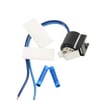
If you find heavy frost in the freezer, focus on the defrost system because a defrost failure can ice up the fan area and reduce airflow. A common defrost-related part on this model is the refrigerator defrost bi-metal thermostat 5303918214.
The ice fan is what keeps the ice maker compartment at the right temperature. When it cannot move enough cold air, ice production drops, cubes can melt and refreeze, and the refrigerator may run longer than normal.
For the exact fan location, access panels, and any model-specific diagnostics for 25357102600, follow the 25357102600 owner's manual.
Last updated: January 2026
What are the common problems with Kenmore Elite refrigerators?
Common problems on the Kenmore Elite 25357102600 side-by-side refrigerator include warm temperatures from airflow issues, frost buildup from defrost or door-seal problems, water and ice dispenser troubles, and unusual noises from fans or the compressor area. We troubleshoot these by checking settings, airflow, and a few key service parts.
- Not cooling or temperatures too warm: doors opened often, controls set too warm, blocked vents, dirty condenser coils, or a failed evaporator fan.
- Excessive frost or ice buildup: door not sealing, door left slightly open, or a defrost system issue.
- Water dispenser slow or no water: clogged water filter, kinked supply line, or a valve issue.
- Ice maker issues: restricted water flow, freezer too warm, or dispenser/ice path blockage.
- Noisy operation (buzzing, rattling, clicking): fan blade hitting ice, loose items, or compressor/start component noise.
- Confirm temperature controls are set correctly; after changes, allow 24 hours for temperatures to stabilize.
- Make sure doors fully close and nothing is holding them open.
- Check for blocked air vents inside the refrigerator and freezer.
- Clean condenser coils and verify the unit has proper airflow around it.
- If the unit seems “off,” check whether the cooling system was disabled at the control panel; unplugging is required to fully remove power.
| Symptom | Common fix | Example part for this model |
|---|---|---|
| Bad taste/odor, slow water flow | Replace water filter | Genuine Kenmore refrigerator water filter WF2CB |
| Frost around door edges, warm spots | Replace door gasket | Refrigerator freezer gasket 241786014 |
| Warm fridge/freezer, fan noise | Inspect fan blade for damage/ice contact | Refrigerator evaporator fan blade 5308000010 |
Warm temperatures and frost buildup usually get worse over time; they can lead to food spoilage, higher energy use, and extra strain on the sealed refrigeration system. Catching airflow and door-seal issues early prevents bigger repairs.
For model-specific operating details (temperature controls, filter release button location, and safety steps), follow the 25357102600 owner's manual. You can also use our DIY guide how to replace the water filter in a Kenmore refrigerator when water flow or taste points to a clogged filter.
Last updated: January 2026
Who makes elite refrigerators?
Kenmore Elite refrigerators (including model 25357102600) are sold under the Kenmore brand and were produced for Sears by major appliance manufacturers. The exact manufacturer can vary by model and production run, so we recommend confirming by checking the identification label and the 25357102600 owner's manual.
Use these quick checks to match the unit to its original manufacturer family:
- Look for the model and serial tag inside the fresh food compartment (often on a side wall).
- Note the full model number (25357102600) and serial number.
- Check for a manufacturer prefix pattern; many Kenmore models use number prefixes tied to a supplier.
- Compare the control panel layout and dispenser style to the diagrams in the 25357102600 owner's manual.
- If you are ordering maintenance items, match parts by model, not by guessed manufacturer.
For most repairs, the most important thing is ordering parts that fit Kenmore Elite 25357102600, because parts compatibility is model-specific.
- Matters most for: service procedures, wiring layouts, and control board variations.
- Matters less for: routine maintenance items like filters, bulbs, and door bins.
If you are maintaining performance, these are frequently replaced items for this refrigerator:
- Genuine Kenmore refrigerator water filter WF2CB (water taste, flow, and ice quality)
- Refrigerator air filter AFCB (odor control)
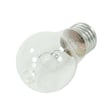
- Refrigerator light bulb 316538904 (interior lighting)
| What you need | Best way to choose | Example part for 25357102600 |
|---|---|---|
| Water filtration | Match by model number | WF2CB water filter |
| Odor control | Match by model number | AFCB air filter |
| Interior light | Match by part ID | 316538904 light bulb |
Kenmore is a brand label, and different manufacturers built different Kenmore Elite refrigerators over the years. Using the model number 25357102600 to select parts and follow the correct procedures prevents fit issues, leaks, and repeat failures.
Last updated: January 2026
How many cubic feet is my Kenmore Elite refrigerator?
For Kenmore Elite refrigerator model 25357102600, the cubic-foot capacity is the total storage volume (fresh food plus freezer) shown in the specifications information for your exact model. The fastest way to confirm it is to check the 25357102600 owner's manual and the model and serial (rating) label inside the refrigerator.
Use these model-specific places first so you get the correct total capacity for your exact configuration.
- Check the Specifications section in the 25357102600 owner's manual.
- Look for the model and serial (rating) label inside the fresh food compartment (commonly on a side wall).
- If the label lists fresh food and freezer volumes separately, add them together for total cubic feet.
- If you see multiple numbers, use the one labeled total or capacity (not dimensions).
| Label wording | What it means | What to do |
|---|---|---|
| Total volume (cu. ft.) | Combined refrigerator + freezer space | This is your cubic feet |
| Fresh food volume + freezer volume | Separate compartment volumes | Add them for total |
| Dimensions (H x W x D) | Physical size, not storage volume | Do not use for cubic feet |
Cubic feet is the standard way to compare storage space between refrigerators. It also helps when planning shelf and bin layouts, organizing airflow, and deciding how much food you can store without blocking vents.
Last updated: January 2026