Owner’s manual
 Error Codes



Is a top mount or bottom mount fridge better?
A bottom-mount refrigerator is better when you want fresh-food items at eye level and more freezer organization; a top-mount refrigerator is better when you want a simpler layout that often costs less to buy and run. Your Kenmore 79574145910 is a bottom-mount design.
Quick comparison
| Feature | Top-mount (freezer on top) | Bottom-mount (freezer on bottom) |
|---|---|---|
| Fresh-food access | More bending | Less bending (fridge at eye level) |
| Freezer organization | Basic shelf space | Typically better with pull-out drawers/baskets |
| Energy use | Often slightly lower | Often slightly higher |
| Price and complexity | Usually simpler | Usually more features and parts |
When a bottom-mount is the better choice
Bottom-mount models are a strong fit when you:
- Use the refrigerator section more than the freezer
- Want pull-out freezer storage for better visibility
- Prefer wider shelves and more door-bin organization
- Store heavier items (milk, produce) where they are easier to reach
For your Kenmore 79574145910, the bottom freezer layout also means you need enough space to fully open the freezer drawer during installation and daily use; the exact clearances and dimensions are listed in the owner's manual.
When a top-mount is the better choice
Top-mount models are usually the better pick when you:
- Want the simplest, most straightforward layout
- Prefer a lower upfront cost
- Use the freezer more often than the fresh-food section
- Have a tighter space where a large bottom drawer swing is inconvenient
Why it matters
Choosing the “better” style is really about how you use your kitchen. Bottom-mount refrigerators prioritize everyday access to fresh food and freezer organization, while top-mount refrigerators prioritize simplicity and efficiency.
Last updated: February 2026
What are the common problems with Kenmore Elite refrigerators?
Common problems we see on Kenmore Elite refrigerators like model 79574145910 include warm temperatures from blocked airflow or frequent door openings, frost buildup from door-seal or defrost issues, unusual noises from fans or the compressor, and water leaks from a clogged defrost drain. For model-specific troubleshooting steps, use the 79574145910 owner's manual.
Most common symptoms and what they usually point to
- Refrigerator or freezer too warm: blocked air vents, doors opened often, or the unit is still stabilizing after install (up to 24 hours)
- Frost buildup or poor airflow: door not sealing, door left ajar, or defrost system trouble
- Loud or new noises: normal defrost water dripping, or a high-efficiency compressor making a pulsating or high-pitched sound
- Water under the refrigerator: defrost drain restriction; water can back up and leak
- Ice maker or water issues: restricted filter, low water pressure, or a valve problem
Quick checks we recommend before replacing parts
- Give it time after setup: allow up to 24 hours for temperatures to stabilize.
- Check airflow: make sure packages are not blocking the air vents between compartments.
- Reduce door-open time: frequent or long openings raise temperature and moisture.
- Inspect door closing: confirm doors close fully and do not pop open.
- Listen for “normal” sounds: dripping during defrost and some compressor noise can be normal.
Parts that commonly relate to these problems (when a repair is needed)
| Symptom | Common part involved | Example part for this model |
|---|---|---|
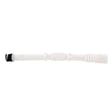
| Water leaking, puddles | Drain path components | Refrigerator drain tube 5251JA3003D |
| Warm temps, poor cooling | Condenser airflow | Refrigerator condenser fan motor EAU63923602 |
| Ice maker not filling | Water supply control | Refrigerator water inlet valve 5220JB2010A |
| Door not sealing, frost | Door gasket | Lg refrigerator freezer door gasket MDS64172919 |
Why it matters
These symptoms often overlap. For example, a door that is not closing properly can cause warm temperatures and frost, and a clogged drain can create leaks during defrost. Starting with airflow and door-seal checks prevents unnecessary part replacement.
Last updated: February 2026
What model Kenmore fridge do I have?
If you’re on the Kenmore refrigerator model page for 79574145910, your fridge model is Kenmore 79574145910 (the manual also lists it as 795.7414*, where the asterisk is the color code). To confirm on the appliance, match the model number from the rating label to the number on your paperwork.
Where to find the model number on the refrigerator
On most Kenmore bottom-mount refrigerators, the model and serial label is typically located in one of these spots:
- Inside the fresh food compartment on a side wall
- On the ceiling area inside the refrigerator compartment
- Behind or near a crisper drawer (you may need to slide the drawer out)
- Along the door frame area (visible when the door is open)
- Behind the lower kick plate or toe grille (less common, but possible)
For model-specific details and diagrams, use the owner's manual.
How to read the model format (what the “795” means)
Kenmore model numbers often start with a 3-digit prefix that helps identify the manufacturing source. For this refrigerator, 795 is the prefix you will see at the start of 79574145910.
Common places you’ll see the model number
| Location | What you’ll see | Why it helps |
|---|---|---|
| Rating label inside fridge | Model and serial | Best for ordering exact-fit parts |
| Use & care guide | Model family (example: 795.7414*) | Confirms series and color-code format |
| Parts list page | Full model (79574145910) | Matches parts to your exact unit |
Why it matters
The exact model number controls which parts fit your refrigerator, including key items like the water filter, door gasket, and ice maker. Even small number differences can change the correct part.
Parts that commonly require an exact model match
- Water filter (example: genuine Kenmore refrigerator water filter 9980 AGF80300805)
- Freezer door gasket
- Ice maker assembly
- Electronic control board
- Door mullion and door hardware
Last updated: February 2026
Why is my refrigerator not getting cold at the bottom?
If your Kenmore 79574145910 is warm in the lower fresh-food area, the most common causes are restricted airflow (blocked vents or overpacked shelves), a recent install or defrost cycle, or a cooling-system issue such as dirty condenser components. Use the checks in the owner's manual to narrow it down.
Quick checks that fix most “warm at the bottom” complaints
- Wait out normal conditions: after installation it can take up to 24 hours to reach set temperatures.
- Give it 30 minutes after defrost: temperatures can rise slightly during defrost; cooling returns after the cycle.
- Find and clear air vents: cold air moves between freezer and refrigerator through vents; move packages away from vents.
- Reduce door-open time: frequent or long openings let warm, humid air in and raise compartment temps.
- Confirm it is not in Demo Mode: if the display shows “OFF”, cooling is disabled until Demo Mode is turned off.
Airflow and “warm at the bottom” (what to look for)
Cold air typically enters the refrigerator compartment through vents and must circulate back. When airflow is blocked, the bottom shelves often warm first.
| What you notice | Likely cause | What to do |
|---|---|---|
| Top feels cooler than bottom | Vents blocked by food bins or packages | Clear space around vents; avoid packing items tightly against the back wall |
| Temps swing after shopping | Doors opened often or too long | Minimize openings; let temps stabilize |
| Whole refrigerator warm | Demo Mode or control set to OFF | Exit Demo Mode; verify temperature settings |
| Warm plus poor cooling overall | Heat not being removed well | Clean condenser area; check condenser fan operation |
When to suspect a part problem
If airflow is clear and settings are correct but the bottom stays warm, we focus on heat removal and refrigeration performance.
- Condenser fan not running: the unit may struggle to cool; consider the refrigerator condenser fan motor EAU63923602.
- Condenser coil clogged or damaged: heat cannot dissipate efficiently; inspect and clean, and replace if needed with the refrigerator condenser coil ACG73749403.
- Sealed-system symptoms: persistent warm temps, long run times, or unusual compressor behavior can point to compressor or related components.
Why it matters
A warm lower section is usually an airflow problem, but if it is caused by poor heat rejection (condenser coil or fan) the compressor can run longer than normal, which increases energy use and can lead to broader cooling complaints.
Last updated: February 2026