Owner’s manual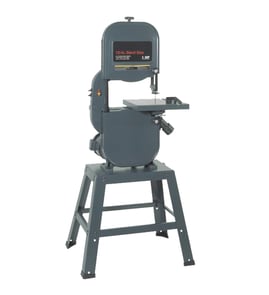

How to replace belt on Craftsman band saw?
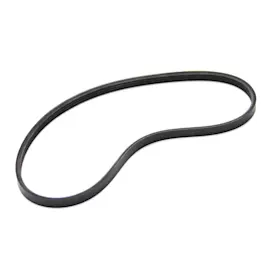
On the Craftsman 315214770 9-inch band saw, you replace the drive belt by removing the blade, pulling the lower wheel/pulley shaft out slightly, swapping the belt, then reinstalling and rechecking blade guides and thrust bearings. Follow the steps in the owner's manual.
- Turn the saw off, remove the switch key, and unplug the power cord.
- Wear eye protection and keep hands clear of sharp blade teeth.
- Work on a stable bench or stand so the saw cannot tip.
- Unplug the band saw and remove the switch key.
- Remove the saw blade and set it aside (the belt sits behind the lower wheel).
- Remove the nut and washer from the middle of the saw housing (this secures the lower wheel/pulley shaft).
- Pull the lower wheel away from the saw housing to access the belt.
- Remove the worn drive belt from the pulleys.
- Install the new belt:
- Place the belt on the lower wheel pulley.
- As you slide the pulley shaft back into the housing, route the belt over the motor pulley.
- Reinstall and tighten the nut and washer.
- Reinstall the saw blade, then check blade guides and thrust bearings before cutting.
- Belt is fully seated in both pulley grooves.
- Lower wheel spins freely by hand with no rubbing.
- Blade tracks centered on the wheels.
- Blade guide assembly is locked in place.
| Item | Purpose | Notes |
|---|---|---|
| Hex key set | Cover/guard and adjustment fasteners | Many band saws use metric sizes |
| Wrench or socket | Nut and washer on pulley shaft | Use the correct size to avoid rounding |
| Work gloves | Handling blade and sharp edges | Remove gloves when doing fine adjustments |
A worn or stretched drive belt can cause slipping, slow blade speed, vibration, and poor cut quality. Replacing the belt and then confirming guide and thrust bearing setup helps the Craftsman 315214770 cut straighter and run smoother.
Last updated: February 2026
What are the parts of a bandsaw?
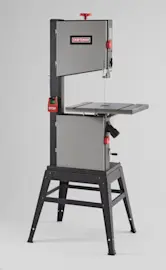
On the Craftsman 315214770 9-inch band saw, the main parts include the saw blade, saw table, blade guard, blade guide support, blade tension knob, tracking knob, and the switch with a removable switch key. These parts work together to keep the blade aligned, tensioned, and safe to operate.
These are the most common components called out for the Craftsman 315214770:
- Saw blade: the continuous cutting band installed on the wheels
- Saw table: supports the workpiece; tilts for bevel cuts
- Throat plate: insert in the table that provides blade clearance
- Blade guard: helps protect you from contacting the moving blade
- Blade guide support and blade guide assembly: helps keep the blade from twisting during cutting
- Blade tension knob: sets blade tension for different blades and cutting needs
- Tracking knob and tracking view window: keeps the blade centered on the wheels
- Table lock handle and angle adjustment knob: locks and adjusts table tilt
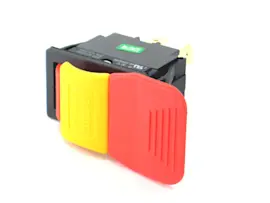
- Switch and switch key: power control; removing the key locks the saw in OFF
- Dust exhaust port and adapter: supports dust collection (shop vac or dust system)
For the labeled diagram and feature names, use the owner's manual.
| Part | What it does | When you adjust it |
|---|---|---|
| Blade tension knob | Tightens/loosens blade tension | Blade changes, drift issues, blade flutter |
| Tracking knob | Centers blade on the wheels | After blade install, if blade walks forward/back |
| Blade guide assembly | Supports blade to reduce twist | Before cutting, when changing blade width |
| Table tilt controls | Sets bevel angle | Any angled cut |
Most band saw problems (blade wandering, rough cuts, excessive vibration, or blade breakage) trace back to three areas: tension, tracking, and blade guide setup. Keeping those parts correctly adjusted improves cut accuracy and helps protect the wheels, guides, and blade.
- Unplug the saw before opening covers or making adjustments.
- Remove the switch key when the saw is unattended.
- Lock the blade guide assembly before turning the saw on.
Last updated: February 2026
What is the 3-tooth rule for bandsaws?
The 3-tooth rule means your band saw blade should have at least three teeth in the cut at all times. On a Craftsman 315214770 9-inch band saw, this keeps the cut stable, reduces snagging, and helps prevent tooth stripping, stalling, and rough cuts.
- Measure the thickness of the wood at the cut.
- Choose a blade TPI (teeth per inch) so that thickness spans 3 or more teeth.
- Make a test cut using gentle feed pressure; do not force the work into the blade (this matches the safe cutting guidance in the owner's manual).
Use this as a starting point for wood and wood-composition materials.
- Thin stock (about 1/8 to 1/4 inch): 14 to 24 TPI
- General purpose (about 1/4 to 1 inch): 6 to 10 TPI
- Thick stock and resawing (over 1 inch): 3 to 4 TPI
- Curves: use a narrower blade width (the manual notes blade width limits the minimum circle size)
- Too few teeth in the cut can:
- grab and chatter
- strip teeth
- leave a rough edge
- increase the chance of the workpiece jerking
- Too many teeth in the cut can:
- pack sawdust in the gullets
- heat the blade
- slow the cut and increase burning
| Material thickness at cut | Target teeth engaged | Typical blade choice |
|---|---|---|
| 1/8 inch | 3+ | 18 to 24 TPI |
| 1/4 inch | 3+ | 10 to 14 TPI |
| 3/4 inch | 3+ | 6 to 10 TPI |
| 2 inches | 3+ | 3 to 4 TPI |
These basics matter as much as TPI on the Craftsman 315214770:
- Clamp or bolt the saw to a stable bench before cutting
- Confirm the blade teeth point down toward the table
- Keep the blade clean and sharp, with sufficient set
- Support large workpieces to reduce pinching
- Feed slowly and steadily; do not force the cut
Matching blade TPI to stock thickness is one of the fastest ways to improve cut quality and reduce blade problems. It also supports safer operation because the blade tracks more predictably and the workpiece is less likely to snag.
Last updated: February 2026
What size blade does a 12" in Craftsman bandsaw use?
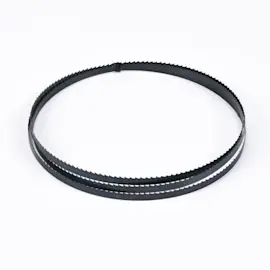
A “12-inch Craftsman band saw” commonly uses an 80-inch blade, but blade length is model-specific. For the Craftsman 315214770 band saw (the model covered here), the correct blade is 59-1/4 inches long and 1/8 inch to 3/8 inch wide. Confirm in the 315214770 owner's manual.
Use these specifications when buying a replacement blade for model 315214770:
- Blade length: 59-1/4 in.
- Blade width range: 1/8 in. to 3/8 in.
- Tooth direction: teeth point down toward the table
- Tooth count (TPI): choose based on material and finish needed
| Item | 12 in. Craftsman band saw (typical) | Craftsman 315214770 (this model) |
|---|---|---|
| Blade length | 80 in. | 59-1/4 in. |
| Blade width | varies by saw | 1/8 in. to 3/8 in. |
Blade width controls curve ability and straight-cut stability:
- 1/8 in.: tight curves, small-radius work
- 1/4 in.: general-purpose cutting
- 3/8 in.: straighter cuts, less blade twist
Using the correct blade length lets the saw tension and track properly; using the right width improves accuracy and reduces blade twisting or breakage.
Last updated: February 2026