Owner’s manual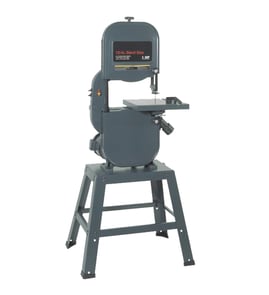

How do I know the size of my bandsaw blade?
For your Craftsman 113248510 12-inch band saw, blade “size” means blade width and blade length (plus tooth pitch, or TPI). We match blade width to what the saw supports, then confirm length by checking the blade itself or measuring it safely; see the owner's manual for blade setup and safety rules.
What blade widths fit this model
The manual specifies this saw comes with a 1/4-inch blade and accepts 1/8-inch to 1/2-inch blade widths.
| Spec | What to use | Why it matters |
|---|---|---|
| Blade width | 1/8 in to 1/2 in | Wider blades track straighter; narrower blades cut tighter curves |
| “Stock” blade | 1/4 in | Common all-purpose starting point |
| Tooth pitch (TPI) | Varies by material | Controls cut speed and finish quality |
How to identify your blade size (width, length, TPI)
Before handling the blade: unplug the saw, switch it off, and remove the switch key. The manual also warns not to wear gloves around the blade.
- Width: measure from the back edge of the blade to the tip of the teeth.
- Length: if the blade is off the saw, lay it out in a loop, mark a spot (often the weld), and roll it along a tape measure until the mark returns.
- TPI: count the number of teeth in 1 inch; that number is the TPI.
- Tooth direction check: teeth should point downward toward the table when installed.
- After changing width: re-check tracking, guides, thrust bearings, and tension.
Quick blade selection guide
- Curves and tight radius cuts: choose a narrower blade (commonly 1/8 in to 1/4 in).
- Straighter cuts and resawing: choose a wider blade (commonly 3/8 in to 1/2 in).
- Smoother finish: higher TPI.
- Faster cutting in thicker stock: lower TPI.
Why it matters
Using the correct blade width and setting proper tension and guide alignment reduces blade breakage, improves tracking on the rubber tires, and helps prevent binding and kickback during cuts.
Last updated: February 2026
What is the 3-tooth rule for bandsaws?
The 3-tooth rule means you should choose a band saw blade pitch (TPI) so at least three teeth are in the cut at all times. On your Craftsman 113248510 12-inch band saw, this improves control, reduces snagging, and helps prevent tooth stripping and blade damage.
How to apply the rule (quick method)
- Measure the material thickness (the direction the blade teeth travel through).
- Pick a blade TPI that gives 3 to 6 teeth in the workpiece for most wood cuts.
- If the cut is rough, go slightly finer; if the blade loads up or burns, go slightly coarser.
Simple TPI selection guide (wood and plastics)
| Material thickness | Typical blade pitch | What you get |
|---|---|---|
| 1/8 to 1/4 in. | 10 to 14 TPI | Cleaner cut on thin stock |
| 1/4 to 3/4 in. | 6 to 10 TPI | Good general-purpose control |
| 3/4 to 2 in. | 3 to 6 TPI | Faster cutting, better chip clearing |
Setup details that matter on model 113248510
Even with the right TPI, poor guide and guard setup can cause wandering, vibration, or premature blade wear. In the Craftsman manual, we follow these basics:
- Keep the saw unplugged while changing blades or adjusting guides.
- Confirm the blade teeth point downward toward the table.
- Adjust the upper blade guide and blade guard to just clear the workpiece.
- Set the blade guides about 1/32 inch from the gullet (the deepest part between teeth), not tight against the teeth.
- Use a blade width that matches the job; this saw is designed for 1/8-inch to 1/2-inch blade widths.
For the exact adjustment sequence (tracking, guides, and tension), use the 113248510 owner's manual.
Why it matters
When fewer than three teeth are engaged, each tooth takes too big a bite. That increases chatter, makes the cut harder to control, and raises the risk of stripping teeth or kinking the blade, especially when turning tight radii.
Last updated: February 2026
What is the specs of the Craftsman 12 inch bandsaw 113248510?
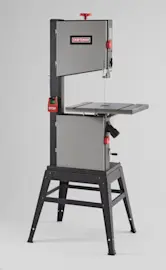
The Craftsman 113248510 is a Craftsman 12-inch vertical band saw. For the exact specifications (cutting capacity, table size, blade length range, and motor/electrical rating), use the specifications section in the 113248510 owner's manual.
What we can confirm for model 113248510 from the manual parts breakdown
The manual’s illustrated parts lists for model 113248510 confirm these model-specific features and serviceable assemblies:
- Drive assembly with an upper wheel, ball bearing, and wheel tire
- Blade tension system (blade tension screw and knob are listed)
- Base and table components (front table, alignment key, covers, cord and strain relief parts)
- Bevel drive and motor mount assembly (bevel lock, handwheel gear/segment, and related hardware)
Specs to pull from the manual (the exact numbers you are looking for)
When you open the manual, look for a “Specifications” or “Product specifications” section and record these items:
- Throat depth (blade to frame)
- Maximum cutting height (resaw capacity)
- Table size and table tilt range
- Blade length and supported blade widths
- Motor rating and power requirements
Quick checklist: what to measure vs. what to read
Some specs are best read from the manual, while others can be verified with a tape measure:
| Spec item | Best source |
|---|---|
| Motor rating, electrical requirements | Manual label/specs section |
| Blade length and width range | Manual specs section |
| Table size | Measure table surface |
| Max cutting height | Measure from table to upper guide at max clearance |
Why it matters
Using the correct model 113248510 specs helps you choose the right band saw blade, set blade tension correctly, and avoid overloading the motor during resawing or thick stock cuts.
Last updated: February 2026