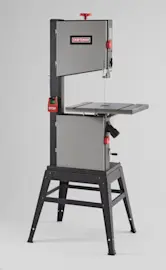
Owner’s manual

What is the 4 inch rule for bandsaw?
The 4-inch rule for a band saw means we keep our hands and fingers at least 4 inches away from the moving blade at all times. On the Craftsman 351214190 bench band saw, we do that by using push tools, proper blade guard height, and safe work support instead of guiding small stock with our fingertips.
How to apply the 4-inch rule on a bench band saw
- Set the upper blade guide and guard as low as practical above the workpiece (a small gap improves control and reduces exposure).
- Use a push stick, push block, or a small-parts holding jig when the cut would bring your hands within 4 inches of the blade.
- Keep the workpiece flat on the cast iron table and use the miter gauge when it helps control the cut.
- Plan the cut so your hands stay to the sides of the blade path, not in line with it.
- Stop the saw before removing offcuts or clearing sawdust near the blade.
Quick safety checklist (before you cut)
The operator guidance for this model emphasizes safe setup and control. We also recommend these basics every time:
| Item to check | What “good” looks like | Why it helps |
|---|---|---|
| Blade tension and tracking | Blade runs centered on the wheels | Reduces wandering and sudden grabs |
| Blade guides | Guides adjusted close to the blade | Improves stability and cut accuracy |
| Work support | Stable bench mounting, stable stance | Prevents tipping and hand slips |
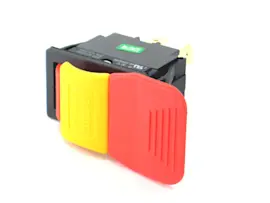
| Switch control | You can shut off quickly; key can be removed | Prevents unintended start-up |
Why it matters
Most band saw injuries happen when a cut gets unstable and a hand drifts into the blade line. The 4-inch rule forces us to use safer control methods (push tools and jigs) so a slip does not become a severe injury.
Helpful model-specific notes
- This Craftsman 351214190 is designed to be mounted to a stable, level bench or table; a solid mount reduces vibration and improves control.
- Disconnect power before changing or adjusting the blade; wear leather gloves for blade handling (never gloves while operating).
Parts and documentation
For operating and safety details (including blade tensioning, tracking, and guide adjustment), use the 351214190 owner's manual. For parts lookup by model number, search Sears PartsDirect.
Last updated: February 2026
Why does my Craftsman bandsaw blade keep falling off?
On the Craftsman 351214190 bench band saw, the blade usually falls off when tracking or tension is off, the wheels are dirty, or the blade guides are misadjusted. We correct this by unplugging the saw, hand-rotating the wheel, and setting tracking with the rear tracking knob per the owner's manual.
Fix it in a safe, repeatable order
Before adjusting anything, unplug the saw. The manual warns not to do tracking adjustments while the band saw is running.
- Release and reapply blade tension using the tension lever; then fine-tune with the tension knob.
- Open the doors and hand-rotate the drive wheel clockwise; watch the blade through the tracking window.
- Adjust tracking with the tracking knob on the back of the frame:
- If the blade rides away from the cabinet, turn the knob clockwise.
- If the blade rides toward the cabinet, turn the knob counterclockwise.
- Tighten the tracking lock nut after the blade tracks correctly.
- Clean sawdust and pitch off the tires and wheels; debris causes poor tracking and blade slippage.
Common causes and what you will notice
| What is wrong | What you see | What to do |
|---|---|---|
| Blade tracking off | Blade walks forward or backward on the wheel | Set tracking by hand-rotating the wheel and adjusting the tracking knob |
| Incorrect blade tension | Blade flutters, wanders, or pops off during a cut | Re-tension with the lever, then fine-adjust with the tension knob |
| Dirty wheels/tires | Blade slips, tracking changes after a few cuts | Clean wheels and tires; keep dust from building up |
| Guide blocks/bearings misset | Blade gets pushed off line when you start cutting | Reset guides so they support the blade without forcing it sideways |
Why it matters
A blade that is not tracking correctly can spring off the wheels and cause injury, and it also leads to crooked cuts, binding, and repeated blade damage. Keeping the wheels clean and tracking set prevents slippage and improves cut accuracy.
Parts and ordering note
We use the parts list for model 351214190 to match the correct items (such as guide components, tires, or hardware) to your exact saw; you can also search by model number on Sears PartsDirect.
Last updated: February 2026
How do I know what size my bandsaw blade is?
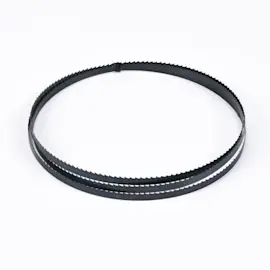
For the Craftsman 351214190 bench band saw, the blade size is defined by length, width, and teeth per inch (TPI). Your saw is specified for a 62-inch blade length and 1/4-inch to 3/8-inch blade width; confirm the exact setup and adjustments in the 351214190 owner's manual.
Blade size for Craftsman 351214190 (what to look for)
A “bandsaw blade size” is usually these three specs:
- Blade length: the total loop length (this model uses 62 in.)
- Blade width: tooth tip to back of blade (this model supports 1/4 in. to 3/8 in.)
- TPI (pitch): teeth per inch, chosen by material and cut quality
Quick reference table
| Spec | What it means | Craftsman 351214190 spec | Why you care |
|---|---|---|---|
| Length | Total loop length | 62 in. | Must match the saw’s wheel spacing and tension range |
| Width | Tooth tip to back edge | 1/4 in. to 3/8 in. | Wider blades track straighter; narrower blades cut tighter curves |
| TPI | Teeth per inch | Choose by material | Controls speed vs. smoothness and reduces tooth stripping |
How to confirm the blade you have (fast, accurate checks)
If you already have a blade installed or an old blade to reference:
- Check the blade printing (many blades list length, width, and TPI on the band).
- Measure width with a ruler or calipers from tooth tip to the back edge.
- Estimate TPI by counting how many tooth points fall in 1 inch.
- Confirm length by reading the blade marking; if it is unmarked, lay the blade flat and measure the full loop length with a tape.
Choosing TPI for your cut (simple rules)
We use these rules to pick a blade that cuts cleanly and protects the teeth:
- Soft wood and softer materials: 6 to 8 TPI
- Harder materials: 8 to 12 TPI
- Keep at least 3 teeth in the cut at all times to prevent “shocking” and tooth loss.
Why it matters
Using the correct 62-inch blade length and staying within the 1/4-inch to 3/8-inch width range helps the blade tension correctly, track on the wheels, and work with the guide pins and thrust bearing adjustments. That directly improves cut accuracy and reduces premature blade wear.
If you need to search additional replacement parts or diagrams by model number, we recommend starting with the model parts list and then using Sears PartsDirect for broader model-based search.
Last updated: February 2026
How to replace belt on Craftsman band saw?
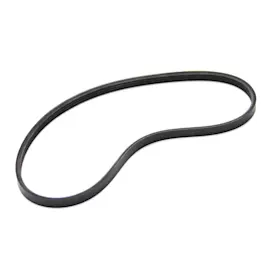
On the Craftsman 351214190 bench band saw, replacing the drive belt involves disconnecting power, opening the lower access area, relieving belt tension, swapping the belt on the motor and lower wheel pulleys, then re-tensioning and test-running for smooth operation. Use the 351214190 owner's manual for the correct cover removal and adjustment points.
Safety first
- Unplug the saw before removing covers or touching the belt, pulleys, wheels, or wiring.
- Let the motor stop completely before servicing.
- Wear eye protection; wear gloves only when handling the blade (never while operating).
- Keep hands clear of pinch points around the pulleys and lower wheel.
- Replace a worn or damaged power cord before using the saw.
Belt replacement steps
- Disconnect power and open the lower door/cover.
- Relieve belt tension using the motor mount or belt tension mechanism.
- Roll the old belt off the motor pulley, then off the lower wheel pulley.
- Install the new belt on the lower wheel pulley first, then on the motor pulley.
- Set tension so the belt deflects slightly with firm finger pressure.
- Verify pulley alignment; the belt should run centered and not rub the guard.
- Close covers and test run briefly; recheck tension if you hear squealing or feel vibration.
Belt tension quick guide
| Symptom | Likely cause | Fix |
|---|---|---|
| Squeals on startup | Belt too loose | Increase tension slightly |
| Excess vibration | Belt too tight or misaligned | Reduce tension, align pulleys |
| Smooth, steady cut | Tension correct | Recheck after a few cuts |
Why it matters
Correct belt tension transfers motor power to the drive wheel without slipping, which improves cut consistency and helps protect the motor and bearings.
Getting the right replacement belt
Use the model number 351214190 to match the belt size/type in the parts breakdown; you can also search by model number on Sears PartsDirect.
Last updated: February 2026
What is the 3-tooth rule for bandsaws?
For the Craftsman 351214190 bench band saw, the 3-tooth rule means selecting a bandsaw blade pitch (TPI) so at least three teeth are in contact with the workpiece at all times during the cut. This prevents blade shocking, reduces tooth stripping, and improves cut quality; see the blade pitch section in the 351214190 owner's manual.
How to apply the 3-tooth rule
Use the workpiece thickness at the cut to choose TPI so multiple teeth share the load.
- Measure the thickness where the blade enters the material (for tubing, use wall thickness).
- Choose a finer TPI for thin material so you keep 3 or more teeth engaged.
- Choose a coarser TPI for thicker material to clear chips efficiently.
- If the blade chatters or snags, move to a finer TPI.
- If the cut is slow and the gullets pack with dust or chips, move to a coarser TPI.
What our manual says for model 351214190
The manual explains that blade pitch is teeth per inch (TPI) and that the material being cut determines how many teeth should be in contact with the work. It also states:
- There should always be at least three teeth in contact with the cut.
- Too-large pitch can cause blade shocking, which can strip teeth.
Quick reference table
| If you are cutting | Common symptom when TPI is wrong | What to change |
|---|---|---|
| Thin sheet or thin-wall tubing | Snagging, tooth stripping, rough start | Increase TPI (finer) |
| Thick solid stock | Slow feed, gullets loading up | Decrease TPI (coarser) |
| Harder material | Harsh “shocking,” rough cut | Increase TPI and feed steadily |
Why it matters
Keeping at least three teeth engaged spreads cutting force across multiple teeth. That reduces impact on each tooth, helps the blade track more smoothly, and extends blade life.
Parts and accessories
If you need replacement parts or accessories for your saw, start with the model-specific parts list; you can also search by model number on Sears PartsDirect.
Last updated: February 2026