Owner’s manual
 Error Codes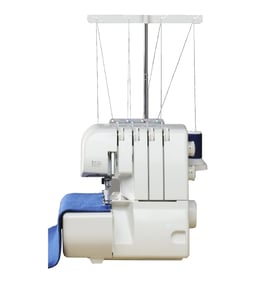

What is the difference between a serger and an overlock machine?
A serger and an overlock machine are the same type of sewing machine; “serger” is the common name in the U.S., and “overlock” describes the stitch the machine makes. Your Kenmore 3851664190 is an overlock (serger) designed to trim, overcast, and seam fabric in one pass.
What both names refer to
Both terms describe a machine that forms an overlock stitch using loopers (and usually 1 to 2 needles) to wrap thread around the fabric edge while the knife trims the seam allowance.
Common uses include:
- Finishing raw edges to reduce fraying
- Sewing stretchy seams on knits
- Creating clean, durable seam finishes
- Producing a thread “chain” at the start and end of stitching
How an overlock (serger) differs from a regular sewing machine
A standard sewing machine typically makes lockstitches and does not trim fabric as you sew. An overlock machine like the Kenmore 3851664190 is built around loopers, multiple thread paths, and edge trimming.
| Feature | Overlock (serger) | Regular sewing machine |
|---|---|---|
| Cuts fabric while sewing | Yes (built-in knife) | No |
| Typical threads used | 3 to 4 | 1 top + 1 bobbin |
| Best at edge finishing | Excellent | Good with zigzag/overcast foot |
| Hemming | Limited (special techniques) | Strong (many hem options) |
Why it matters
Knowing the terms helps you choose the right instructions and troubleshooting steps. For example, most “serger” issues involve threading, looper paths, tension dials, presser foot position, and lint around the feed dogs, which are all core overlock-machine systems.
Tips for getting the best results on this model
We recommend these basics for the Kenmore 3851664190:
- Use standard Kenmore needle size 11 or 14 for typical fabrics
- Keep threads under the presser foot and pulled to the back before sewing
- If stitches skip or thread breaks, recheck threading and tension settings first
- Clean lint from the feed dog area to keep fabric feeding smoothly
For threading paths, tension basics, and model-specific setup, use the owner's manual.
Last updated: February 2026
What is the difference between a sewing machine and an overlocker?
A standard sewing machine is built to construct garments with straight and zigzag stitches (zippers, buttonholes, topstitching), while an overlocker (serger) like the Kenmore 3851664190 trims the fabric edge and overcasts it at the same time for a clean, stretchy seam finish. For threading, stitch setup, and adjustments, use the owner's manual.
What an overlocker (serger) does best
- Trims seam allowances with the built-in knife while stitching
- Finishes raw edges to reduce fraying on woven fabrics
- Creates stretchy seams on knits using multiple threads and loopers
- Produces fast, professional-looking seam finishes for hems and seams
- Uses differential feed to help prevent wavy seams on knits and puckering on light fabrics
What a regular sewing machine does best
- Straight stitch construction and precise seam control
- Zigzag, decorative stitches, and edge stitching without cutting fabric
- Buttonholes, zipper installation, and detailed garment work
- Quilting, topstitching, and sewing in tight areas
- Attaching notions like buttons, snaps, and hooks
Quick comparison
| Feature | Sewing machine | Overlocker (Kenmore 3851664190) |
|---|---|---|
| Cuts fabric while sewing | No | Yes (knife trims edge) |
| Seam finish | Basic to advanced (depends on stitch) | Overcast/serged edge finish |
| Best for knits | Good (with stretch stitches) | Excellent (stretchy serger seams) |
| Thread path | Usually 1 needle thread plus bobbin | Multiple threads with loopers |
| Typical use | Construction and detail work | Seaming and edge finishing |
Why it matters
Using the right machine prevents common problems like thread breaks, skipped stitches, and puckering. On an overlocker, correct threading and tension setup are especially important because multiple threads and loopers form the stitch; the Kenmore 3851664190 is designed to run with the presser foot down during sewing and uses standard Kenmore needle sizes 11 or 14.
Last updated: February 2026
How much is an overlock sewing machine?
An overlock (serger) sewing machine typically costs about $150 to $600 for most home models; heavy-duty and specialty machines often run $600 to $2,000+. For your Kenmore 3851664190, the exact price depends on condition (new vs. used), included accessories, and whether it has been serviced; use the 3851664190 owner's manual to confirm features and included attachments.
Typical price ranges (what you can expect)
- Entry-level home sergers: $150 to $300
- Mid-range home sergers: $300 to $600
- Higher-end sergers (more stitch options, smoother feed): $600 to $1,200
- Heavy-duty or semi-industrial: $1,200 to $2,000+
What changes the price the most
- Condition: clean stitch formation, no skipped stitches, no unusual noise
- Included accessories: presser feet, spool stand, thread guides, needle plate, cover
- Service history: recently cleaned and timed machines sell for more
- Capability: 3-thread vs. 4-thread operation, differential feed, stitch length adjustment
Quick feature checklist for Kenmore 3851664190
Use this to compare listings and make sure you are pricing the same type of machine.
| Feature to check | What it affects | Where to confirm |
|---|---|---|
| Differential feed dial | Helps prevent stretching or puckering | 3851664190 owner's manual |
| Stitch length dial | Controls stitch length for different fabrics | 3851664190 owner's manual |
| 3-thread vs. 4-thread threading | Changes seam strength and finish | 3851664190 owner's manual |
| Needle size 11 or 14 | Common sizing for fabric types | 3851664190 owner's manual |
Why it matters
Overlock machines vary widely in value because performance depends on correct threading, tension, and timing. A machine that threads smoothly and forms an even chain stitch is worth significantly more than one that needs adjustment.
Last updated: February 2026
Is Kenmore sewing machine 3851664190 low shank?
“Low shank” is a presser-foot category used for many regular sewing machines; the Kenmore 3851664190 is an overlock (serger) and uses serger-specific presser feet instead of standard low-shank walking feet. Use the 3851664190 owner's manual to match the correct presser foot style for this model.
How to identify the correct presser foot for a serger
We use the attachment style and the serger’s clearances (needle, loopers, knife) to confirm fit.
- Unplug the machine before inspecting the presser foot area.
- Open the looper cover and look at how the foot mounts (serger feet are typically a dedicated mount, not “low/high shank”).
- Compare your foot and holder to the diagrams and parts names in the manual.
- Check that the foot provides clearance for the loopers and cutting knife.
- If you’re shopping for a specialty foot (gathering, piping, elastic), match it to “Kenmore 3851664190 overlock/serger” wording, not “385-series low shank.”
Quick compatibility guide
| Foot description you see online | Expected fit on Kenmore 3851664190 | Why |
|---|---|---|
| “Low-shank walking foot / even-feed foot” | Not the right category | Walking feet are for feed-dog sewing machines; sergers feed differently and need looper/knife clearance |
| “Kenmore 3851664190 serger/overlock presser foot” | Correct category | Designed for this overlock platform and mounting style |
| “High-shank” or “slant-shank” foot | Not the right category | Those terms apply to standard sewing machines, not serger feet |
Why it matters
Using the wrong presser foot on an overlock machine can cause needle strikes, poor stitch formation, fabric feeding issues, or interference with the loopers and knife.
Last updated: February 2026
How old is the Kenmore sewing machine model 3851664190?
Kenmore overlock sewing machine model 3851664190 is a mechanical serger, but the model number by itself does not translate to a single, reliable build year. The most accurate way to date your specific unit is to match the serial/production code on the machine to the identification information in the owner's manual.
How we date a Kenmore 3851664190 accurately
Use the model number to confirm you have the right documentation, then use the machine’s serial or production markings to narrow the year.
- Confirm the model is printed exactly as 3851664190 on the machine label
- Find the serial number or production code on the machine (often on the body, underside, or near a cover)
- Compare the label format and machine layout to the diagrams and parts views in the owner's manual
- Record any suffixes, revision marks, or additional numbers shown with the model
Where to look for the model and serial label
On many Kenmore overlock sewing machines, the identification label is placed where it stays readable but protected.
- Underside of the base
- Inside or near the looper cover area
- Near the power switch/handwheel side
- Inside a removable cover panel
What the “385” prefix does and does not tell you
The 385 prefix is useful for identifying the Kenmore model family, but it is not a dependable date code.
| What you can use | What it tells you | What it does not tell you |
|---|---|---|
| Model number 3851664190 | Exact model for manuals and parts lookup | Exact manufacturing year |
| Serial/production code | Production run timing for your unit | Nothing unless you decode it |
Why it matters
Knowing the correct production run helps us match the right service specs (needle system/size, threading path, tension settings, and timing adjustments) so you avoid ordering the wrong parts or making the wrong adjustment.
Last updated: February 2026