Installation guide
 Owner’s manual
 Error Codes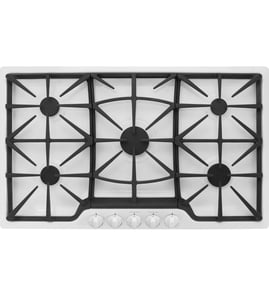



Can you use a downdraft vent with a gas cooktop?
Yes. You can use a downdraft vent with a gas cooktop when the cooktop is designed for downdraft ventilation, and the ducting is installed to the required size and layout. For Jenn-Air model CVGX2423B, the installation instructions include specific duct cutout and ducting requirements.
What to confirm before you install or use downdraft ventilation
- The cooktop is a downdraft-capable design (the CVGX2423B installation instructions reference an exhaust option and duct cutout).
- The duct size matches the recommended configurations (round or rectangular ducting, depending on run length).
- The duct run stays within common limits (keep elbows and long runs to a minimum for best capture).
- The wall cap and damper move freely while the vent is operating.
- Clearances are met (including side-wall clearance guidance and cabinet-to-motor clearance for cooling).
Ducting basics (what the documentation calls out)
Jenn-Air’s guidance focuses on capturing cooking fumes and smoke; performance depends heavily on ducting size, length, and elbows. Use the ducting layouts and cutout dimensions in the CVGX2423B installation guide.
| Ducting situation | Typical guidance for this cooktop style | What it affects |
|---|---|---|
| Longer duct runs | Use larger ducting (commonly 6-inch round or 3-1/4 x 10-inch rectangular) | Better airflow, less noise |
| Straight out the back through the wall | Smaller ducting may be specified for short runs | Fit and backdraft control |
| Too many elbows | Limit 90-degree elbows and keep spacing between them | Smoke capture and fan load |
Why it matters
Downdraft systems work best when airflow is not restricted. Undersized ducting, excessive elbows, or a stuck damper reduces capture, which can leave more heat, smoke, and cooking odors in the kitchen.
Parts that commonly relate to downdraft vent operation
If the downdraft fan does not run or control feels inconsistent, these model-matched parts are commonly involved:
- Filter WPY706012 (helps keep airflow moving by trapping grease)
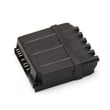
- Knob fan switch W11715914 (user control interface for the fan)
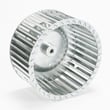
- Blower wheel WPY707985 (moves air through the ducting)
Last updated: February 2026
What are the most common issues with CVGX2423B?
The most common problems we see on the Jenn-Air CVGX2423B gas cooktop are ignition failures (clicking but no flame), uneven or weak burner flames, and downdraft vent issues (fan not running or poor airflow). These symptoms usually trace to burner cleaning, gas conversion/orifice setup, or ignition and fan-switch components.
Common CVGX2423B symptoms and likely causes
- Burner clicks but won’t light: dirty burner ports, wet igniter area, failed ignition circuit
- Continuous clicking after flame lights: misaligned burner cap, moisture, dirty electrode
- Weak, yellow, or uneven flame: clogged ports, incorrect gas pressure, wrong orifice for fuel type
- One burner won’t ignite but others do: dirty electrode, wiring issue, switch problem
- Downdraft fan won’t run: failed fan switch/knob, wiring issue, blower problem
- Poor venting: clogged filter, obstructed ducting, worn blower wheel
Quick checks we recommend first (safe, no disassembly)
- Confirm the burner cap is seated flat and centered on the burner base.
- Clean burner ports with a soft brush; clear debris from the cap and head.
- Dry the igniter/electrode area fully if the cooktop was recently cleaned.
- Try a different burner knob position; note whether the igniter clicks on all burners.
- If you recently changed fuel type, verify the correct LP orifice kit/orifices were installed.
Parts that commonly fix these issues
| Symptom | Part to consider | What it does |
|---|---|---|
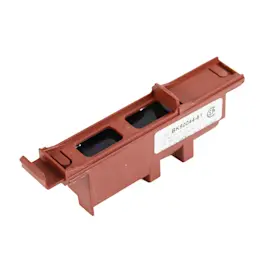
| No spark on multiple burners | Spark module WPW10475147 | Generates high-voltage spark for ignition |
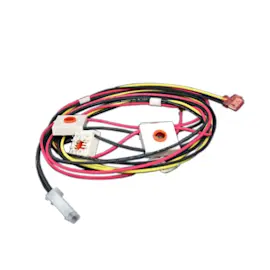
| Spark only when knob is wiggled or one valve won’t spark | Cooktop igniter switch WP71003385 | Sends power to ignition circuit when a knob is turned |
| Downdraft airflow is weak/noisy | Blower wheel WPY707985 | Moves air through the downdraft vent |
| Downdraft venting is poor | Filter WPY706012 | Traps grease and improves airflow |
Why it matters
Ignition and flame quality issues can cause delayed lighting and soot; vent problems reduce smoke and odor removal. Addressing the root cause helps the cooktop light reliably and vent effectively.
For model-specific cleaning steps, gas conversion notes, and venting requirements, follow the CVGX2423B installation guide and the CVGX2423B owner’s manual.
Last updated: March 2026
What is a good gas cooktop?
A good gas cooktop gives you steady flame control, reliable ignition, and safe, correct gas pressure for your home. For Jenn-Air model CVGX2423B specifically, we look for sealed burners with automatic re-ignition, proper ventilation, and correct natural gas or LP setup as outlined in the CVGX2423B owner's manual.
What to look for when choosing a gas cooktop
- Burner performance that fits how you cook: a mix of high-heat and lower-heat burners.
- Sealed burners: easier cleanup and fewer spills reaching internal components.
- Reliable ignition and re-ignition: helps prevent nuisance flame-outs.
- Ventilation compatibility: especially important for downdraft or ducted setups.
- Correct gas type and pressure: natural gas vs LP conversion done correctly.
CVGX2423B features that define “good” for this model
This cooktop is designed with sealed gas burners and automatic re-ignition. It also uses a 4-burner layout with these BTU ratings:
| Burner position | BTU rating | Best for |
|---|---|---|
| Left rear | 10,500 | boiling, sautéing |
| Left front | 6,500 | simmering, sauces |
| Right rear | 6,500 | everyday cooking |
| Right front | 12,000 | high-heat searing |
Gas pressure and installation basics (what “good” depends on)
A cooktop can only perform well when the gas supply matches the design:
- Designed to operate at 5" W.C. on natural gas or 10" W.C. on LP (after conversion)
- Typical supply pressure ranges: 6" to 14" W.C. (natural gas); 11" to 14" W.C. (LP)
- If supply pressure exceeds 14" W.C., an external regulator is required
For clearances, ducting, and installer requirements, follow the CVGX2423B installation guide.
Why it matters
When ignition, burner sizing, ventilation, and gas pressure all match, you get faster boil times, steadier simmering, fewer ignition problems, and safer operation. Many “bad cooktop” complaints trace back to installation, gas conversion, or ventilation issues rather than the cooktop itself.
Last updated: February 2026