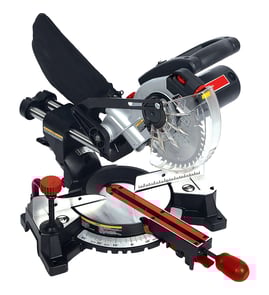

How to get a miter saw to lift up?
To get a Craftsman miter saw like model 137276020 to lift up, you typically need to unlock the head first. Press the saw head down slightly to take pressure off the lock, then pull the lock pin or release lever out so the spring can raise the arm.
Quick unlock steps (most Craftsman miter saws)
- Unplug the saw.
- Hold the handle and push the head down about 1/2 to 1 inch.
- Find the head lock pin/knob (commonly near the pivot at the back of the saw).
- Pull the pin out (or rotate the knob, depending on style) to release the transport lock.
- Slowly let the head rise under spring tension.
- If it still will not lift, check for a jam at the pivot or guard.
If the head is stuck down
A miter saw head can stay down even when “unlocked” if something is binding.
- Check the lower blade guard; it should move freely and not catch on the base.
- Look for sawdust packed around the pivot joint and linkage.
- Inspect the return spring area for a broken spring, missing anchor point, or bent bracket.
- Confirm the lock pin is fully disengaged (some pins need a slight twist to stay out).
- Make sure the saw is not clamped down by a work clamp or accessory.
What you should feel when it is working
| What you do | What should happen | What it suggests if it does not |
|---|---|---|
| Push head down slightly | Lock tension releases | Pin is loaded or bent |
| Pull lock pin/lever | Pin slides freely | Pin is stuck, dirty, or damaged |
| Let go slowly | Head rises smoothly | Return spring or pivot is binding |
Why it matters
Forcing the handle up can bend the lock mechanism, damage the pivot, or crack plastic guard parts. Releasing the lock with the head slightly compressed prevents damage and keeps the saw cutting square.
Helpful DIY reference
For general electrical troubleshooting if you are also dealing with a non-starting saw, we use a meter to confirm power and switches safely; see how to use a multimeter to test electrical parts video.
Last updated: February 2026
Are sliding miter saws accurate?
Yes, sliding miter saws can be accurate, but they are typically harder to keep perfectly dialed-in than non-sliding (chop) miter saws because the slide rails add moving parts that can introduce play. For a Craftsman 137276020 miter saw, accuracy comes down to setup, blade condition, and how you support the workpiece.
What affects accuracy on a sliding miter saw
- Rail play and bearing wear: Any side-to-side movement in the head shows up as cut wander.
- Fence alignment: A fence that is not square to the blade causes consistent out-of-square cuts.
- Miter and bevel detents: Detents that do not land precisely can shift common angles (0°, 45°).
- Blade quality and sharpness: A dull or low-tooth-count blade deflects more, especially in hardwood.
- Workpiece support: Long stock that droops or twists changes the cut angle.
Quick accuracy checks (5-minute tune-up)
- Unplug the saw and lock the head down.
- Check 0° miter and 0° bevel with a reliable square.
- Make a test cut on straight scrap, then “flip test” the pieces to see if the cut is truly square.
- Pull the head through the cut with steady pressure; do not force it.
Sliding vs non-sliding: what to expect
| Feature | Sliding miter saw | Non-sliding miter saw |
|---|---|---|
| Crosscut capacity | Higher | Lower |
| Setup sensitivity | Higher | Lower |
| Long-term precision | Good with maintenance | Typically easier to keep tight |
| Footprint | Larger | Smaller |
Why it matters
If you do trim, cabinetry, or repeatable angle cuts, small alignment errors compound fast. A well-tuned slider gives you the extra crosscut capacity without sacrificing fit and finish.
For safe electrical troubleshooting steps during tune-ups (switches, cords, connections), use our guide: how to use a multimeter to test electrical parts video.
Last updated: February 2026
How to tighten a mitre saw blade?
To tighten the blade on your Craftsman 137276020 miter saw, unplug the saw, lock the spindle (or blade), then tighten the arbor bolt in the correct direction for your saw. Finish by reinstalling any covers and confirming the blade spins freely by hand.
Safety first (do this every time)
- Unplug the miter saw; do not rely on the trigger switch.
- Raise the blade guard as needed to access the arbor area.
- Wear cut-resistant gloves when handling the blade.
- Use the correct wrench; avoid adjustable wrenches that can slip.
- Keep the spindle lock fully engaged only while loosening or tightening.
Tightening steps
- Unplug the saw and lower the handle to a stable position.
- Engage the spindle lock (often a button or lever near the motor housing) so the arbor cannot rotate.
- Access the arbor bolt by removing the spindle cover screw(s) if your saw has a cover.
- Tighten the arbor bolt with the supplied wrench.
- Many miter saws use a reverse-thread arbor bolt (tighten opposite of standard righty-tighty). If the bolt loosens when you try to tighten, reverse direction.
- Reinstall the spindle cover and ensure the lower blade guard returns smoothly.
- Disengage the spindle lock, then rotate the blade by hand to confirm it does not rub and the guard moves freely.
Which way do I turn the arbor bolt?
Because we do not have model-specific documentation for the Craftsman 137276020 here, use this quick check:
| What you observe | What it usually means | What to do |
|---|---|---|
| Bolt loosens when you try to tighten | You are turning the wrong direction (likely reverse thread) | Turn the opposite direction to tighten |
| Spindle lock slips or clicks | Lock not fully engaged | Re-seat the lock and try again |
| Blade wobbles after tightening | Blade not seated or flange dirty | Re-seat blade; clean flanges |
Why it matters
A properly tightened blade reduces wobble, improves cut accuracy, and helps prevent the blade from slipping on the arbor during startup or braking.
Helpful DIY reference
If you need a refresher on safely checking electrical components while troubleshooting a non-starting saw after reassembly, use our how to use a multimeter to test electrical parts video.
Last updated: February 2026
What is the best miter saw on the market?
There is no single “best” miter saw for everyone; the best choice depends on what you cut most (trim, framing lumber, hardwoods), how often you move the saw, and whether you need sliding capacity. For most users, a 10-inch or 12-inch sliding compound miter saw with a solid fence, accurate detents, and a reliable cut-line indicator is the best all-around pick.
How we recommend choosing the “best” miter saw
- Blade size: 10-inch for lighter weight and common trim work; 12-inch for more crosscut capacity.
- Sliding vs. non-sliding: sliding is best for wider boards; non-sliding is simpler and often lighter.
- Bevel capability: single bevel is fine for basic work; dual bevel saves time on crown molding and complex trim.
- Cut-line system: LED shadow line or laser helps repeatability (but fence alignment still matters most).
- Dust collection: expect modest performance; prioritize a good shroud design and a shop vac connection.
- Portability: if you travel job-to-job, weight and handle design matter as much as power.
Quick match: which type fits your work?
| Your main use | Best fit | Why it matters |
|---|---|---|
| Base/crown/trim | 10-inch or 12-inch sliding compound | Cleaner angles, better capacity for nested trim |
| Deck/framing | 12-inch sliding compound | Wider crosscuts and faster throughput |
| Small shop, tight space | Compact slider or non-slider | Less rear clearance, easier bench setup |
| Highest precision woodworking | Premium slider + fine adjustment | Better fences, smoother rails, tighter detents |
What to check before you buy (or before you blame the saw)
Even the top-rated saw will cut poorly if setup is off. These are the make-or-break checks:
- Fence is straight and square to the blade
- Miter detents land accurately at 0°, 15°, 22.5°, 31.6°, 45°
- Bevel stops hit true 0° and 45°
- Blade is sharp and correct for the material (fine-tooth for trim, fewer teeth for framing)
- Table is flat and the workpiece is supported (stand or extension wings)
Why it matters
The “best” miter saw is the one that stays accurate after transport, holds calibration, and matches your typical cut size. Choosing the right blade size and slider style prevents re-cuts, burning, and out-of-square joints.
For model identification and parts lookup for your Craftsman 137276020, we use the same model-number rules shown in how to find your appliance model number (and what it means for parts).
Last updated: February 2026
Can a 12 in miter saw cut through a 4x4?
Yes. A 12-inch miter saw typically crosscuts a 4x4 in a single pass, as long as the board is positioned flat on the table and tight to the fence; this general guidance applies to Craftsman miter saws like model 137276020.
What affects whether it cuts in one pass
A “4x4” is usually about 3-1/2 in. by 3-1/2 in., so the real question is your saw’s maximum cut depth at 90° and how you position the lumber.
- Blade diameter and guard design: 12-inch saws usually have more cut depth than 10-inch saws.
- Non-sliding vs. sliding: sliding models help with width (2x10, 2x12), not cut depth.
- Cut angle: bevels and miters reduce capacity compared to a straight 90° cut.
- Fence and table alignment: a misaligned fence can force the wood to sit crooked and reduce effective capacity.
- Blade condition: a dull blade can bind and stall, especially in dense or wet lumber.
Best practice for cutting a 4x4 on a miter saw
Use these steps to get a clean, controlled cut.
- Unplug the saw before adjusting the fence, bevel, or miter settings.
- Place the 4x4 flat on the table (don’t stand it on edge unless your saw’s capacity clearly supports it).
- Hold the workpiece firmly against the fence; clamp it if your saw supports clamping.
- Let the blade reach full speed before entering the cut.
- Cut steadily without forcing; if the motor slows dramatically, back off and check the blade.
Quick capacity check (what to expect)
Because we do not have model-specific cut-capacity specs for Craftsman 137276020 here, use this as a practical rule-of-thumb.
| Saw type | Typical result on a 4x4 at 90° | Notes |
|---|---|---|
| 12-inch non-sliding | Usually one-pass cut | Best with the 4x4 laid flat |
| 12-inch sliding | Usually one-pass cut | Slide helps with wider boards, not depth |
| 10-inch (any) | Sometimes one-pass, sometimes not | May require flipping the post |
Why it matters
If the saw cannot fully clear the thickness, forcing the cut increases kickback risk and can damage the blade, motor, or workpiece. When in doubt, a controlled “cut and flip” method is safer and more accurate.
Helpful DIY reference
For safe electrical troubleshooting if the saw won’t start or bogs down under load, use how to use a multimeter to test electrical parts video.
Last updated: February 2026