Owner’s manual
 Error Codes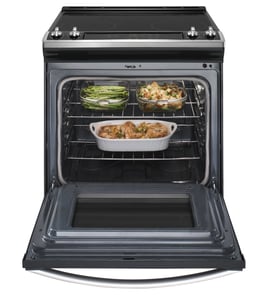



Are ovens 30 amp or 50 amp?
For the Whirlpool WEE745H0LZ0 electric slide-in range, the electrical supply is typically 40 or 50 amps, not 30 amps. The correct breaker and cord size depend on the range’s kW rating shown on the model/serial/rating plate; we recommend confirming it in the WEE745H0LZ0 owner's manual.
Whirlpool’s installation requirements for this 30-inch range call for a 40 A minimum circuit protection in many installations, with 40 A or 50 A power supply cord kits used depending on the range rating and your home’s circuit.
- Check the model/serial/rating plate (behind the oven door, top right of the oven frame) for the exact electrical rating.
- Use a UL-listed range cord rated 250 V minimum and 40 A or 50 A as specified.
- If your home has a 50 A circuit, use a 50 A rated cord kit.
- A circuit breaker is recommended.
- Electrical connections should be made by a licensed, qualified installer.
Most full-size electric ranges are wired on 240 V circuits and land in the 40 to 50 amp range. Here is the common mapping used in Whirlpool’s range rating chart.
| Range electrical rating (kW) | Typical circuit/cord rating |
|---|---|
| 8.8 to 16.5 kW (120/240 V) | 40 A or 50 A |
| 16.6 to 22.5 kW (120/240 V) | 50 A |
- Receptacle type: many installations use a 14-50R receptacle.
- 3-wire vs 4-wire: local code and grounding method determine which is correct.
- Cord strain relief: required to protect wiring at the terminal block opening.
- Existing wire gauge: must match the breaker size (do not upsize a breaker without verifying wiring).
Using the correct amp rating protects the wiring, terminal block, and control components from overheating. An undersized circuit can trip breakers; an oversized breaker can allow wiring to overheat before it trips.
Last updated: January 2026
What is a common problem of the electric oven?
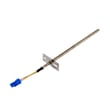
Incorrect or uneven heating is the most common electric-oven problem on a Whirlpool electric slide-in range like model WEE745H0LZ0. In most cases, the cause is a failing bake element, a temperature-sensing issue, or a power supply problem that prevents the oven from reaching and holding the set temperature (see the WEE745H0LZ0 owner's manual).
- Oven will not heat at all: failed bake element, control not sending power, or a supply issue.
- Takes too long to preheat: weak bake element or temperature sensor drift.
- Bakes unevenly: partially failed element, rack placement, or airflow restrictions.
- Display works but oven stays cold: control or wiring issue.
- Error code such as F9 or F9,E0: home outlet wiring may be miswired; disconnect power and have an electrician verify the supply.
- Confirm power: Make sure the range is plugged in and the breaker is fully reset.
- Test for heat: After turning the oven on for about 5 minutes, check whether any heat is building.
- Check airflow: Keep oven vent ducts unobstructed; blocked venting can affect baking performance.
- Inspect the bake element: Look for blisters, cracks, or burned spots.
| Symptom | Common suspect | Example part for WEE745H0LZ0 |
|---|---|---|
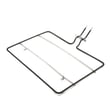
| No bake heat | Bake element open/failed | Bake element W10779716 |
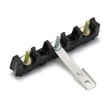
| Cooktop works, oven acts erratic | Loose/burned power connection | Range terminal block WPW10245259 |
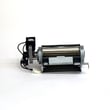
| Overheating around controls, fan noise issues | Cooling airflow problem | Cooling fan assembly W11107275 |
An oven that cannot heat correctly wastes energy and can undercook food. On electric ranges, heating problems also help identify electrical issues early (for example, a tripped breaker, loose terminal connections, or a miswired outlet).
Last updated: January 2026
What is the life expectancy of a Whirlpool electric range?
A Whirlpool electric range typically lasts 13 to 15 years. For your Whirlpool WEE745H0LZ0 electric slide-in range, lifespan depends most on heat exposure to controls, how often high-heat cycles are used, and how quickly worn heating parts are replaced; see the maintenance guidance in the WEE745H0LZ0 owner's manual.
- Cooking frequency and heat levels: daily high-heat use shortens component life.
- Self-clean usage: high temperatures can stress wiring, sensors, and the control area.
- Ventilation and cooling: a working cooling fan helps protect the control compartment.
- Spills and cleaning habits: boilovers that bake onto elements and glass can cause overheating.
- Electrical supply quality: loose connections or miswiring can damage components over time.
Most ranges are replaced because one or more key systems becomes unreliable or expensive to repair.
| Symptom | Common cause | Typical fix |
|---|---|---|
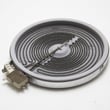
| Oven heats unevenly or not at all | Failed oven heating element | Replace the bake element W10779716 |
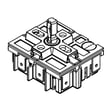
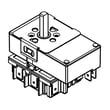
| Cooktop element will not regulate | Worn infinite switch | Replace the correct switch for that burner |
| Control area gets unusually hot | Weak airflow in control compartment | Inspect/replace cooling fan assembly |
| Intermittent power or burning smell at cord area | Loose/overheated connection | Inspect terminal block and wiring |
- Keep the cooktop clean so heat transfers efficiently.
- Avoid running back-to-back high-heat cycles when possible.
- Let the oven cool with the door closed after cooking (reduces heat shock).
- Address heating issues early (a weak element can overwork other parts).
- Periodically check that the range is level and stable (reduces door and hinge wear).
A range that is maintained and repaired promptly usually costs less to own over time because it avoids secondary damage (overheated wiring, stressed controls, and repeated breaker trips) that can turn a simple part replacement into a larger repair.
Last updated: January 2026