Installation guide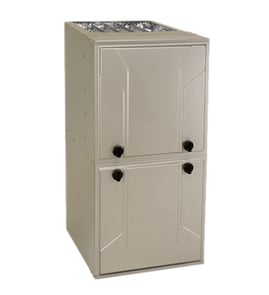

How many square feet will a 80,000 BTU gas furnace heat?
An 80,000 BTU gas furnace can heat about 1,300 to 2,600 square feet, depending on climate, insulation, air sealing, ceiling height, and ductwork. For your Nordyne M1MB077, use the sizing and installation requirements in the installation guide to match the furnace to your home.
Quick rule-of-thumb coverage
These estimates use common BTU-per-square-foot ranges; colder climates and leakier homes land on the lower end.
- Mild climate, tight/modern home: ~30 BTU per sq. ft. (about 2,600 sq. ft.)
- Moderate climate, average insulation: ~40 BTU per sq. ft. (about 2,000 sq. ft.)
- Cold climate, older/drafty home: ~55 to 60 BTU per sq. ft. (about 1,300 to 1,450 sq. ft.)
- High ceilings or lots of glass: size toward the lower sq. ft. estimate
- Duct leakage or restricted returns: reduces delivered heat to rooms
What changes the answer the most
| Factor | More BTUs needed | Fewer BTUs needed |
|---|---|---|
| Climate | Long, cold winters | Short, mild winters |
| Home envelope | Air leaks, low insulation | Tight air sealing, high insulation |
| Ceiling height | Tall/vaulted | Standard 8 ft |
| Windows | Large/older windows | Efficient windows |
M1MB077 installation details that affect real-world heating
The installation instructions call out airflow and fuel setup items that directly impact comfort and performance:
- Return air must stay open and unobstructed; do not cover or restrict the return opening.
- High altitude installations (above 2,000 ft.) require following the guide’s altitude and gas-heating-value instructions; input adjustments are based on the installation conditions.
- Gas supply piping must support the required flow for the furnace input; the guide provides gas flow and pipe capacity tables.
Why it matters
Correct sizing and proper return air and gas supply setup help the furnace heat evenly and run efficiently, instead of struggling to deliver heat through restricted airflow or an undersupplied gas line.
Last updated: February 2026
How to get a furnace running?
For a Nordyne M1MB077 furnace, we start by confirming the thermostat is calling for heat, the furnace On-Off switch is ON, and power is restored at the breaker. This model uses direct ignition (no pilot), so do not try to light it by hand; follow the installation guide.
Quick start checklist (safe, high-impact checks)
- Set the thermostat to HEAT and raise the setpoint above room temperature.
- Turn electric power ON to the furnace at the breaker or fuse box.
- Verify the furnace On-Off switch is set to ON.
- Make sure the front panel/door is fully closed (many furnaces will not run if the door switch is open).
- Replace a dirty air filter (restricted airflow can trip safety limits and stop heat).
- If the blower runs but there is no heat, look for a status light on the control board and note the flash pattern.
If it is a gas gun (direct ignition) model like M1MB
These steps match the direct-ignition sequence described for M1B models.
- Set the thermostat to the lowest setting.
- Turn off electric power to the furnace.
- Turn the gas valve OFF.
- Wait 10 minutes to clear any gas.
- Set the furnace On-Off switch to ON.
- Turn the gas valve ON.
- Restore electric power ON.
- Set the thermostat to HEAT and your desired temperature; ignition typically occurs in about 45 seconds.
What to check if it still will not ignite
- Electrical supply: confirm the furnace circuit is powered.
- Thermostat operation: verify it is working and wired correctly.
- Thermostat wiring: check for broken or loose low-voltage wires.
- Transformer or fuse: a blown low-voltage fuse or failed transformer can prevent ignition.
- Limit switches: an open limit can stop the burners from lighting.
Common symptoms and what they usually mean
| What you see | Most likely cause | What we do next |
|---|---|---|
| Nothing runs (no blower, no clicks) | No power, switch OFF, blown fuse | Check breaker, On-Off switch, control fuse |
| Blower runs, no heat | Safety limit open, ignition failure | Replace filter, check vents, read status light |
| Tries to light, then shuts down | Flame sensing/ignition issue | Inspect flame sensor/ignitor (service-level) |
Why it matters
A furnace that will not start is often being held off by a safety control (door switch, limit switch, ignition control). Following the correct direct-ignition start sequence helps you restore heat without bypassing safety devices.
Last updated: February 2026
What model of furnace do I have?
Your furnace model is printed on the rating plate (data sticker) on the furnace cabinet. For a Nordyne furnace like model M1MB077, that sticker lists the model number, serial number, electrical supply, and other specs a technician uses for troubleshooting and parts matching.
Where to find the model number on a Nordyne furnace
Look for a metal or foil rating plate on the furnace cabinet. Common locations include:
- Inside the burner compartment door (gas models)
- On the inside wall of the blower compartment
- On a side panel near the electrical junction box
- Near the gas valve area (gas furnaces) or burner assembly (oil furnaces)
If you have a manufactured-home style furnace, the label is often easy to see once the front access panel is removed.
What to write down from the data sticker
Copy these items exactly as shown (including letters and dashes):
- Model number (example: M1MB077)
- Serial number (used to identify production run and exact configuration)
- Electrical rating (typically 120V, 60Hz, 1-phase on many Nordyne units)
- Fuel type (gas or oil) and any listed input/output ratings
- Any cabinet size or series identifiers (helpful for fit and airflow setup)
Quick model-prefix guide (helps confirm what you have)
The installation information for this furnace family uses the model prefix to identify the ignition and fuel system:
| What the model number starts with | What it usually indicates | What that means for you |
|---|---|---|
| M1B | Gas gun model | Hot surface ignition; no standing pilot; do not light by hand |
| M5 | Oil gun model | Automatic ignition; do not light by hand |
Why it matters
Using the exact model number prevents ordering the wrong furnace parts and helps match the correct wiring schematic, ignition type (hot surface ignitor vs. oil primary control), and installation requirements like clearances and duct connection details.
For additional model identification and installation details specific to M1MB077, use the installation guide.
Last updated: February 2026