Owner’s manual
 View engine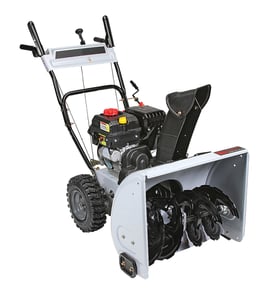



Can you use 10W30 instead of 5W30 in a snowblower?
Yes, for Craftsman model 536881501, we recommend sticking with SAE 5W-30 because the operator’s manual specifies 5W-30 and notes that synthetic 5W-30 is acceptable for all temperatures. Using 10W-30 can make cold starting harder in freezing weather, even if it runs fine once warmed up.
What the manual for model 536881501 specifies
Our guidance for this snow thrower is based on the 536881501 operator's manual. It calls out:
- Engine oil type: SAE 5W-30
- Oil capacity: 16 oz
- Synthetic oil note: synthetic 5W-30 is acceptable for all temperatures
When 10W-30 is most likely to cause problems
10W-30 is thicker at cold temperatures than 5W-30, so the main risk is harder starting and slower oil flow right after startup.
- Temperatures near or below freezing
- Outdoor storage (engine and oil are fully cold-soaked)
- Electric start struggles or recoil starter feels unusually stiff
- Short run times (engine never fully warms up)
Quick comparison: 5W-30 vs 10W-30 for winter use
| Oil grade | Cold-start flow | Best use case | Winter recommendation |
|---|---|---|---|
| 5W-30 | Better | Snowblowers, cold weather | Preferred for 536881501 |
| 10W-30 | Worse | Milder temps, warmer seasons | Not ideal for cold starts |
If you already put 10W-30 in
If the snowblower starts easily and runs normally, you can usually finish the job; then switch back to 5W-30 at the next oil change. If starting is difficult, drain and refill with 5W-30 (or synthetic 5W-30).
Basic oil-check reminders
- Check oil level before use and about every 8 hours of operation
- Fill only to the FULL mark on the dipstick
- Do not overfill
Why it matters
Cold-start lubrication is when small engines see the most wear. Using the oil grade specified for Craftsman 536881501 helps the engine crank easier, lubricate faster, and reduce startup strain in winter conditions.
Last updated: January 2026
Should I use 87 or 91 for snowblower?
For the Craftsman snow thrower model 536881501, we recommend using fresh, clean, unleaded gasoline with a minimum of 85 octane; that means 87 octane regular is the right choice in most cases. Using 91 octane is fine, but it is not required for this model. See the fuel guidance in the 536881501 operator’s manual.
What to use (and what to avoid)
- Use 87 octane (regular) as your go-to fuel.
- Use fresh gasoline (do not use old fuel from a can that has been sitting).
- Avoid leaded gasoline.
- Avoid fuel that has been contaminated with water or dirt.
- For storage, either run the tank dry or treat fuel with stabilizer per the manual.
87 vs 91: what changes and what does not
Higher octane does not automatically mean “better” for small engines; octane mainly relates to knock resistance.
| Fuel choice | OK for model 536881501? | When it makes sense |
|---|---|---|
| 87 octane (regular) | Yes | Normal operation; meets the manual’s minimum octane requirement |
| 91 octane (premium) | Yes | If it is the freshest fuel available; otherwise no advantage for this model |
Why it matters
Using the correct fuel helps your 5 HP, 148 cc engine start easier, run smoother, and reduces common issues like hard starting and rough running caused by stale or contaminated gasoline.
If you are having fuel-related problems
If the engine runs erratically or is hard to start, we recommend checking the fuel quality first, then inspecting the fuel delivery path. A restricted filter can contribute to fuel starvation.
- Drain and replace old fuel with fresh unleaded gasoline
- Check the fuel line for kinks or cracking
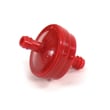
- Inspect or replace the fuel filter 298090S
Last updated: January 2026
How many HP is a 243cc snow blower?
A “243cc snow blower” doesn’t map to one fixed horsepower rating because different engines can share the same displacement but be tuned and governed differently. For your Craftsman model 536881501, our 536881501 operator’s manual lists the engine as 5.0 HP with 148 cc displacement, so it is not a 243cc unit.
Why cc and HP don’t match 1-to-1
Engine displacement (cc) is the cylinder volume; horsepower is the power output under specific test conditions. Two 243cc engines can have different HP because of:
- Governed RPM (max engine speed under load)
- Carburetor and ignition tuning
- Compression ratio and valve timing
- Emissions calibration
- Operating conditions (temperature, altitude, fuel quality)
What to use for your Craftsman 536881501
If you’re shopping parts or comparing performance, use the model-specific specs from the manual:
| Model | Displacement | Rated horsepower |
|---|---|---|
| 536881501 | 148 cc | 5.0 HP |
This is the most reliable way to avoid mixing up “series names” or marketing labels with actual engine output.
If you truly have a 243cc snow blower
If your machine’s engine label shows 243 cc, it’s a different model or a different engine than the one specified for 536881501. In that case, match parts and specs to the engine/model tag, not just cc.
- Check the model number tag on the snowblower housing
- Check the engine label for displacement and model/type code
- Use the correct manual for that exact model/engine
- For fuel delivery issues on many small engines, a clogged filter is common; inspect and replace the fuel filter 298090S if your parts list for your exact model/engine calls for it
Why it matters
Using the correct HP and engine specs helps you choose compatible parts (like belts, ignition components, and fuel system parts) and prevents ordering parts that fit a different engine family.
Last updated: January 2026