



Where can I find the Craftsman lawn mower model number?
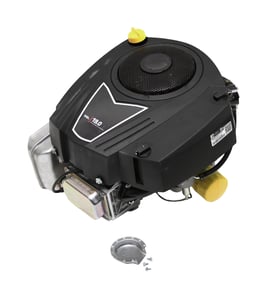
For Craftsman equipment, the model number is printed on the product identification label (ID tag). On many riding mowers, you can find it by flipping the seat forward and checking the label on the underside of the seat; for the engine parts shown here, the engine model is 143965003.
Look for a sticker or metal tag in one of these spots:
- Under the seat (often on the underside of the seat or seat pan)
- On the mower frame near the rear wheels
- On the deck housing (near the discharge chute area)
- Near the engine shroud or blower housing
- On the handle bracket (common on walk-behind mowers)
Model numbers are usually a mix of numbers and sometimes letters. For engine parts, the engine model is often a numeric string like 143965003.
| What you see on the label | What it helps with | Example |
|---|---|---|
| Equipment model number | Finding mower chassis and deck parts | Riding mower model on seat label |
| Engine model number | Finding engine-specific parts | 143965003 |
| Serial number | Identifying production run | Varies |
Using the exact model number helps us match the correct carburetor, ignition, and fuel system parts for your Craftsman engine, which prevents ordering the wrong gasket, float, or O-ring.
These steps still get you to the right parts list:
- Check for a second label on the frame or deck
- Clean the tag gently and take a clear photo
- Match common engine service parts by diagram and description
- Start with high-wear items like the carburetor 640084B or needle seat 631021B when troubleshooting fuel issues
Last updated: February 2026
Who makes Craftsman engines?
Craftsman engines are made by multiple manufacturers, depending on the specific product and production run. For a Craftsman lawn and garden engine model 143965003, the most reliable way to identify the actual engine maker is to match the engine’s model and specification numbers to the correct parts list, then order the exact replacement parts for that engine.
On most lawn and garden equipment, “Craftsman” is the brand on the equipment, while the engine itself is built by an engine manufacturer. Use these checks:
- Look for an engine ID tag or stamping on the blower housing, valve cover, or near the muffler
- Record the engine model number, spec number, and date code (if shown)
- Compare those numbers to the parts breakdown for Craftsman 143965003
- If you are servicing the carburetor, confirm the carburetor family by matching parts like the float and needle seat
- Use the matched parts list to avoid ordering the wrong ignition or fuel-system parts
Craftsman equipment has commonly used engines from several makers over the years. What you see depends on the machine type (mower, tiller, snowblower) and the era.
| What you see on the engine | What it usually means | Why it matters for parts |
|---|---|---|
| Tecumseh-style model numbers (often 6-10 digits) | Tecumseh-built engine family | Carburetor and ignition parts must match the engine family |
| Briggs & Stratton model/type/code format | Briggs & Stratton engine | Tune-up parts and carb settings differ |
| Kohler model and spec format | Kohler engine | Gaskets and ignition components are maker-specific |
| Kawasaki model format | Kawasaki engine | Fuel and ignition parts are not interchangeable with others |
The engine maker determines the correct carburetor, ignition, and sealing parts. For example, fuel issues often trace back to carburetor internals like the needle seat 631021B or sealing points like the lawn mower o-ring 631028A, and those parts must match the exact engine design.
When you are unsure, start with the system you are repairing:
- Hard starting or surging: carburetor, float bowl, needle seat
- Fuel smell or leaks: O-rings, fuel cap, fuel tank
- No spark: ignition coil/lamination, stop wire terminal
Last updated: February 2026
What engine does Craftsman riding mower use?
Craftsman riding mowers use different engines depending on the exact mower model and build; the Craftsman 143965003 we support here is an engine model, not a complete riding mower. To identify what engine your specific Craftsman riding mower uses, match the engine model number on the engine shroud to the parts list for that engine.
Use these quick checks to confirm the engine model before ordering parts:
- Look for the engine ID tag or stamped numbers on the blower housing, valve cover area, or recoil starter shroud
- Write down the full engine model number (for example, 143965003) and any spec or date code рядом it
- Compare the number to the engine parts list for an exact match
- If the mower has a separate mower model number, keep both numbers; the mower model identifies the chassis and deck parts
- If the engine runs rough or won’t start, confirm fuel and ignition parts match the engine model before replacing anything
Most Craftsman riding mowers are equipped with one of these engine families (varies by mower model and year):
| Engine brand/family | Typical configuration | What it affects most |
|---|---|---|
| Briggs & Stratton | Single-cylinder or V-twin | Tune-up parts, carburetion, ignition |
| Kohler | Single-cylinder or V-twin | Charging system, carburetor, governor |
| Tecumseh (older units) | Single-cylinder | Carburetor and ignition parts availability |
The engine model number determines the correct carburetor, ignition, and fuel system parts. For example, engine 143965003 commonly uses carburetor-related service parts like a needle seat 631021B and carburetor 640084B; using the wrong parts can cause hard starting, flooding, or surging.
These are the most common “engine ID” related symptoms and the parts they point to:
- Fuel leaking or flooding: needle seat, float, bowl gasket, fuel tank cap venting
- Starts then dies: carburetor restriction, dirty bowl, sticking float
- No start with good fuel: ignition components and stop wire circuit
Last updated: February 2026
What are the three parts of an engine?
The three main parts we use to describe a small gas engine like the Craftsman 143965003 are the engine block (cylinder), the rotating assembly (piston and crankshaft), and the valve train (camshaft and valves). Together, these parts create compression, convert combustion into rotation, and control airflow.
- Engine block and cylinder: the main casting that holds the cylinder bore and supports internal parts.
- Piston and crankshaft: the piston moves up and down; the crankshaft turns that motion into rotating power.
- Camshaft and valves: the camshaft opens and closes the intake and exhaust valves at the right time.
- The piston moves up to compress the fuel-air mix in the cylinder.
- Combustion pushes the piston down.
- The crankshaft converts that push into rotation to drive the equipment.
- The camshaft times the valves so fresh mixture enters and exhaust leaves.
Even though the “three parts” idea is a simplification, we do list key components for the Craftsman 143965003 that fit those groups:
| Engine section | Example part on this model | What it does |
|---|---|---|
| Engine block/cylinder | Cylinder 36469A | Houses the piston and forms the combustion chamber |
| Rotating assembly | Crankshaft 34740 | Delivers rotating output power |
| Valve train | Lawn & garden equipment engine intake valve 32645A | Controls intake airflow into the cylinder |
Knowing these three sections helps you troubleshoot faster. For example, hard starting often points to fuel delivery (carburetor), compression (cylinder, valves), or spark timing (ignition components), and each symptom maps back to one of these core engine areas.
Last updated: February 2026