Owner’s manual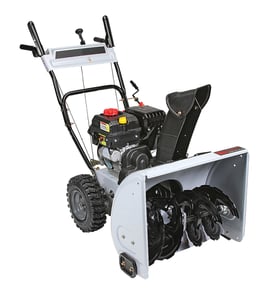




How to find snowblower model number?
On a Craftsman gas snow blower like model 53688521200, the model number is printed on the product ID label. It’s commonly located on the rear of the unit, often between the wheels, and it may also appear in the front pages of the 53688521200 owner's manual.
Where to look on the machine
Check these common label locations first:
- Rear of the snowblower frame, between the wheels
- Side of the frame near the engine mounting area
- Under or behind the top cover/control panel area
- Near the auger housing frame (lower front section)
- On the handle support/frame area
What the model number looks like (and why it matters)
For this Craftsman unit, the manual shows the model format as 536.885212 (often printed with a dot), which corresponds to 53688521200 on parts listings. Using the exact model number helps us match the correct parts diagrams and avoid ordering the wrong scraper, chute, or ignition components.
Quick format guide
| Where you see it | Example | What to do |
|---|---|---|
| ID label on machine | 536.885212 | Write it down exactly as shown |
| Parts lookup/model page | 53688521200 | Use this full number when ordering parts |
| Manual cover pages | 536.885212 | Confirms the correct product family |
Tips to make the label easier to read
- Wipe off snow, salt, and grime; labels get hard to read in winter storage areas.
- Use a flashlight and take a close-up photo; zoom in to confirm digits.
- Copy the full number, including any leading zeros.
Why it matters
The model number is the fastest way to ensure part compatibility for wear items and repairs, such as the scraper 55323MA, belts, ignition switch, and auger components.
Last updated: February 2026
How many years should a snowblower last?
A gas snowblower like the Craftsman 53688521200 lasts 15 to 20 years with normal residential use and consistent maintenance. This model’s manual emphasizes routine tightening, lubrication, seasonal adjustments, and proper storage, which are the biggest factors in reaching that lifespan (or more).
Typical lifespan (what we see most often)
Most homeowners get a long service life when the engine is kept tuned and wear items are replaced on schedule.
| Snowblower type | Typical lifespan | Notes |
|---|---|---|
| Gas (single-stage or two-stage) | 15 to 20 years | Longest overall lifespan with regular tune-ups |
| Electric corded | 10 to 15 years | Fewer engine-related repairs |
| Battery-powered | 8 to 12 years | Tool can last longer; batteries are the main wear item |
What shortens snowblower life fastest
- Storing with old fuel in the tank or carburetor
- Skipping lubrication and seasonal adjustments
- Running the auger with packed ice or debris
- Continuing to use worn parts (belts, scraper, bearings)
- Leaving the machine wet or dirty after use (corrosion)
Maintenance habits that extend life on Craftsman 53688521200
The maintenance schedule and storage steps in the 53688521200 owner’s manual are the best guide for keeping this unit reliable year after year. Focus on these high-impact items:
- Tighten loose screws, nuts, and fasteners regularly
- Lubricate chute control and other lubrication points before storage
- Check the spark plug condition and set the gap to 0.030 in. when replacing
- Inspect the auger and controls after each use; replace worn parts immediately
- Store safely and ventilate; avoid indoor storage with gasoline present
Parts that commonly wear out first
Replacing wear parts on time prevents bigger failures and keeps performance strong.
| Wear area | Common symptom | Example part for this model |
|---|---|---|
| Bottom edge | Poor scraping, leaves snow behind | Scraper 55323MA |
| Auger support | Noise, wobble, vibration | Bearing 577023MA |
| Engine intake | Hard starting, poor running | Filter 394358S |
Why it matters
A snowblower’s “life” is usually determined by fuel-system condition, corrosion, and whether wear items are replaced before they damage larger assemblies. Following the manual’s maintenance and storage steps is what turns a 10-year machine into a 20-year machine.
Last updated: February 2026
Can I use 5W30 instead of SAE 30 in my snowblower?
For the Craftsman gas snow blower model 53688521200, do not use 5W-30 or SAE 30 engine oil in the fuel system. This model uses a 2-cycle engine that requires gasoline pre-mixed with 2-cycle oil at a 40:1 ratio; straight engine oil is not a substitute.
What to use instead (correct fuel and oil)
This snowblower runs on a gas-and-oil mixture for lubrication.
- Mix 40:1 (gasoline:2-cycle oil)
- That equals 3.2 oz of 2-cycle oil per 1 U.S. gallon of gas
- Pre-mix in an approved gas can; do not add straight gas to the tank
- Shake the container before filling the tank
- Use fresh, clean unleaded gasoline
For the exact procedure and the fuel mixture chart, follow the 53688521200 owner's manual.
Quick comparison: 2-cycle mix vs 4-cycle engine oil
| Item | 2-cycle snowblower (53688521200) | 4-cycle small engine (typical) |
|---|---|---|
| Fuel in tank | Gasoline mixed with 2-cycle oil | Straight gasoline |
| Oil type discussed | 2-cycle oil (mix-in) | 5W-30 or SAE 30 (crankcase) |
| Where oil goes | Mixed into fuel | Separate oil fill/drain |
Why this matters
A 2-cycle engine depends on oil mixed into the gasoline to lubricate bearings and other moving parts. Using straight gasoline or the wrong oil approach can quickly cause poor running and internal damage.
Helpful tips while you are fueling
- Fill outdoors and wipe up spills before starting
- Do not overfill; leave space for fuel expansion
- If storing 30+ days, run the engine until the fuel system is empty
- Avoid leaving blended fuel sitting for long periods
Related maintenance parts you may replace
If you are doing seasonal maintenance, these model-matched parts are commonly replaced:
- Filter 394358S (air filter)
- Switch 56992MA (ignition switch)
Last updated: February 2026
Is a 3 stage snow blower better than a 2 stage?
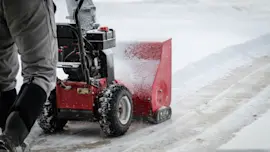
A 3-stage snow blower is better than a 2-stage when you regularly deal with heavy, wet, icy snow or deep end-of-driveway plow piles because it clears faster and resists clogging. For typical snowfall and most driveways, a 2-stage delivers excellent performance with lower cost and simpler maintenance; check your 53688521200 owner's manual for operating and safety basics.
2-stage vs 3-stage: what changes
A 2-stage design uses an auger to pull snow in and an impeller to throw it. A 3-stage adds an accelerator (a fast-spinning “kicker”) between the auger and impeller to move more snow per minute.
What you notice in real use:
- Faster clearing in deep drifts and dense, end-of-driveway snow
- Less bogging down in wet snow
- More moving parts to maintain
Which one is “better” for your driveway
Use this quick checklist to decide:
- Snow type: wet, heavy, icy snow favors 3-stage
- Snow depth: frequent 8+ inch storms favors 3-stage
- Plow berms: frequent tall, compacted piles favors 3-stage
- Driveway size: large areas favor 3-stage speed
- Budget and upkeep: 2-stage is typically the better value
- Storage and maneuvering: 2-stage units are often easier to handle
Quick comparison
| Feature | 2-stage | 3-stage |
|---|---|---|
| Best for | Most homes, moderate snow | Heavy, wet, icy snow and deep drifts |
| Clearing speed | Good | Faster |
| Complexity | Lower | Higher |
| Maintenance | Typically simpler | Typically more involved |
Why it matters
Choosing the right stage helps you clear snow efficiently without overbuying. No matter which style you use, safe operation matters: keep the area clear of debris, and if something jams, shut the engine off and disconnect the spark plug wire before clearing the auger or chute (use a pry bar, not your hands), as outlined in the manual.
Last updated: February 2026