Owner’s manual
 Error Codes



What are the specifications of WRS588FIHW04?
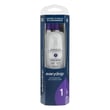
The Whirlpool WRS588FIHW04 is a freestanding, side-by-side refrigerator with a built-in water filtration system that uses Filter 1 (EDR1RXD1) rated for 200 gallons. For exact dimensions, capacity, electrical, and water supply requirements for your unit, use the WRS588FIHW04 owner's manual.
From the model documentation, these specifications are clearly identified:
- Configuration: side-by-side refrigerator
- Installation type: freestanding
- Water filter system: Model P8WB2L (EDR1RXD1, Filter 1)
- Filter capacity: 200 gallons (757 liters)
- Lighting: LED lighting is used on many versions; some LEDs are not user-replaceable
- Water supply requirements and connection steps are included in the manual
Some features and measurements can vary by production version or option package. We recommend confirming these in the manual section for your exact unit:
- Total capacity (cubic feet)
- Overall width, height, and depth (including handles)
- Door swing clearance and leveling details
- Shelf and bin count (the manual notes some counts vary by model)
| Spec area | What to look for | Where to confirm |
|---|---|---|
| Dimensions | Width, height, depth, clearance | WRS588FIHW04 owner's manual |
| Electrical | Voltage, outlet type, grounding | WRS588FIHW04 owner's manual |
| Water | Supply pressure, tubing connection | WRS588FIHW04 owner's manual |
| Filtration | Filter type and capacity | WRS588FIHW04 owner's manual |
Correct specifications help prevent fit issues (cabinet opening and door clearance), reduce installation problems (water line and electrical), and ensure the ice maker and water dispenser perform correctly.
Last updated: February 2026
What's the average lifespan of a Whirlpool refrigerator?
Most Whirlpool refrigerators, including the Whirlpool WRS588FIHW04 side-by-side, typically last 10 to 18 years with normal household use. Consistent care (good airflow, clean condenser area, stable temperatures) is what most often separates a 10-year fridge from an 18-year fridge.
A refrigerator’s life is mainly driven by compressor run time, heat load, and how hard the sealed system has to work.
- Ventilation and placement: keep proper clearance so heat can escape
- Room temperature: extreme heat makes the compressor run longer
- Door seal condition: air leaks cause longer run times and frost issues
- Ice maker and water system health: leaks or restrictions add stress and can cause damage
- Cleaning and care habits: spills, odors, and blocked vents reduce performance
For model-specific care and placement requirements, follow the clearances and maintenance guidance in the WRS588FIHW04 owner's manual.
| Refrigerator age | What’s common | What we recommend |
|---|---|---|
| 0 to 5 years | Minor adjustments, filter changes | Keep airflow clear; verify temps (37°F fresh food, 0°F freezer) |
| 6 to 10 years | Ice maker, fan, door switch wear | Address noises early; check door sealing |
| 11 to 18 years | Higher chance of cooling or defrost issues | Decide repair vs replace based on part cost and condition |
These steps reduce compressor workload and help prevent temperature swings.
- Allow the ventilation space noted in the manual (side/top clearance and rear clearance)
- Keep door gaskets clean and sealing evenly
- Avoid overpacking; don’t block interior air vents
- Keep the unit out of heat sources (oven, direct sun, radiator)
- If ice production slows, troubleshoot the water supply and valve early
If you’re chasing ice or water issues that can shorten component life, the how to prevent water dispenser and ice maker problems guide is a solid checklist.
When a refrigerator runs hot or leaks air, it cycles longer and harder. That extra run time accelerates wear on key components like the compressor, evaporator fan, and ice maker, which directly impacts how long your WRS588FIHW04 lasts.
Last updated: February 2026
What is the most common problem with a Whirlpool refrigerator?
The most common problem we see with Whirlpool refrigerators like model WRS588FIHW04 is a cooling complaint (warm fridge or freezer), often tied to airflow restrictions (dirty condenser coils, blocked vents, frost buildup) or a fan issue. Ice maker and water system problems are also very common.
- Not cooling well: clean condenser coils, confirm vents are not blocked by food, listen for the evaporator fan.
- Frost buildup or warm freezer: check for a door not sealing, frequent door openings, or a defrost drain/defrost issue.
- Ice maker not making ice: confirm ice maker is turned on, water supply is on, and the ice bin is seated correctly.
- Water dispenser slow or no water: purge air after filter changes, confirm household water pressure, check for a frozen water line.
- Water leaks/puddles: look for a clogged defrost drain or a leaking water line/valve.
| Symptom | Most likely cause | Best first step |
|---|---|---|
| Fridge warm, freezer OK | Airflow issue in fresh food section | Clear vents; verify fan airflow |
| Freezer warm, little/no ice | Fan/defrost/door seal issue | Check door seal; look for frost on rear panel |
| No ice, water works | Ice maker off or ice maker fault | Verify shutoff setting; test ice maker |
| No water and no ice | Water supply/valve issue | Check supply valve; inspect inlet valve |
If basic checks do not fix the issue, these model-compatible parts are often involved:
- Ice production problems: Refrigerator ice maker W10873791
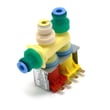
- No water to dispenser or ice maker: Refrigerator water inlet valve WPW10341320
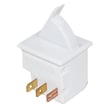
- Door not “telling” the control it is closed (lights, cooling behavior): Refrigerator door switch W11396033
- Airflow noise or poor circulation: evaporator fan area components (for example, the fan blade)
Cooling and airflow problems can quickly lead to food spoilage, and water system issues can cause leaks and ice maker failures. Catching simple causes early (coils, vents, door sealing, water supply) prevents unnecessary part replacement.
For operating and care steps (including vacation settings for the ice maker and water supply shutoff), follow the WRS588FIHW04 owner's manual.
Last updated: February 2026
How do I find the cubic feet of my Whirlpool refrigerator?
For your Whirlpool WRS588FIHW04 side-by-side refrigerator, the cubic feet (total capacity) is listed in the product specifications for that exact model. You can also estimate capacity by measuring the fresh food and freezer interiors and converting cubic inches to cubic feet; see the WRS588FIHW04 owner's manual for where to find the model/serial label and other identification details.
- Match the model number WRS588FIHW04 to the product specifications (most accurate).
- Check the model/serial (rating) label inside the refrigerator compartment.
- Use interior measurements only when you need an estimate.
- Keep in mind that shelves, ducts, and the ice maker reduce usable space compared to “official” capacity.
- Measure the usable interior of the fresh food section: width, height, depth (in inches).
- Measure the usable interior of the freezer section the same way.
- Convert each section to cubic feet, then add them together.
| Measurement | Formula | Notes |
|---|---|---|
| Cubic inches | Width × height × depth | Measure in inches |
| Cubic feet | Cubic inches ÷ 1,728 | 1 ft³ = 1,728 in³ |
Manufacturers publish capacity using standardized methods; your measurement usually comes out lower because it reflects real, usable space after accounting for shelves, drawers, air channels, and the ice maker.
- Measure liner wall-to-wall, not shelf width.
- Measure depth to the back wall, not the front edge of shelves.
- Add fresh food + freezer totals for the best estimate.
Last updated: February 2026