 Error Codes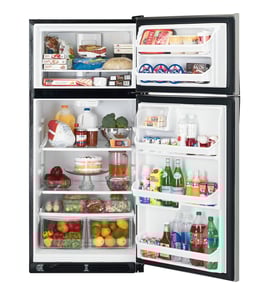

What are the disadvantages of a top mount fridge?
A top-mount refrigerator like the Magic Chef CTF1826ARW is usually affordable and reliable, but the main tradeoff is convenience: fresh-food items sit lower, so you bend more often, and many top-mount designs offer fewer premium features than other layouts.
Common disadvantages (what you will notice day to day)
- More bending for fresh food: the refrigerator section is below the freezer, so you reach down more for produce, drinks, and leftovers.
- Less “eye-level” organization: shelves and crisper drawers can feel less accessible than in bottom-freezer models.
- Fewer built-in dispenser options: many top-mount models do not include an external ice or water dispenser.
- Smaller freezer usability: the top freezer can be narrower and more “stacking dependent,” which makes it harder to keep organized.
- Door-swing clearance: in tight kitchens, the door swing can limit access to drawers and shelves.
Quick comparison: top mount vs. bottom freezer
| Feature | Top mount (like CTF1826ARW) | Bottom freezer |
|---|---|---|
| Fresh food access | Lower, more bending | Higher, easier access |
| Freezer access | Easy, at chest/eye level | Lower, more bending |
| Typical price | Lower | Higher |
| Premium features | Less common | More common |
Why it matters
Most households use the fresh-food compartment far more than the freezer. If you are in and out of the refrigerator all day, the top-mount layout can feel less comfortable over time, especially for taller users or anyone with back or knee strain.
Helpful tips to reduce the downsides
- Keep everyday items on the upper refrigerator shelves to reduce bending.
- Use clear bins to group snacks, lunch items, and condiments.
- Avoid overpacking the freezer; stack flat items and label bags.
- If odors build up faster due to tighter organization, follow how to get rid of refrigerator smells.
Last updated: January 2026
What is the life expectancy of a top freezer refrigerator?
A top-freezer (top-mount) refrigerator like the Magic Chef CTF1826ARW typically lasts 10 to 15 years. With steady maintenance (clean condenser coils, good door gasket seal, stable temperatures), it commonly reaches the upper end of that range.
Typical lifespan and what affects it
Most top-freezer refrigerators are among the longest-lasting styles because they use a simpler cooling layout than many premium designs.
- Typical life expectancy: 10 to 15 years
- Often achievable with good care: 13 to 17 years
- Shortens lifespan fastest: dirty condenser coils, poor airflow, and door seal leaks
- Big wear items: evaporator fan motor, defrost system components, thermostat/thermistor, door gaskets
Maintenance checklist to help it last longer
Use this routine to reduce compressor run time and prevent warm spots, frost buildup, and food spoilage.
- Vacuum and brush condenser coils (commonly every 6 to 12 months)
- Keep 2 to 3 inches of clearance behind the cabinet for airflow
- Clean and inspect door gaskets; replace if torn or not sealing
- Keep freezer vents clear; avoid blocking airflow with packages
- Set temperatures to typical targets: 0°F freezer and 37°F to 40°F fresh food
Quick “is it worth repairing?” guide
| If the refrigerator is… | Usually makes sense to… |
|---|---|
| Under 8 years old | Repair most common failures |
| 8 to 12 years old | Repair if the issue is a fan, gasket, or defrost problem |
| Over 12 to 15 years old | Compare repair cost vs. replacement value |
Why it matters
Knowing the expected lifespan helps us decide when maintenance will pay off (coils, seals, airflow) versus when repeated cooling or defrost failures point to end-of-life planning.
For related maintenance that can reduce strain on the cooling system, use our guide: how to use your refrigerator efficiently.
Last updated: January 2026
Are top mount or bottom mount fridges better?
Top-mount and bottom-mount refrigerators can both be “better”, it depends on how you use your fridge. For the Magic Chef CTF1826ARW top-mount style, you typically get a simpler layout and often lower energy use, but you bend more to reach fresh-food items.
Quick comparison
| Feature | Top-mount (freezer on top) | Bottom-mount (freezer on bottom) |
|---|---|---|
| Fresh-food access | Lower, more bending | Higher, easier on back/knees |
| Freezer access | Eye to chest level | Lower, often drawer-style |
| Typical cost | Usually lower | Usually higher |
| Complexity | Often simpler | Often more features/parts |
| Energy use | Often slightly lower | Often slightly higher |
When a top-mount is the better choice
A top-mount refrigerator like the Magic Chef CTF1826ARW is usually the better fit when you want straightforward cooling, fewer “extras”, and good value.
- You use the freezer frequently (it’s easier to see and reach)
- You want a simpler design that’s often easier to maintain
- You are replacing an older top-mount and want a similar fit and feel
- You prefer a lower purchase price over premium features
- You have limited kitchen space and want a classic door swing layout
When a bottom-mount is the better choice
Bottom-mount models are usually the better fit when fresh-food convenience is the priority.
- You cook often and access the refrigerator section many times per day
- You want less bending for produce, drinks, and leftovers
- You like freezer drawers and better organization for frozen foods
- You want more modern features (varies by model)
Why it matters
The “best” fridge style is the one that matches your daily habits. If you open the refrigerator door far more than the freezer, a bottom-mount can feel more comfortable. If you want a simpler, value-focused design, a top-mount like the CTF1826ARW is often the practical choice.
Helpful DIY resources
- How to use your refrigerator efficiently
- How to fix a fridge door seal
- How to get rid of refrigerator puddles
Last updated: January 2026
What are the common problems with Magic Chef mini fridges?
Magic Chef mini fridges most commonly have temperature problems (not cooling enough or freezing items), water pooling, frost buildup, and noise or vibration. The same symptom categories can also show up on the Magic Chef CTF1826ARW top-mount refrigerator, but mini fridges are more sensitive to room temperature, ventilation, and door sealing.
Common mini fridge problems and what usually causes them
- Not cooling or weak cooling: dusty condenser area, poor ventilation around the cabinet, thermostat/control issues, or a sealed-system/compressor problem
- Freezing in the fresh-food area: control set too cold, items blocking airflow, or a temperature sensor/control problem
- Runs all the time: warm room, frequent door openings, weak door gasket seal, or restricted airflow around the unit
- Water pooling inside: defrost drain restriction (models with auto-defrost), or heavy humidity and frequent openings
- Rattling, buzzing, clicking: unit not level, tubing/pan vibration, fan noise (if equipped), or start device clicking
Quick checks we recommend (10 to 20 minutes)
- Leave 2 to 4 inches of clearance around the sides and back for airflow.
- Set a normal starting point: 37°F fridge and 0°F freezer (if your unit has a freezer section).
- Clean dust from the condenser area (often underneath or behind the unit).
- Check the door gasket for gaps; close a paper strip in the door and confirm it grips all around.
- Keep food from blocking interior vents and the cold-air outlet.
Mini fridge vs top-mount (like CTF1826ARW): what changes
| Topic | Mini fridge (compact) | Top-mount like CTF1826ARW |
|---|---|---|
| Ventilation impact | Very high; tight spaces cause warm temps | High; still needs airflow but larger condenser area |
| Temperature swings | More noticeable with door openings | Typically steadier with more insulation and airflow paths |
| Frost and water issues | Often from humidity and door sealing | Often tied to defrost drain, door seal, or airflow restrictions |
Why it matters
Most “not cold” and “freezing” complaints come from airflow and sealing problems. Fixing ventilation, cleaning the condenser area, and correcting door gasket leaks reduces run time, prevents food spoilage, and limits frost buildup.
Related DIY help
- Use how to fix your evaporator cooling fan if you hear fan noise, airflow is weak, or temperatures are uneven.
Last updated: January 2026





