
What is the 4 inch rule for drill press?
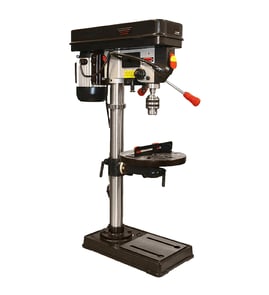
The 4-inch rule for a drill press is a safety best practice: we keep our hands and fingers at least 4 inches away from the rotating drill bit and cutting area. On a Craftsman drill press stand model 33525982, this helps prevent slips, grabs, and contact injuries.
What the rule means in real use
Use the rule any time the bit is spinning or the workpiece could shift.
- Keep hands 4 inches or more from the bit, chuck, and rotating work
- Clamp the workpiece; do not “hand-hold” small stock
- Use a vise or drill press clamps for round, short, or narrow pieces
- Remove the chuck key before turning the tool on
- Stop the spindle completely before clearing chips or measuring
How to keep your hands 4 inches away
These habits make the 4-inch rule easy to follow:
- Position a drill press vise so your hands stay on the vise handle, not near the bit
- Use a scrap backer board to reduce tear-out and sudden grabbing
- Set the table height so you are not reaching under the bit
- Use a brush or chip hook to clear swarf (never your fingers)
- Tie back hair, avoid gloves near rotating parts, and secure loose sleeves
Quick guide: safer holding methods
| Task | Risk if hand-held | Better option |
|---|---|---|
| Small parts drilling | Part spins and pulls fingers in | Vise + clamp |
| Round stock drilling | Stock rolls and “catches” | V-block in a vise |
| Thin sheet drilling | Sheet lifts and cuts hands | Clamp to backer board |
Why it matters
A drill bit can grab the workpiece instantly, especially with larger bits, dull bits, or high feed pressure. Keeping a 4-inch buffer and using clamps reduces the chance of the workpiece spinning, breaking bits, and causing hand injuries.
Related DIY help
For general electrical safety checks on powered tools and cords, we use how to use a multimeter to test electrical parts video.
Last updated: February 2026
What are the slots on a drill press base for?
The slots on the base of a Craftsman drill press stand model 33525982 are clamping and mounting slots (often T-slots). We use them to bolt the drill press down to a bench or to clamp large or awkward workpieces directly to the base when the table is moved out of the way.
What you can do with the base slots
- Bolt the drill press to a stand or bench for stability and reduced vibration.
- Clamp a workpiece to the base when it is too tall or wide for the table.
- Use step blocks and strap clamps to hold irregular shapes securely.
- Mount a drill press vise or fixture plate (when the table is removed or swung aside).
- Add stops or jigs for repeatable hole spacing.
Common setups (quick comparison)
| Setup | When it helps | What you gain |
|---|---|---|
| Bolting the base down | Any drilling, especially larger bits | Less walking, less chatter, better accuracy |
| Clamping to the base | Tall work, long stock, table clearance issues | More vertical clearance under the chuck |
| Fixture plate on base | Repetitive drilling | Faster positioning and consistent results |
Why it matters
Using the base slots correctly improves safety and accuracy. A secured drill press and a firmly clamped workpiece reduce spinning, grabbing, and bit breakage, which also helps protect the quill, chuck, and bearings.
Safety and best practices
- Unplug the drill press before changing setups, bits, or clamps.
- Keep clamps and bolt heads clear of the bit path and rotating chuck.
- Use a backing board under the workpiece to reduce tear-out.
- Clamp the work; do not hold it by hand.
- If the workpiece rocks, shim it flat before tightening clamps.
For general DIY safety and setup habits that apply to shop tools, we recommend reviewing are diy appliance repairs safe.
Last updated: February 2026
What is a good horsepower for a drill press?
A good horsepower (HP) for a drill press depends on the hole size, material, and bit type you plan to use. For most home-shop drilling on wood and light metal, we recommend about 1/2 to 3/4 HP; for frequent larger holes in steel, 1 to 1-1/2 HP is the practical step up.
Quick horsepower guide (what we recommend)
- 1/4 to 1/3 HP: light-duty work (small bits, softwood, plastics)
- 1/2 HP: general DIY drilling; good all-around choice for most users
- 3/4 HP: better torque for larger bits, Forstner bits, hole saws, and mild steel
- 1 to 1-1/2 HP: frequent metal drilling, larger diameters, tougher alloys
- 2+ HP: heavy-duty production work; often paired with industrial machines
What matters more than HP (especially on a stand setup)
Because the Craftsman 33525982 is a drill press stand, the “right HP” is really about the drill you mount and how you use it. These factors often matter as much as motor size:
- Low-speed capability (torque comes from slower RPM with the right bit)
- Sharp bits (dull bits make any motor feel underpowered)
- Proper feed pressure (steady pressure, no forcing)
- Workholding (vise or clamps to prevent grabbing and spinning)
- Bit choice (step bits, brad-point, Forstner, hole saws all load differently)
Simple selection table
| Your typical work | Recommended HP | Notes |
|---|---|---|
| Small holes in wood/plastic | 1/4 to 1/3 | Prioritize speed control and sharp bits |
| General DIY (wood, aluminum, light steel) | 1/2 to 3/4 | Best balance of power and control |
| Larger holes in steel, frequent use | 1 to 1-1/2 | Choose lower RPM options and quality bits |
Why it matters
Choosing enough HP helps prevent stalling, overheating, and rough holes. Just as important, matching speed and bit type to the material reduces grabbing and improves accuracy, which is critical on any drill press stand.
Related DIY reading
Last updated: February 2026
How to repair a drill press spindle?
On the Craftsman 33525982 drill press stand, spindle repair typically means removing the quill assembly, inspecting the spindle and bearings, then replacing worn bearings or the spindle so the chuck runs true again. This job requires careful alignment and safe handling of press-fit parts.
Before you start (safety and setup)
- Unplug the drill press and remove the chuck and bit.
- Lower the table or remove it for working room.
- Mark the depth stop and return spring housing positions so you can reassemble consistently.
- Take photos as you go; small washers and spacers must go back in the same order.
- If the spindle is bent or the taper is damaged, plan on replacing the spindle, not just the bearings.
Spindle repair steps (typical process)
- Remove the belt cover and release belt tension; slip the belt off the pulleys.
- Remove the return spring tension (control the spring so it does not snap back).
- Remove the quill retaining hardware (often a retaining ring or collar, depending on design).
- Slide the quill out of the head.
- Separate the spindle from the quill (usually by driving the spindle out with a soft mallet and proper support).
- Remove and replace spindle bearings (use an arbor press or bearing puller as needed).
- Reinstall the spindle into the quill, reinstall the quill, then reset spring tension and belt tension.
What to inspect while it’s apart
- Bearings: roughness, play, noise, heat discoloration
- Spindle taper: scoring, rust, wobble at the chuck mount
- Quill bore: wear or galling that causes side-to-side movement
- Pulley and keyway: looseness that mimics spindle wobble
Quick symptom-to-cause guide
| Symptom | Most common cause | Typical fix |
|---|---|---|
| Chuck wobble | bent spindle or worn bearings | replace spindle and/or bearings |
| Grinding noise | failing bearings | replace bearings |
| Quill won’t return | return spring mis-set or damaged | reset/replace spring |
| Runout changes with belt tension | pulley/belt issue | replace belt or tighten pulley |
Why it matters
A worn spindle or bearing set increases runout, overheats the quill, and makes accurate drilling difficult. Fixing the spindle restores smooth feed, safer operation, and cleaner holes in wood or metal.
For tool and test basics that help during teardown and reassembly, we recommend must have tools for appliance repair.
Last updated: February 2026
How much does a Craftsman 33525982 drill press weigh?
The Craftsman 33525982 listing is for a drill press stand/parts model, and the assembled weight depends on the exact drill press configuration (bench vs. floor style, motor size, and castings). Most drill presses with a stand fall in a broad 50 to 200 lb range; weigh your unit for an exact number.
Best way to get the exact weight (at home)
Use one of these methods to get a reliable number for moving, shipping, or a lift gate.
- Bathroom scale method: weigh yourself, then weigh yourself holding a removed component; subtract.
- Component method: remove the head, table, and base (if possible) and weigh each piece separately.
- Hanging scale method: sling one component at a time and lift just enough to read the scale.
- Crate method: if it is boxed, weigh the boxed unit, then subtract packaging weight.
Typical weight ranges (planning numbers)
Use these ranges for planning only; your exact weight depends on whether your setup is benchtop or floor-standing.
| Drill press type | Typical assembled weight | What drives the weight |
|---|---|---|
| Benchtop drill press | 40 to 90 lb | Smaller base and motor |
| Floor drill press with stand | 90 to 200 lb | Larger base/column and heavier head |
Safe moving and setup tips
Weight affects tipping risk and injury risk, especially with a top-heavy head and column.
- Plan on two-person lifting for the head/motor assembly.
- Remove the table and head first to reduce top-heavy tipping.
- Keep the column upright during transport.
- Use a dolly/hand truck and secure the load with straps.
- Set the base on a level surface and tighten all fasteners before use.
Why it matters
Knowing the real weight helps you choose the right moving method, prevents tip-overs, and improves stability and drilling accuracy once installed.
If you need to confirm you are matching parts to the correct Craftsman model number, use how to find your appliance model number (and what it means for parts).
Last updated: February 2026