Installation guide
 Owner’s manual
 Error Codes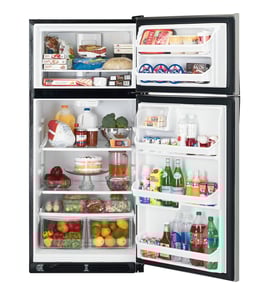

What are the disadvantages of a top mount fridge?
A top-mount refrigerator like the Frigidaire FFHT1826LWB typically costs less and is reliable, but the main tradeoffs are convenience and features: you bend more to reach fresh food, freezer space can be less organized, and dispenser options are often limited compared to other styles.
- Less convenient fresh-food access: the refrigerator compartment is lower, so you reach down more often.
- Freezer organization can be basic: many top-mount freezers have fewer built-in dividers, bins, or pull-out drawers than bottom-mount designs.
- Fewer premium features: external water and ice dispensers are less common on top-mount models.
- More temperature swings with frequent freezer use: opening the top freezer often can let warm air in, which can affect frost buildup and recovery time.
- Door clearance needs: if the hinge side is near a wall, you may need extra space to open the door wider.
We recommend these practical steps to make a top-mount layout work better day to day:
- Keep everyday items at eye level on the main shelves; store rarely used items in lower bins.
- Use the crisper area for heavier produce to avoid overloading door bins.
- Make sure the cabinet is properly leveled so doors close easily and seal well.
- Leave proper airflow clearance around the refrigerator for steady cooling.
- If your model has an ice maker but no water hookup yet, keep the ice maker turned OFF until water is connected.
| Feature | Top mount (FFHT1826LWB style) | Bottom mount |
|---|---|---|
| Fresh-food access | Lower, more bending | Higher, easier access |
| Freezer access | Eye level | Lower drawer |
| Typical features | Simpler, fewer dispenser options | More feature-heavy |
| Cost and complexity | Usually lower | Usually higher |
Most “disadvantages” come down to ergonomics and organization. If you shop the refrigerator section more than the freezer, a bottom-mount can feel easier. If you want simpler ownership and value, a top-mount like the FFHT1826LWB is often a strong fit.
For model-specific setup details like leveling, clearances, and ice maker water-supply guidance, use the FFHT1826LWB owner’s manual.
Last updated: January 2026
Are top mount or bottom mount fridges better?
Top-mount and bottom-mount refrigerators are both good choices; the better option depends on how you use your kitchen. For a Frigidaire top-mount like model FFHT1826LWB, you typically get simpler design and strong efficiency, while bottom-mount models usually put fresh food at eye level for easier daily access.
| Feature | Top-mount (freezer on top) | Bottom-mount (freezer on bottom) |
|---|---|---|
| Fresh food access | Lower, more bending | Higher, less bending |
| Freezer access | Easier, at chest level | Lower, more bending |
| Typical efficiency | Often very good | Often slightly higher use |
| Complexity | Usually simpler | Often more features |
| Cost | Often lower | Often higher |
A top-mount refrigerator is usually the best fit when you want straightforward cooling, fewer features to maintain, and a layout that works well in smaller kitchens.
- You want a simpler refrigerator design with fewer components
- You use the freezer frequently (frozen foods, ice trays, bulk storage)
- You want strong day-to-day efficiency and lower operating cost
- You prefer easier access to the freezer without crouching
- You want a layout that is typically easier to level and keep doors closing properly
A bottom-mount refrigerator is usually the best fit when you spend most of your time in the fresh-food section.
- You cook often and want fresh food at eye level
- You have back or knee discomfort and want less bending for daily items
- You store lots of produce, drinks, and leftovers in the refrigerator section
- You do not access the freezer as often
Even the “better” style can feel worse if it is installed poorly. For FFHT1826LWB, proper clearances and leveling help the doors close correctly and help the unit cool efficiently.
- Leave about 3/8 inch at the sides and top, and about 1 inch at the back for airflow
- Level the cabinet so doors close freely; the refrigerator should slope slightly from front to back
- Avoid blocking the toe grille area so air can circulate
Choosing the right mount style affects comfort (how often you bend), food organization, and long-term operating cost. Installation basics like leveling and airflow clearances can make a noticeable difference in temperature stability and door sealing.
For model-specific setup guidance, use the FFHT1826LWB owner’s manual and the FFHT1826LWB installation guide.
Last updated: January 2026
What is the most common problem with a Frigidaire refrigerator?
Cooling complaints are the most common issue we see with Frigidaire refrigerators like model FFHT1826LWB, including “not cold enough,” warm fresh food, or a freezer that is too warm. Many of these problems trace back to airflow restrictions, temperature control settings, or door sealing issues.
- Confirm the refrigerator is plugged in firmly and the outlet has power.
- Make sure the temperature control is not set to “0” (off).
- Wait 20 minutes and recheck if the unit is in a defrost cycle.
- Allow 24 hours after any control change for temperatures to stabilize.
- Verify doors close fully and nothing is blocking vents inside.
If basic checks do not help, these parts are frequent suspects on top-mount refrigerators:
| Symptom | Common cause | Example part for FFHT1826LWB |
|---|---|---|
| Warm refrigerator section, freezer seems OK | Weak airflow in the fresh food section | Evaporator fan blade issues (inspect for damage/ice) using refrigerator evaporator fan blade 5308000010 |
| Frost buildup on rear freezer panel, warming temps | Defrost system problem | Defrost heater or defrost thermostat such as refrigerator defrost heater 242044008 |
| Moisture, warm temps, or long run times | Air leak at the door | Door gasket problems (match color) such as Frigidaire refrigerator door gasket (white) 242193206 |
If your FFHT1826LWB has electronic controls and is showing an error, use Frigidaire refrigerator error codes to narrow the problem to a sensor, fan, or control-related issue before replacing parts.
A refrigerator that cannot move air correctly or seal the doors will run longer, struggle to hold safe food temperatures, and can lead to frost buildup that makes cooling even worse.
For the exact control style (electronic vs. mechanical), recommended temperature settings, and operating notes for FFHT1826LWB, follow the instructions in the FFHT1826LWB owner's manual.
Last updated: January 2026
Why is my Frigidaire top mount freezer not freezing?
If your Frigidaire FFHT1826LWB top-mount freezer is not freezing, the most common causes are incorrect temperature control settings, poor airflow from a failed evaporator fan, heavy frost from a defrost problem, or warm air leaking past the door gasket. Use the checks below to pinpoint the issue quickly using the FFHT1826LWB owner's manual.
- Confirm the refrigerator/freezer control is not set to “0”; “0” turns off the compressor (cooling stops).
- Give temperatures time to stabilize after changes; allow about 24 hours after adjusting controls.
- Make sure the freezer door closes fully and nothing is holding it open.
- Listen for the evaporator fan in the freezer; if it is not running, cold air will not circulate.
- Check for heavy frost on the freezer back wall; that often points to a defrost system issue.
| Symptom | Most likely cause | What to do first |
|---|---|---|
| Freezer warm, fridge also warm | Cooling system not running or poor heat removal | Verify control not at “0”; clean condenser area; confirm condenser fan runs |
| Freezer warm, fridge somewhat cool | Airflow problem in freezer | Check evaporator fan operation; clear blocked vents |
| Frost/ice buildup on freezer panel | Defrost problem | Inspect defrost components; consider the refrigerator defrost heater 242044008 and refrigerator defrost bi-metal thermostat 5303918634 |
| Frost around door edge, moisture | Door not sealing | Inspect gasket for gaps/tears; warm and reshape gasket if warped |
These are model-matched parts that often come up during diagnosis on FFHT1826LWB:
- Refrigerator evaporator fan blade 5308000010 (if the fan is noisy, broken, or not moving air)
- Refrigerator defrost heater 242044008 (if frost blocks airflow)
- Refrigerator defrost bi-metal thermostat 5303918634 (if defrost heat is not being controlled correctly)
- Frigidaire refrigerator door gasket (white) 242193206 or Frigidaire refrigerator door gasket (black) 242193212 (if warm air leaks in)
A freezer that cannot reach freezing temperatures usually fails for one of two reasons: the sealed system is not removing heat effectively, or cold air cannot circulate because frost or a fan/airflow issue is blocking it. Catching the cause early helps prevent food spoilage and reduces compressor run time.
Last updated: January 2026