Owner’s manual
 Error Codes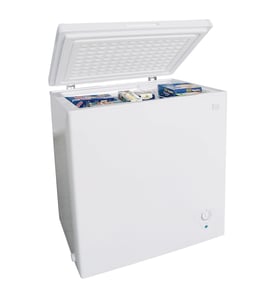




How often should you defrost a chest freezer?
For the GE FCM11PHBWW chest freezer, defrosting is typically needed about twice a year, and you should not let frost build up beyond about 1/2 inch for best efficiency. Follow the step-by-step defrosting directions in the FCM11PHBWW owner's manual.
Recommended defrost schedule
We use two simple rules for manual-defrost chest freezers like this GE model:
- Plan to defrost about every 6 months in most climates
- Defrost sooner if frost reaches about 1/2 inch (13 mm)
- Defrost before long trips or heavy seasonal use (so it runs efficiently)
- If the lid is opened frequently, expect to defrost more often
Quick defrost checklist (safe method)
Use this approach to protect the liner, lid gasket, and drain system:
- Turn the temperature control to OFF and unplug the freezer
- Move food to coolers or insulated bags
- Leave the lid open; place pans of hot water inside to loosen frost
- Remove large frost pieces before they melt
- Use the front defrost drain and sponge up water to prevent overflow
- Reinstall the drain plug and cap, then restart and return food
What to use (and what to avoid)
| Task | Use | Avoid |
|---|---|---|
| Scraping frost | Plastic or wood spatula | Ice pick, knife, sharp tools |
| Speeding defrost | Pans of hot water | Any electrical device (heater, hair dryer) |
| Cleaning after defrost | Warm water plus baking soda solution | Abrasives, scouring pads, bleach cleaners |
Why it matters
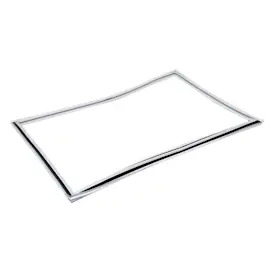
Keeping frost below about 1/2 inch helps the GE FCM11PHBWW cool more efficiently, preserves storage space, and reduces run time. It also helps the lid seal do its job; if your gasket is torn or not sealing, frost can build faster (the door seal WR24X21277 is the lid gasket used to keep warm air out).
Last updated: January 2026
What temperature should a chest freezer be set at?
For the GE FCM11PHBWW chest freezer, we recommend keeping food storage at 0°F (-18°C) or colder. On this model, the temperature control is a 1 to 7 scale (7 is coldest); start at the factory-recommended setting 4, then fine-tune one step at a time using the FCM11PHBWW owner's manual.
Recommended setting and how to adjust it
The control on the FCM11PHBWW is numbered, not a direct temperature display. Use this approach:
- Start at 4 for normal household use.
- Wait several hours after each one-step change for temperatures to stabilize.
- Turn the control one step colder if foods feel soft or ice cream is too easy to scoop.
- Turn the control one step warmer if items are rock-hard and you want slightly less aggressive freezing.
- Keep the lid closed as much as possible; frequent openings warm the cabinet.
Quick temperature targets
| What you want | Target temperature | What to change |
|---|---|---|
| Safe long-term storage | 0°F (-18°C) or colder | Adjust toward colder if above 0°F |
| Faster pull-down after loading | Colder than normal temporarily | Return to normal after stabilized |
| Reduce frost and temperature swings | Stable 0°F | Open lid less, adjust slowly |
Common reasons your setting needs to change
These factors often require a small adjustment even when the control is working correctly:
- Freezer placed where room temperature is very hot or very cold
- Large amount of unfrozen food added at once
- Lid not sealing tightly (warm air leaks in)
- Too-frequent lid openings
- Frost buildup reducing efficiency
Why it matters
Keeping the freezer at 0°F or below slows bacterial growth and helps prevent quality loss (texture changes and freezer burn). Small, slow adjustments also prevent overcorrecting and chasing temperature swings.
Last updated: January 2026
Why is my GE chest freezer not cooling?
If your GE FCM11PHBWW chest freezer is not cooling, the most common causes are the temperature control being set to OFF, a power problem at the outlet, the lid not sealing fully, or restricted airflow around the cabinet. We recommend following the checks in the FCM11PHBWW owner's manual first.
Quick checks we recommend (in order)
- Confirm the temperature control is not set to OFF; move it to a colder setting.
- Make sure the freezer is fully plugged in and the outlet has power (reset the breaker or replace the fuse if needed).
- Check that no package is holding the lid open, even slightly.
- Look for excessive frost buildup; heavy frost can reduce cooling performance.
- Verify there is adequate space around the cabinet for air circulation.
- After changes, allow several hours for temperatures to stabilize.
Lid seal and frost: the most common cooling killers
A chest freezer that “runs but won’t get cold” often has warm air leaking in through the lid gasket or from the lid being held open by food packages. If the gasket is torn, hardened, or not sealing evenly, replacing the door seal WR24X21277 restores proper sealing and helps the freezer pull down to temperature.
Defrosting guidance (when frost is heavy)
The manual recommends defrosting before frost exceeds about 1/2 inch. Use a plastic or wood scraper; do not use sharp tools or electrical devices during defrosting. Chest models also use a front drain to manage defrost water.
What to check based on what you observe
| What you notice | Most likely cause | What to do next |
|---|---|---|
| No lights, no sound | No power or control set to OFF | Check control setting, outlet power, breaker/fuse |
| Runs a lot, still warm | Lid not sealing or opened too often | Inspect gasket, remove obstructions, limit openings |
| Frost buildup | Lid leak or frequent openings | Defrost, then recheck lid seal |
| Runs long cycles | Poor airflow around cabinet | Improve clearance around the freezer |
Why it matters
When warm, humid air leaks into a chest freezer, it creates frost and forces the compressor to run longer. Fixing sealing, airflow, and defrost issues typically restores normal cooling and reduces energy use.
Last updated: January 2026