Owner’s manual
 View engine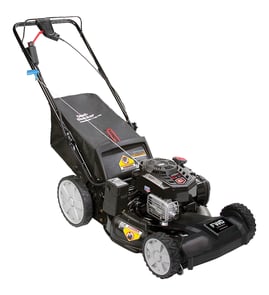




What model number is the Craftsman 917377891?
The model number for this Craftsman walk-behind gas lawn mower is 917.377891 (often written without the dot as 917377891). You’ll see it printed on the mower’s model tag and on the cover of the 917377891 owner's manual.
Where to find the model number on the mower
We recommend confirming the model number directly from the mower’s identification label before ordering parts like a blade, drive control, or wheel components.
- Check the rear of the deck near the discharge opening or rear door area
- Look around the handle bracket area
- Wipe dirt and grass residue off the label so all digits are readable
- Record the full model number exactly (including the dot, if shown)
- If the label is damaged, match parts using the exploded views in the 917377891 owner's manual
Why the dot matters (and when it doesn’t)
Both formats typically refer to the same mower; parts lookup systems may display it one way or the other.
| You see this | It means | Use it when |
|---|---|---|
| 917.377891 | Same model number with a dot | Reading the mower label or manual cover |
| 917377891 | Same model number without a dot | Searching parts diagrams and parts lists |
Why it matters
Craftsman model numbers are the fastest way to get the right parts the first time. For example, the parts list for model 917.377891 includes items like the 21-inch blade and drive system components; using the exact model number prevents ordering a similar-looking part that won’t fit.
Last updated: January 2026
Should I use 87 or 91 gas for lawn mower?
For the Craftsman lawn mower model 917377891, we recommend using fresh 87-octane (regular) unleaded gasoline for normal mowing. Higher octane (like 91) is not required for performance; what matters most is clean, fresh fuel stored properly and not carried over from season to season.
Best fuel choice for this mower
- Use 87 octane unleaded from a busy station (fresher fuel turnover).
- Avoid using old fuel; stale gas is a common no-start and rough-running cause.
- Keep fuel containers clean and rust-free; rust and dirt in the gas can cause problems.
- If the mower will sit for weeks, treat fuel with stabilizer and follow storage steps in the 917377891 owner's manual.
When 91 octane makes sense (and when it does not)
91 octane is mainly for engines designed for higher compression. Most walk-behind mower engines run correctly on 87.
| Fuel choice | Use it when | What you gain |
|---|---|---|
| 87 octane (regular) | Everyday mowing | Correct operation for typical mower engines |
| 91 octane (premium) | Only if your engine label/manual specifically calls for it | Usually no measurable benefit |
| Fresh fuel + stabilizer | Storage, seasonal equipment | Fewer starting and carburetor issues |
Quick checks if you suspect fuel-related problems
If your mower is hard to start, surges, or loses power, fuel quality is one of the first things we check.
- Drain and replace with fresh 87 octane
- Inspect the gas can for rust, dirt, or water contamination
- Check the air filter and spark plug condition
- Review the troubleshooting section in the 917377891 owner's manual
Why it matters
Using the right fuel helps prevent stale-fuel starting problems, reduces deposits in the fuel system, and supports reliable performance. The manual also emphasizes not storing gasoline from one season to the next, which is often the real cause behind “bad gas” symptoms.
Last updated: January 2026
Where can I find my lawn mower engine model number?
On Craftsman walk-behind mower model 917377891, the mower’s model and serial numbers are on a decal on the rear of the lawn mower housing. For the engine model number, check the engine itself; it’s typically printed on a label or stamped into the blower housing or valve cover area. See the 917377891 owner's manual for the mower decal location.
Where to look on the engine
Engine ID labels are usually on a flat, easy-to-clean surface. Check these common spots first:
- Top of the engine shroud (blower housing)
- Valve cover area (often on the side of the engine)
- Near the muffler heat shield (look for a sticker or stamped pad)
- Above or behind the air filter housing
- On the recoil starter housing (pull-start assembly)
Quick steps to find it fast
- Turn the mower off and let the engine cool completely.
- Wipe dirt and grass off the engine with a rag (labels hide under buildup).
- Use a flashlight and look for a sticker with MODEL / TYPE / CODE or a stamped metal pad.
- Write the numbers down exactly as shown (include dashes and all digits).
Mower model vs. engine model (what’s the difference?)
| What you’re identifying | Where it’s found | What it’s used for |
|---|---|---|
| Mower model/serial (917377891) | Rear housing decal | Correct Craftsman chassis, deck, wheels, drive parts |
| Engine model/type/code | On the engine label or stamp | Correct carburetor, ignition parts, filters, engine gaskets |
Why it matters
The mower model number (917377891) helps us match walk-behind mower parts like the drive control, wheels, and blade hardware. The engine model number is what you use to match engine-specific parts like spark plugs, air filters, and carburetor components.
Last updated: January 2026
Is it cheaper to repair or replace a lawn mower?
For a Craftsman walk-behind mower like model 917377891, it’s usually cheaper to repair when the problem is routine maintenance or a small wear item, but it’s usually cheaper to replace when the engine or drive system needs major work and the repair cost approaches about half the price of a comparable new mower. Use the 917377891 owner's manual to match symptoms to the right fix.
A quick way to decide
- Repair if it’s a tune-up issue (blade, spark plug, air filter, cleaning under the deck).
- Repair if the mower still starts easily and cuts well after basic maintenance.
- Replace if the engine has low compression, heavy smoking, or repeated no-start after fuel and ignition checks.
- Replace if the self-propel/drive system needs major service and you’re paying for labor.
- Replace if the deck is rusted through or the crankshaft is bent (often from impacts).
Typical cost comparison (rule-of-thumb)
| Situation | Typical best choice | Why |
|---|---|---|
| Blade is dull/bent, mower vibrates | Repair | A blade swap is straightforward and restores cut quality |
| Wheels bind up from grass/debris | Repair | Cleaning the drive wheel area is low-cost and common |
| Suspected drive belt or carburetor problems | Often replace (or pro repair) | The manual directs belt/carburetor concerns to a qualified service center; labor can add up |
| Engine runs poorly even after tune-up | Often replace | Major engine work can exceed the mower’s value |
Model-specific notes that affect the decision
The 917377891 manual emphasizes regular maintenance (spark plug, air filter, blade condition) and notes that drive belt and carburetor concerns are typically handled by a qualified service center. That means “big” repairs can quickly become labor-heavy compared to the value of an older walk-behind mower.
If you choose to repair: high-impact, low-cost fixes
- Keep the blade sharp and replace a bent blade; consider the lawn mower blade 532180459 if you need the correct replacement.
- Clean debris from the rear drive wheels so they turn freely.
- Follow the seasonal maintenance schedule (spark plug, air filter, lubrication).
- Store fuel properly and prep for off-season storage.
Why it matters
Repairing the right item first prevents repeat failures and protects the engine and drive system. A simple blade or wheel cleanup can restore performance, while major drive or engine work often pushes total cost into “replace” territory.
Last updated: January 2026