Owner’s manual
 Error Codes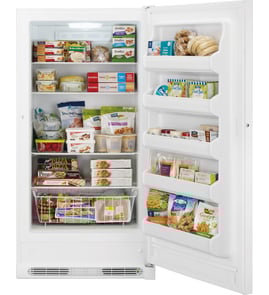


Does a Kenmore freezer have a reset button?
Kenmore Elite freezer model 25328093803 does not use a dedicated “reset button” for normal operation. If you need to clear an alarm or recover after a power interruption, use the Alarm Reset function on the control panel and confirm the temperature setting in the 25328093803 use and care guide.
What you can reset on this model
On this Kenmore upright freezer, “reset” usually means resetting an alarm condition or restoring normal control operation.
- Silence/clear the Hi Temp alarm: press Alarm Reset to silence the buzzer.
- Lock/unlock the controls (to prevent accidental changes): press and hold Alarm Reset for about 3 seconds.
- Turn the freezer OFF/ON at the control: press DOWN until the display shows 0 (OFF); press UP until it shows 4 or your desired setting.
Quick reset checklist (safe, no tools)
- Make sure the display is not set to 0 (OFF).
- Press Alarm Reset once to silence any active alarm.
- If the controls seem unresponsive, unlock them by holding Alarm Reset for about 3 seconds.
- Allow several hours for temperatures to stabilize after any setting change.
Common “reset” situations and what to do
| What’s happening | What it usually means | What to do |
|---|---|---|
| “HI TEMP” light on, buzzer sounds | Freezer temperature rose above the alarm threshold | Press Alarm Reset, then check door seal and airflow |
| Freezer not running | Control may be set to OFF, or power issue | Confirm display is not 0, verify outlet and breaker |
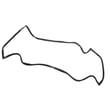
| Door not sealing well, frost or warm spots | Air leak at door gasket | Inspect and clean gasket; replace if torn (see freezer door gasket 5304507205) |
Why it matters
Using the correct control-panel reset steps prevents unnecessary part replacement and helps protect frozen food. Many “needs reset” complaints are actually caused by a control lock, the unit being set to 0 (OFF), or a door seal leak.
Last updated: January 2026
How many cubic feet is my upright freezer?
For Kenmore model 25328093803, the exact cubic-foot capacity is listed on the model’s rating label and in the 25328093803 owner's manual. As a practical guide, most full-size upright freezers fall in the 10 to 20+ cubic feet range, depending on cabinet height and width.
How to find the exact capacity for model 25328093803
Check these common places first:
- Owner’s manual: look for “capacity,” “specifications,” or “product data” in the first pages or back section
- Rating label: typically inside the cabinet (often on a side wall) or near the door opening
- Model tag area: sometimes behind the lower toe grille or near the hinge area
- Packaging or sales paperwork (if you still have it)
If you only need an estimate, you can also compare your freezer’s exterior size to typical upright freezer size groups.
Typical upright freezer size groups (quick reference)
These ranges help you estimate capacity when you only know the approximate dimensions.
| Size group | Typical capacity | Typical exterior size (W x H x D) |
|---|---|---|
| Compact | 3 to 5 cu. ft. | 20 to 24 in. x 31 to 37 in. x 20 to 25 in. |
| Small | 5 to 9 cu. ft. | 21 to 25 in. x 55 to 60 in. x 22 to 26 in. |
| Medium | 10 to 16 cu. ft. | 23 to 31 in. x 60 to 73 in. x 27 to 30 in. |
| Large | 17+ cu. ft. | 27 to 34 in. x 64 to 76 in. x 29 to 30 in. |
Why it matters
Capacity affects how you load and freeze food safely. A common guideline is to freeze about 3 pounds of fresh food per cubic foot at one time, and allow about 4 hours for the freezer to cool down completely before loading unfrozen food (details and usage tips are in the 25328093803 owner's manual).
Last updated: January 2026
Why is my Kenmore Elite freezer not freezing?
If your Kenmore Elite upright freezer 25328093803 is running but not freezing, the most common causes are incorrect temperature control settings, poor airflow from frequent door openings or a door that is not sealing, or a defrost or refrigeration-system problem that prevents the evaporator from getting cold. Start with the checks in the 25328093803 owner's manual.
Quick checks we recommend first
- Make sure the temperature control is not set to OFF (OFF stops the compressor but does not disconnect power).
- Confirm the freezer is plugged in firmly and the outlet has power; a tripped breaker or blown fuse can stop cooling.
- Limit door openings and verify the door closes fully; a slightly open door can quickly warm the cabinet.
- Check the door seal for dirt, gaps, or damage; a poor seal causes warm, moist air to enter and reduces freezing.
- If the freezer was recently unplugged or loaded with warm food, allow time to pull down to temperature.
What to look for (symptoms and likely causes)
| What you notice | What it usually points to | What to do next |
|---|---|---|
| Freezer does not run at all | Power issue, control set to OFF | Verify outlet power, reset breaker, set control colder |
| Runs “too much” but still warm | Door not sealing, frequent openings, warm room | Check gasket, reduce openings, improve airflow around cabinet |
| Frost buildup and weak cooling | Defrost system issue | Inspect for heavy frost on the evaporator cover; test defrost components |
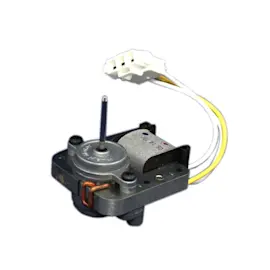
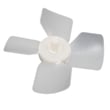
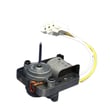
| Warm cabinet, little or no airflow inside | Evaporator fan problem | Listen for fan; consider the freezer evaporator fan motor 297309000 if the fan is not running |
Parts that commonly affect freezing on this model
These parts are often involved when an upright freezer runs but will not maintain temperature:
- Freezer evaporator fan motor 297309000 (moves cold air through the cabinet)
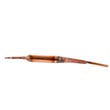
- Refrigeration appliance defrost bi-metal thermostat 297216600 (helps control defrost heating)
- Refrigeration appliance defrost heater 297253602 (melts frost off the evaporator)
- Electronic control board (controls cooling and defrost timing)
- Compressor and sealed system components (cooling capacity)
Why it matters
A freezer that is not freezing can be caused by something simple (control set to OFF, door not sealing, recent warm food load), but ongoing warm temperatures can also indicate a defrost failure or airflow problem that will worsen quickly and lead to food spoilage.
Last updated: January 2026