Owner’s manual
 Error Codes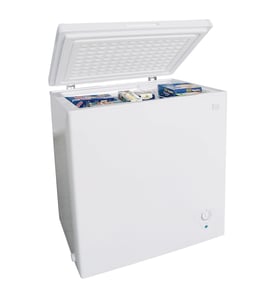



What can cause a chest freezer to stop working?
A Kenmore 25314502102 chest freezer usually stops working because it is not getting steady power, the temperature control is set to OFF, or a basic start-up issue is preventing the compressor from running. We recommend checking the power supply and control settings first, then moving to component-level troubleshooting using the owner's manual.
- Make sure the plug is fully seated in the outlet (a loose plug can stop operation).
- Confirm the temperature control is not set to OFF (OFF stops the compressor but does not fully disconnect power).
- Check the home fuse or breaker; use the correct circuit protection (the manual calls out a 15-amp time-delay fuse).
- Avoid outlets protected by GFCI; they are not recommended for this freezer.
- Do not use an extension cord or adapter plug.
- Make sure the outlet is not controlled by a wall switch or pull cord.
| What you notice | Most likely cause | What to do next |
|---|---|---|
| No sound, no cooling | No power, loose plug, tripped breaker | Verify outlet power, reset breaker, reseat plug |
| Lights work but no cooling | Temperature control set to OFF or failed control | Set control colder; if still no run, test/replace control parts |
| Runs “sometimes” | Voltage fluctuation, weak connection, nuisance trip | Try a dedicated non-GFCI outlet; check cord and receptacle |
| Runs a lot but still warm | Door not sealing, warm loads, frequent openings | Reduce door openings; check gasket and loading |
If the freezer has power and the control is set correctly but the compressor still will not run or temperature is unstable, these model-specific parts are common suspects:
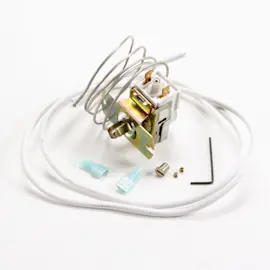
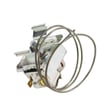
- Freezer temperature control thermostat 5304496559 (controls compressor cycling)
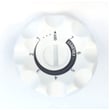
- Freezer temperature control knob 216707200 (can slip or crack and prevent proper setting)
- Indicator light 216738400 (helps confirm the unit is calling for cooling)
- White-westinghouse refrigerator electronic control board 216954208 (if your unit uses an electronic control)
A “no-run” freezer can be as simple as a control set to OFF, but running on the wrong outlet (GFCI, switched outlet, extension cord) or with unstable voltage can also cause repeated shutdowns and can damage the compressor motor over time.
Last updated: February 2026
Where is the model number on a Kenmore chest freezer?
On a Kenmore chest freezer model 25314502102, the model and serial number plate is typically on the left exterior wall of the cabinet. Use that label when ordering parts, checking specifications, or looking up troubleshooting steps in the owner's manual.
For chest freezers like 25314502102, we recommend checking these spots in order:
- Left exterior wall of the freezer cabinet (most common for chest models)
- Near the rear of the cabinet on the outside
- Along the side panel where the lid hinges mount
- On the inside rim near the top opening (less common)
The plate usually lists both identifiers. Record both so you can match parts correctly.
- Model number (for this unit: 25314502102)
- Serial number (unique to your freezer)
- Sometimes the electrical rating (volts/amps) and refrigerant info
| Item on label | Why it matters |
|---|---|
| Model number | Ensures diagrams and parts lists match your exact freezer |
| Serial number | Helps confirm production details when parts vary by series |
Kenmore freezers often share similar cabinet designs across multiple model numbers. Using the exact model number from the plate prevents ordering the wrong items, especially for control parts like the freezer temperature control thermostat 5304496559 or cosmetic pieces such as the freezer temperature control knob 216707200.
Last updated: February 2026
What is the average lifespan of 25314502102?
The average lifespan of the Kenmore 25314502102 chest freezer is about 12 years with normal household use and basic maintenance (good airflow, clean condenser area, and a tight lid seal). For care and operating guidance, use the owner's manual.
- Room conditions: hot garages and tight enclosures make the compressor run longer.
- Air circulation: blocked airflow around the cabinet shortens sealed-system life.
- Frost buildup: heavy frost reduces efficiency and increases run time.
- Lid seal habits: frequent openings and a poor seal add moisture and workload.
- Power quality: repeated outages and low voltage stress the compressor.
| Component | Typical service life | Common symptom |
|---|---|---|
| Temperature control (thermostat/knob) | 8 to 15 years | Warm freezer or temperature swings |
| Electronic control board (if equipped) | 7 to 12 years | No cooling, erratic operation |
| Sealed refrigeration system (compressor, refrigerant loop) | 10 to 20 years | Runs constantly, won’t reach temp |
If your freezer is not holding temperature, the control components are common starting points, such as the freezer temperature control thermostat 5304496559.
A chest freezer that is nearing end-of-life often uses more electricity and struggles to maintain safe food-storage temperatures. Catching airflow issues, frost buildup, or control problems early can extend the life of the compressor and sealed system.
- Keep 2 to 3 inches of clearance around the freezer for airflow.
- Defrost when frost reaches about 1/4 inch.
- Confirm the control is set for steady freezing (target 0°F).
- Make sure the lid closes squarely and isn’t blocked by baskets or packages.
Last updated: March 2026