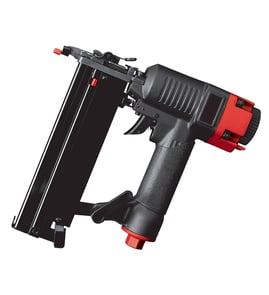

How to reload a Craftsman nail gun?
To reload a Craftsman 351183140 16-gauge finishing nailer, open the magazine, pull the pusher (feeder) back until it locks, load a strip of 16-gauge finish nails in the correct direction, then release the pusher so it feeds nails forward under spring tension.
Safe reload steps (recommended)
- Disconnect the air hose or remove the battery before loading.
- Point the nailer away from yourself and others.
- Open the magazine latch and slide the magazine open.
- Pull the pusher/feeder all the way back until it clicks into the locked position.
- Place the nail strip into the magazine channel (heads aligned in the track).
- Press the pusher release and guide the pusher forward so it rests against the nails.
Nail and magazine checks that prevent jams
Reload issues usually come from nail size, orientation, or a pusher that is not fully latched.
- Use the correct nail type: 16-gauge finish nails (straight or angled depends on the magazine design).
- Confirm nail length is within the nailer’s rated range (most 16-gauge finish nailers run about 1 inch to 2-1/2 inches).
- Load with nail heads seated in the head track; do not force nails that sit crooked.
- Make sure the pusher spring has firm tension and is not binding.
| What you see | Most likely cause | What to do |
|---|---|---|
| Nails do not advance | Pusher not released or not seated on nails | Re-lock pusher, reload, then release slowly |
| Frequent jams at nose | Wrong angle/type or bent nails | Switch to correct nails; discard damaged strips |
| Double-feeds | Worn driver/channel or debris in magazine | Clean magazine; inspect for wear |
Why it matters
Loading with the pusher locked back and nails aligned in the magazine keeps the feed system timed correctly, which reduces misfires, double-feeds, and nose jams.
For more help finding the exact model and matching parts diagrams, use how to find your appliance model number (and what it means for parts).
Last updated: February 2026
Why does my Craftsman nail gun keep jamming?
Your Craftsman 351183140 16-gauge finishing nailer usually jams when the fasteners do not match the tool (gauge, length, or collation), the magazine is dirty or damaged, or the driver blade is worn or not returning smoothly. Correct nails and a clean feed path prevent most repeat jams.
Most common causes (and what to check first)
- Wrong nails for the magazine: confirm 16-gauge finish nails with the correct length range and collation style for your nailer.
- Bent, rusty, or glued nails: discard any strips with damaged heads, bent shanks, or heavy adhesive buildup.
- Dirty magazine and nose: packed sawdust and resin slow the pusher and let nails tip.
- Low or inconsistent air supply (pneumatic setups): pressure that is too low can cause partial drives and jams.
- Worn driver blade or bumper: a rounded driver tip or degraded bumper increases misfeeds.
- Dry O-rings or internal drag: sticking parts can prevent full driver return.
Quick jam-clear and reset steps
- Disconnect the air hose (or remove the battery, if applicable) and remove all nails.
- Open the nose or jam-release (if equipped) and remove the stuck fastener.
- Inspect the driver channel for a broken nail fragment.
- Clean the magazine rails and nose area; then reload a fresh strip of correct nails.
- Test-fire into scrap wood and confirm consistent depth.
Nail and setup checklist
| What to match | What “wrong” looks like | What happens |
|---|---|---|
| Gauge and collation | Not true 16-gauge, wrong angle/collation | Nails skew, double-feed, or bind |
| Nail condition | Bent, rusty, damaged strip | Frequent nose jams |
| Air pressure (if pneumatic) | Too low or fluctuating | Partial drive, nail stuck |
Why it matters
Repeated jamming can chip the driver blade, damage the magazine rails, and create unsafe misfires. Fixing the nail match and feed-path friction first prevents unnecessary parts replacement.
For help identifying the exact model number on the tool before ordering parts, use how to find your appliance model number (and what it means for parts).
Last updated: February 2026
What type of nail gun is best for baseboards?
For most baseboard installs, we recommend a 15-gauge or 16-gauge finish nailer because it has the holding power you need for thicker trim and solid wood. Your Craftsman model 351183140 is a 16-gauge finishing nailer, which fits this job well.
Quick recommendation by baseboard type
- Standard baseboards (MDF or pine, typical thickness): 16-gauge finish nailer
- Thicker hardwood baseboards or wide profiles: 15-gauge finish nailer
- Delicate trim, small returns, or touch-ups: 18-gauge brad nailer
- Very thin decorative pieces: 23-gauge pin nailer (usually paired with wood glue)
What to consider before you choose
- Holding power: 15-gauge generally holds stronger than 16-gauge; both hold better than 18-gauge brads for baseboards.
- Hole size and fill work: 18-gauge leaves smaller holes; 15-gauge leaves the largest holes.
- Risk of splitting: Thicker nails can split narrow trim; switching to 18-gauge helps on fragile pieces.
- Where you fasten: Baseboards hold best when you hit studs; construction adhesive can reduce the number of nails needed.
- Nail length: Most baseboard work uses nails long enough to pass through the baseboard and drywall and still bite into framing.
Gauge comparison (at a glance)
| Tool type | Typical best use on trim | Pros | Trade-offs |
|---|---|---|---|
| 15-gauge finish nailer | Thick baseboards, hardwood, high-hold areas | Strong hold | Larger holes, more split risk |
| 16-gauge finish nailer (like 351183140) | Most baseboards and door casing | Great all-around balance | Slightly less hold than 15-gauge |
| 18-gauge brad nailer | Light trim, small pieces, repairs | Small holes | Less holding power |
Why it matters
Baseboards get bumped by vacuums, feet, and furniture; using a finish nailer (15- or 16-gauge) helps keep trim tight to the wall over time and reduces loosening.
If you need help identifying the exact model before buying nails or accessories, use how to find your appliance model number (and what it means for parts).
Last updated: February 2026
Why is my finish nailer not shooting nails?
If your Craftsman 351183140 16-gauge finishing nailer is not shooting nails, the cause is almost always a feed blockage (jam), the wrong nails, a stuck safety contact tip, or a power/drive issue. Unload the nailer first, then clear the nose and verify the fasteners.
Safety first
- Disconnect the air hose if it is pneumatic, or remove the battery/unplug if it is electric.
- Point the tool away from yourself and others.
- Remove all nails from the magazine before opening the nose.
Quick checks that fix most no-fire problems
- Wrong nails: Confirm you are using 16-gauge finish nails of the correct style and length for the tool.
- Jam in the nose: Open the nose (if your model has a quick-release) and remove any bent nail or debris.
- Magazine/pusher issue: Make sure the nail strip slides freely and the pusher spring moves smoothly.
- Safety contact tip: Press the contact tip by hand; it must move freely and return fully.
- Trigger movement: Verify the trigger is not sticking and returns fully.
Power and drive checks (match to your nailer type)
Use the column that matches how your 351183140 is powered.
| What to check | Pneumatic nailer | Cordless/electric nailer |
|---|---|---|
| Power source | Regulator set correctly; hose/coupler not leaking | Battery charged; terminals clean; correct battery installed |
| Drive strength | Pressure stays steady while firing | Motor spins normally; no weak cycling |
| Common fix | Add a few drops of pneumatic tool oil if your tool requires oil | Reseat battery; clear any lockout caused by a jam |
If it cycles but still will not drive nails
- Recheck nail gauge and collation style; mismatched nails will not feed.
- Clean the magazine rails and nose channel; pitch and sawdust stop feeding.
- If the tool leaks air (pneumatic) or sounds strained (cordless), internal seals or the driver assembly can be worn and may need service.
Why it matters
A no-fire condition usually means the driver cannot complete a full stroke or the nails cannot advance. Clearing the feed path and matching the correct 16-gauge nails prevents repeated jams and damage to the nose and driver.
For help identifying the exact model number before ordering parts or looking up diagrams, use how to find your appliance model number (and what it means for parts).
Last updated: February 2026