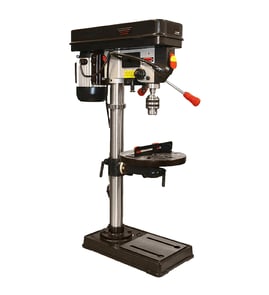

What is a 13 drill press?
A 13-inch drill press is a drill press size class that refers to its maximum swing (about 13 inches), meaning it can drill to the center of a workpiece up to about 6-1/2 inches from the column. It is typically a benchtop drill press with more capacity and speed options than smaller 8-inch models like the Craftsman 137280050.
What “13-inch” means (and what it does not)
Most drill press “inch” ratings describe swing, not the table size or the maximum hole size.
- Swing: roughly the diameter of the largest circle you can drill centered on the spindle
- Throat distance: about half the swing (around 6-1/2 inches on a 13-inch press)
- Not the chuck size: chuck capacity is a separate spec (often 1/2 inch on many 13-inch presses)
- Not the horsepower: motor power varies by brand and model
Typical differences: 13-inch vs. 8-inch drill press
A 13-inch benchtop drill press is usually built for larger stock and more demanding drilling than an 8-inch unit.
| Feature | 8-inch drill press (like 137280050) | 13-inch drill press (typical) |
|---|---|---|
| Swing | About 8 inches | About 13 inches |
| Throat distance | About 4 inches | About 6-1/2 inches |
| Common chuck capacity | 3/8 inch | 1/2 inch |
| Typical use | Light-duty drilling | Heavier-duty drilling, larger work |
Why it matters when choosing parts or accessories
The “13-inch” class affects what fits and what performs well, especially for drilling larger panels or using bigger bits.
- Larger swing helps when drilling near the center of wider boards
- More speed settings help match RPM to bit size and material
- A larger table and stronger column reduce vibration and wandering
- Chuck capacity can limit the maximum shank size you can use
Quick tip for Craftsman 137280050 owners
If you are comparing your Craftsman 137280050 to a 13-inch drill press, focus on swing, chuck capacity, and speed range first; those specs drive real-world capability more than the “inch” label.
Related: how to find your appliance model number (and what it means for parts)
Last updated: February 2026
What is the 4 inch rule for drill press?
The 4-inch rule for a drill press means we keep our hands and fingers at least 4 inches away from the rotating drill bit and any spinning workpiece. On a Craftsman 137280050 8-inch drill press, that typically means clamping the material to the table instead of holding it by hand.
How to follow the 4-inch rule (practical steps)
- Clamp the workpiece to the drill press table; do not hand-hold small parts.
- Use a drill press vise for short, narrow, or round stock.
- Keep your fingers behind the clamp or vise jaws, not beside the bit.
- Remove the chuck key before turning the drill press on.
- Set the correct speed and feed; let the bit cut without forcing it.
- Stop the machine before clearing chips; use a brush, not your fingers.
Quick guide: what to use to keep hands away
| Situation | Best choice | Why it helps |
|---|---|---|
| Small flat piece | Clamp + backer board | Prevents lifting and spinning |
| Round stock (dowel, pipe) | V-block or drill press vise | Stops rolling and grabbing |
| Thin sheet metal | Clamp + sacrificial board | Reduces grabbing and burrs |
| Repetitive holes | Fence/stop block + clamps | Keeps hands consistently away |
Why it matters
A drill press can grab the bit or the workpiece instantly. The 4-inch rule forces us to use workholding (clamps, vise, fixtures) so the material cannot spin, which is the most common way hands get pulled toward the bit.
Parts and setup tips that support safer drilling
Even without model-specific part listings for the Craftsman 137280050, these checks improve control and reduce grabbing:
- Verify the chuck is tight and seated; a loose chuck increases wobble.
- Confirm the table lock is secure so the table cannot rotate.
- Use sharp bits; dull bits require more force and increase slip risk.
- Use cutting oil on metal to reduce heat and binding.
For more general DIY safety guidance before starting repairs or adjustments, review are diy appliance repairs safe.
Last updated: February 2026
How to repair a drill press spindle?
On the Craftsman 137280050 8-inch drill press, spindle repair usually means removing the quill assembly, pressing off and replacing worn bearings, then reinstalling or replacing the spindle and reassembling the quill so it runs true with minimal play.
Before you start (safety and setup)
- Unplug the drill press; never work on the quill/spindle with power connected.
- Remove the chuck and any bit; lower the table for clearance.
- Mark the depth stop and quill return spring position so reassembly is easier.
- Take photos as you go; small washers and spacers must go back in the same order.
- If you need wiring checks during reassembly, use a meter and follow safe test practices in how to use a multimeter to test electrical parts video.
Spindle repair steps (typical process)
- Remove the chuck: Open the jaws fully and use the correct taper wedge or drift (if your chuck/arbor uses a Morse/Jacobs taper).
- Access the quill: Remove the belt cover, relieve belt tension, and move the belt off the pulleys if needed.
- Remove the quill retaining hardware: Many drill presses use a retaining ring or collar to hold the quill/spindle assembly in place.
- Separate the quill and spindle: Support the quill and press or tap the spindle out carefully to avoid bending it.
- Inspect and replace bearings: Roughness, noise, heat, or side-to-side play points to bad spindle bearings. Press bearings off and on using proper support so force is applied to the correct race.
- Reassemble and align: Reinstall the spindle into the quill, reinstall retaining hardware, set belt tension, then check runout at the chuck.
What to replace vs. reuse
| Symptom | Most likely cause | Typical fix |
|---|---|---|
| Chuck wobble/runout | Bent spindle or damaged taper | Replace spindle or arbor; clean taper surfaces |
| Grinding noise | Worn spindle bearings | Replace bearings |
| Quill sticks | Dirty quill bore or damaged return spring | Clean/lube quill; service spring |
Why it matters
A worn spindle or bearing set causes runout, vibration, oversized holes, and faster chuck wear. Fixing the spindle assembly restores accuracy and reduces load on the motor and belt drive.
Last updated: February 2026
What is a good horsepower for a drill press?
For a typical home shop drill press, 1/2 HP to 3/4 HP is a good target for drilling wood, plastics, and light metal; for frequent metal drilling, larger bits, or hole saw work, 1 HP or more is a better fit. On the Craftsman 137280050 8-inch drill press, low speeds and proper setup often matter more than raw horsepower.
Quick horsepower guide (what it handles)
- 1/3 to 1/2 HP: light-duty drilling, small bits, softwoods, plastics
- 1/2 to 3/4 HP: most DIY and hobby work; occasional mild steel with sharp bits
- 1 to 1-1/2 HP: frequent metalworking, larger diameter holes, hole saws, step bits
- 2+ HP: heavy-duty production work (usually larger floor presses)
What matters as much as horsepower
Horsepower helps prevent stalling, but drilling performance depends heavily on torque, speed range, and technique.
- Low RPM capability: essential for metal and larger bits (less heat, less grabbing)
- Pulley/belt speed changes: more speed options usually means better control
- Sharp bits and cutting fluid (for metal): reduces load on the motor
- Proper feed pressure: steady pressure cuts better than forcing the bit
- Workholding: clamp the workpiece; never hand-hold metal
Recommended setup by material
| Material | Typical goal | What to prioritize |
|---|---|---|
| Wood | clean holes, minimal tear-out | higher RPM, sharp brad-point bits |
| Plastic | no melting, no cracking | moderate RPM, light feed, sharp bits |
| Mild steel/aluminum | no overheating, no grabbing | low RPM, cutting fluid, firm clamping |
Why it matters
Choosing the right horsepower helps you avoid stalling, belt slipping, and overheated bits. For an 8-inch drill press like the Craftsman 137280050, pairing reasonable horsepower with the right speed and safe workholding delivers the biggest real-world improvement.
For electrical troubleshooting that can mimic “low power” (bad switch, loose wire, failing cord), use our guide: how to use a multimeter to test electrical parts video.
Last updated: February 2026
How much does a Craftsman 137280050 drill press weigh?
The Craftsman 137280050 8-inch drill press weight varies by configuration (motor, base, table, and any mounted vise or auxiliary board). Most 8-inch benchtop drill presses are in the 35 to 65 lb range; the fastest way to get the exact weight is to weigh your assembled unit.
How to get the exact weight (best methods)
- Bathroom scale subtraction: weigh yourself, then weigh yourself holding the drill press; subtract.
- Board-and-scale method: set the drill press on a sturdy board; place one end on a scale and the other end on a same-height block, then repeat for the other end and add the two readings.
- Weigh in major pieces: remove and weigh the motor and table assembly separately, then add the base/column weight.
- Include accessories: a metal drill press vise or bolted-on mounting board commonly adds 5 to 25 lb.
Planning ranges (what to expect)
| Drill press type | Typical assembled weight | What changes it most |
|---|---|---|
| 8-inch benchtop (like model 137280050) | 35 to 65 lb | Motor size, base thickness, added vise |
| 10 to 12-inch benchtop | 55 to 95 lb | Larger motor and heavier base |
| Floor-standing | 120 to 250+ lb | Column and cast-iron base |
Why it matters
Weight affects stability, vibration, and safe handling. A heavier setup usually drills with less chatter, but it also needs a sturdier bench and secure mounting.
Safe handling and mounting tips
- Unplug the drill press before lifting or moving it.
- Lift from the base and column, not the table crank or belt cover.
- Bolt the base to a solid bench; use washers to spread the load.
For general DIY safety practices that also apply to power tools, use are diy appliance repairs safe.
Last updated: February 2026