Owner’s manual
 Error Codes



Are bottom mount fridges better?
For many households, yes: a bottom-mount refrigerator like the GE PWE23KYNGFS keeps fresh-food items at eye level and puts the freezer in a lower drawer, which makes everyday access more comfortable and helps you see and use refrigerated foods more often. See the owner's manual for features and layout details.
When a bottom-mount refrigerator is the better choice
- You use the refrigerator section more than the freezer (milk, produce, leftovers).
- You want less bending for daily items (better ergonomics).
- You like wide shelves and door bins for fresh-food organization.
- You prefer freezer drawers that separate baskets and bins.
- You want a clean, built-in look; many PWE-series models are counter-depth.
When another style may be better
- You access frozen foods constantly (a side-by-side can keep freezer items at mid-height).
- You want narrow door swing clearance (some top-freezer models fit tighter spaces).
- You store lots of tall frozen boxes; some bottom drawers stack less efficiently.
Quick comparison
| Style | Best for | Tradeoffs |
|---|---|---|
| Bottom-mount (bottom freezer) | Fresh-food convenience, visibility | More bending for freezer access |
| Side-by-side | Equal access to fridge and freezer | Narrower shelves for wide platters |
| Top-freezer | Simple layout, often lower cost | More bending for fresh-food access |
Why it matters
“Better” usually comes down to how you cook and shop. If you open the fresh-food doors dozens of times a day, bottom-mount designs reduce bending and make it easier to keep temperatures stable by limiting how long the doors stay open.
Last updated: February 2026
Is GE Café considered high end?
Yes. GE Café is generally considered a high-end (often called “attainable luxury”) appliance line; it typically sits above standard GE and GE Profile styling, with more premium finishes, design options, and feature sets, while GE Monogram is positioned as the ultra-premium tier. For model-specific details on your GE PWE23KYNGFS refrigerator, use the owner's manual.
How GE lines typically compare
GE’s lineup is usually grouped by overall design, features, and price tier. Here’s the common way shoppers compare them:
- GE (standard lines): core features and value-focused designs
- GE Profile: upgraded features and styling; more “premium mainstream”
- GE Café: premium design-forward look (custom hardware/finishes on many models) and pro-style aesthetics
- GE Monogram: luxury tier with the most premium positioning
Quick comparison table
| Line | Typical positioning | What you usually pay for |
|---|---|---|
| GE | Mainstream | Essentials, value |
| GE Profile | Premium | More features, upgraded styling |
| GE Café | High-end | Design options, pro-style look, premium features |
| GE Monogram | Ultra-premium | Luxury build, top-tier design and features |
What “high end” means in day-to-day use
Even within a premium line, performance depends on the specific refrigerator model and how it’s installed and maintained. For the best ownership experience, we recommend:
- Keeping temperatures set to safe targets (about 37°F fresh food and 0°F freezer)
- Replacing the water filter on schedule (many models specify every 6 months, sooner if flow drops)
- Making sure doors seal tightly and close fully
- Addressing alarms and control settings promptly
- Using the correct replacement parts for your exact model
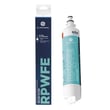
If you’re maintaining filtration on this refrigerator, the correct filter for many GE bottom-freezer models is the GE refrigerator water filter RPWFE.
Why it matters
“High end” usually reflects design, features, and price tier, not a guarantee of fewer repairs. Using the correct parts (like the right water filter) and following the care steps in the manual helps protect cooling performance, water flow, and long-term reliability.
Last updated: February 2026
What is the most common problem with GE PWE23KYNGFS refrigerators?
On the GE PWE23KYNGFS bottom-mount refrigerator, the most common service complaints are temperature and airflow issues (warm fresh food section, inconsistent temps) and ice maker or water dispenser problems (slow flow, odd-tasting ice after filter changes). Many of these trace back to blocked vents, a restricted water filter, or a fan/sensor issue; our owner's manual covers the key operating checks.
What we see most often (and what to check first)
- Warm refrigerator, freezer seems OK: make sure packages are not blocking the air tower vents; blocked airflow can cause uneven cooling.
- Temps do not match the set point: actual temperature can vary slightly from the set temperature based on usage and room conditions.
- Slow water dispensing or weak ice production: replace the water filter on schedule; flow drop is a common symptom of a clogged filter.
- Bad taste or odor in new ice: discard the first bin of ice after starting the ice maker or replacing the filter.
- Door not sealing or doors look uneven: door alignment and gasket sealing issues can mimic cooling problems.
Quick troubleshooting map
| Symptom | Most likely category | What we recommend doing next |
|---|---|---|
| Fresh food warm, freezer cold | Airflow/evaporator fan | Confirm vents are clear; listen for the fresh food fan; inspect the air tower area |
| Temps swing up and down | Sensor/control inputs | Verify settings; avoid blocking vents; consider a temperature sensor check |
| Slow dispenser flow | Water filter/water supply | Replace filter; purge air; confirm household water pressure is steady |
| Ice tastes/smells off after service | Normal after filter/ice maker start | Throw away first bin of ice; run water to flush the system |
Parts that commonly relate to these symptoms
If basic checks do not solve it, these model-specific parts are often involved in cooling or water-flow complaints:
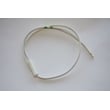
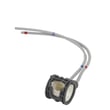
- Refrigerator temperature sensor WR55X10025 (temperature feedback to the control)
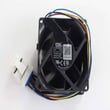
- Refrigerator fresh food fan motor assembly WR60X35205 (moves cold air through the fresh food section)
- GE refrigerator water filter RPWFE (restricted filter commonly causes slow flow)
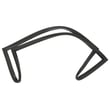
- Refrigerator freezer door gasket WR14X36194 (air leaks can cause temperature instability and frost)
Why it matters
Cooling and ice maker performance depend on steady airflow, accurate temperature sensing, and consistent water flow. Fixing a simple vent blockage or overdue filter early helps prevent food spoilage, nuisance alarms, and longer compressor run times.
Last updated: February 2026