Error Codes




Is GE Café considered high end?
Yes. GE Café is generally considered a high-end line within GE’s mainstream lineup; it focuses on premium styling, upgraded features, and customizable finishes compared with standard GE models. It is typically positioned below true luxury lines, but above many mass-market options.
How GE Café typically compares
Here’s the common “tiering” shoppers use when comparing GE families:
- Standard GE: core features and value-focused designs
- GE Profile: more advanced features and tech-forward upgrades
- GE Café: premium design-forward look, upgraded features, more customization
- GE Monogram: luxury category with higher-end build and pricing
What “high end” means in real-world use
GE Café is often chosen when you want a built-in, designer look without stepping into full luxury pricing. In day-to-day ownership, “high end” usually shows up as:
- More premium exterior styling and finish options
- More feature-rich controls and convenience features
- Higher typical purchase price than standard lines
- More emphasis on matching suites (range, fridge, dishwasher)
How this relates to your GE GFE26JMMWFES refrigerator
Your model GFE26JMMWFES is a GE bottom-mount refrigerator. Even if your unit is not branded “Café,” many GE refrigerators share similar service approaches and components across families. For example, common repairs still involve parts like a temperature sensor, control board, or water filter.
| If you’re comparing… | Expect GE Café to offer… |
|---|---|
| Styling | More premium, design-forward finishes and hardware options |
| Features | More “nice-to-have” convenience features |
| Price | Higher than standard GE and often higher than Profile |
| Category | Premium, but not the top luxury tier |
Why it matters
Knowing where GE Café sits helps set expectations for price, features, and repair costs. Premium lines can use more advanced electronics and assemblies, which can affect part cost and troubleshooting steps.
If you’re maintaining the water and ice system on this refrigerator, the correct replacement filter for many configurations is the GE refrigerator water filter XWFE.
Last updated: February 2026
What does the 26 stand for?
On the GE refrigerator model number GFE26JMMWFES, the “26” typically indicates the refrigerator’s approximate capacity class (about 26 cubic feet), not a special code or symbolic meaning. GE commonly uses these digits in model numbers to help identify size within a product series.
What “26” means in practical terms
For a bottom-mount or French door style refrigerator like GFE26JMMWFES, “26” is used as a quick size identifier.
- It helps distinguish this model from smaller or larger versions in the same family
- It is an approximate class, not a measured-to-the-decimal specification
- Actual usable space can vary based on shelf design, ice maker, and door bin layout
- Capacity class does not change how parts fit; parts must match the full model number
Why the full model number still matters for parts
Even if two GE refrigerators are both “26” class, they can use different electronics, sensors, and water system parts. When ordering, always match GFE26JMMWFES exactly.
Common part categories that are model-specific include:
- Temperature sensing (example: GE profile refrigerator temperature sensor WR55X10025)
- Water filtration (example: GE refrigerator water filter XWFE)
- Airflow control (example: refrigerator air damper WR60X27396)
- Ice maker components (example: icemaker WR30X39266)
Quick reference table
| Model number piece | What it usually indicates | Example for GFE26JMMWFES |
|---|---|---|
| Brand/series prefix | Product family/series | GFE |
| Number (size class) | Approx. capacity class | 26 |
| Remaining letters | Feature package, finish, revision | JMMWFES |
Why it matters
Knowing that “26” is a size class helps set expectations for storage and confirms you are looking at the right model family, but the exact model number is what ensures correct fit and function when replacing parts like a control board, water filter, or temperature sensor.
Last updated: February 2026
What is the most common problem with GE GFE26JMMWFES refrigerators?
The most common issues we see on the GE GFE26JMMWFES bottom-mount refrigerator are ice maker and dispenser problems (no ice, slow ice, frost buildup) and temperature complaints (fresh food too warm or freezer not holding temp). These usually trace back to airflow, a sensor reading issue, or a control-related fault.
Most common symptoms (and what they usually point to)
- Ice maker not making ice or making hollow cubes: restricted water flow, filter issue, inlet valve issue
- Frost or ice buildup near the ice box: airflow restriction or fan-related problem
- Fresh food section warm but freezer cold: air damper not opening, airflow tower issue, evaporator fan issue
- Temps swing up and down: temperature sensor (thermistor) drifting or control logic issue
- Door alarm or “door open” complaints: door not sealing, door alignment, mullion/flipper not closing correctly
Quick checks we recommend first
- Confirm temperatures: setpoint is not the same as actual temp; use a thermometer after 24 hours.
- Check airflow: make sure vents are not blocked by food packages.
- Check the water filter: a clogged filter can reduce ice production and dispenser flow; replace with GE refrigerator water filter XWFE.
- Listen for fans: a failed fan can cause warm temps and frost patterns.
- Look for error codes: if the display shows a code, use GE refrigerator error codes to narrow the failure.
Parts that commonly solve these problems on this model
| Symptom | Common part to check | Why it matters |
|---|---|---|
| Temps inaccurate or inconsistent | GE profile refrigerator temperature sensor WR55X10025 | Bad sensor readings can cause overcooling or warming |
| Fresh food warm, freezer OK | Refrigerator air damper WR60X27396 | Damper controls cold air flow into the refrigerator section |
| No ice or slow ice (with low water flow) | Refrigerator water inlet valve WR57X26303 | Valve controls water supply to the ice maker and dispenser |
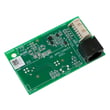
| Random behavior, dead display, odd cycling | Main control board WR55X46945 | Main board manages cooling, fans, and defrost logic |
Why it matters
Ice maker and cooling complaints often get worse over time because restricted airflow, weak water flow, or drifting sensor inputs make the refrigerator run longer, frost more, and struggle to hold steady temperatures.
Last updated: February 2026