Installation guide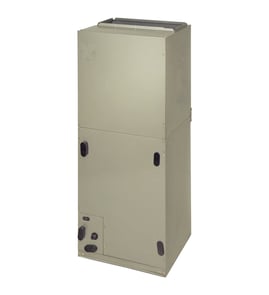

How many square feet can a 2 ton air handler handle?
A 2-ton air handler paired with a properly matched 2-ton outdoor unit typically serves about 800 to 1,200 sq. ft. In a Carrier FY4ANF024000 setup, the real limit is driven by your home’s heat gain, ductwork, and airflow setup (not tonnage alone); see the installation guide for airflow and static pressure details.
What changes the square footage most
- Insulation and air sealing (attic, walls, windows, doors)
- Ceiling height (taller ceilings increase the volume to condition)
- Sun exposure and window area (west-facing glass adds load)
- Duct sizing and leakage (undersized or leaky ducts reduce delivered capacity)
- Blower airflow and static pressure (high static can choke airflow)
- Local climate and humidity (hotter, more humid climates need more capacity per sq. ft.)
Airflow targets for a 2-ton system (what we use in the field)
Most 2-ton systems are set up around 350 to 450 CFM per ton, so a typical airflow target is:
| System size | Typical airflow per ton | Typical total airflow |
|---|---|---|
| 2 ton | 350 to 450 CFM/ton | 700 to 900 CFM |
For the FY4A size “024” family, the installation literature includes airflow performance tables by speed and external static pressure. Use those tables to confirm your blower setting can actually deliver the airflow your ducts require. Reference the installation guide when checking blower speed taps and static pressure limits.
Quick sizing reality check (comfort symptoms)
Use these signs to tell when “square feet per ton” is not lining up with your home:
- Short cycling and clammy air can mean oversized equipment or low airflow
- Long run times and warm rooms can mean undersized equipment or high heat gain
- Noisy returns/whistling often points to restrictive ductwork (high static)
- Frozen coil commonly indicates low airflow (dirty filter, blocked return, blower issue)
Why it matters
If the air handler and ducts cannot move the right airflow, the system will not deliver its rated cooling, humidity control suffers, and you can run into issues like condensate management problems. The FY4A installation guidance also emphasizes proper condensate trapping and drain pitch to prevent overflow and water damage.
Last updated: February 2026
Why is my air handler not working?
If your Carrier FY4ANF024000 air handler is not working (no blower, no airflow, or it will not start), the most common causes are a tripped disconnect or breaker, a blown low-voltage fuse on the control board, a failed blower motor or run capacitor, or a wiring or thermostat signal problem. Use the installation guide wiring and safety steps as your baseline.
Quick checks we recommend first
- Confirm the thermostat is set to Cool (or Heat) and the fan is set to Auto.
- Check the air handler disconnect and the home breaker; reset once if tripped.
- Make sure a filter is installed and not clogged; operating without a filter can damage the blower motor.
- Listen for symptoms:
- Silent: power, fuse, transformer, or control board issue
- Hums but will not spin: capacitor or motor problem
- Runs briefly then stops: overheating, airflow restriction, or control issue
- Inspect for obvious loose or burned wiring at the low-voltage terminals (power off first).
Parts that commonly cause a no-run condition on this model
If power is present and the thermostat is calling, these parts are frequent failure points:
| Symptom | Most likely area | Part on this model page |
|---|---|---|
| Blower will not start, may hum | Run capacitor or blower motor | Capactr run 12907, central air conditioner air handler blower motor HC39AE206 |
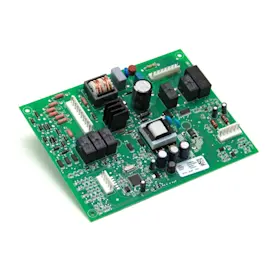
| No response to thermostat call | Fan control board or transformer | Central air conditioner air handler fan control board HK61EA006, central air conditioner air handler transformer HT01CN241 |
| Intermittent operation, odd timing | Control board logic or wiring | Pcb HK61EA001 |
Safe electrical troubleshooting (what to check)
Electrical hazards are real on air handlers; shut off the main disconnect before touching wiring.
- Verify line voltage is present at the unit (after the disconnect).
- Verify the transformer is supplying 24 VAC to the control circuit.
- Check the control board for a 5-amp low-voltage protective fuse (many no-run calls trace back to this fuse).
- Confirm thermostat signals (R, G, Y, W) are reaching the board.
Why it matters
A non-running air handler is often a simple power or low-voltage protection issue, but continuing to reset breakers or running with poor airflow can damage expensive components like the blower motor and control board.
Last updated: February 2026
How much do new air handlers cost?
Most new residential air handlers cost about $1,500 to $4,500 installed (equipment plus labor). For a Carrier FY4ANF024000, the final price is driven by capacity match, electric heat options, and how much duct, drain, and electrical work the installer must modify to meet the requirements in the installation guide.
What drives the installed price
- Size and configuration: airflow capacity, cabinet orientation, and coil setup
- Electric heat package: added parts cost and possible circuit or breaker upgrades
- Ductwork changes: transitions, sealing, insulation in unconditioned spaces
- Condensate drain work: trap, routing, and preventing blow-off issues
- Electrical and controls: wiring condition, transformer, control board, thermostat compatibility
- Access and labor time: attic/crawlspace difficulty, removal and disposal
Typical cost ranges (what to expect)
| Cost item | Typical range | Notes |
|---|---|---|
| Air handler equipment | $900 to $2,800 | Varies by capacity, efficiency features, and options |
| Installation labor and materials | $600 to $1,700 | Duct tie-in, electrical, drain, start-up checks |
| Total installed | $1,500 to $4,500 | Common all-in range for many homes |
FY4ANF024000 details that can raise labor
The Carrier FY4ANF series installation requirements commonly include duct-to-unit sealing, using flexible connectors to reduce vibration, insulating ductwork in unconditioned spaces, and setting up condensate drains correctly. Those steps add time and materials, especially when retrofitting an older system.
Why it matters
Air handlers are part of a matched HVAC system. Correct airflow, static pressure, and drain setup help prevent comfort problems, noise, and moisture issues that can shorten component life.
Last updated: February 2026
How big is a 4 ton air handler?
A 4 ton air handler is designed for about 48,000 BTU of cooling and is typically set up to move about 1,600 CFM of air (around 400 CFM per ton). Physical cabinet dimensions vary widely by brand and orientation; use the installation guide for the exact clearances and mounting requirements for Carrier FY4ANF024000.
What “big” usually means for a 4 ton air handler
Most shoppers mean one of these: cabinet dimensions, airflow, or required service space.
- Airflow target: about 1,600 CFM (often adjustable by blower speed taps/settings)
- Typical cabinet width range: 17 to 24 in.
- Typical cabinet depth range: 18 to 26 in.
- Typical cabinet height range: 45 to 60 in. (varies by upflow, downflow, horizontal)
- Service space: room to open panels and remove the blower assembly
Important note for Carrier FY4ANF024000 (model-specific)
Carrier model numbers that include 024 are commonly a 2 ton class air handler size, not 4 ton. In the FY4A airflow tables, size 024 is shown in the roughly 600 to 1,000 CFM range depending on external static pressure and blower speed, which aligns with a 2 ton setup rather than a 4 ton (about 1,600 CFM).
- If you are matching a 4 ton outdoor unit, confirm the air handler’s data plate and the outdoor unit model
- Check duct sizing; 4 ton systems typically need larger supply and return ducts than 2 ton systems
- Verify blower speed settings and total external static pressure during setup
Quick sizing reference (airflow)
| Nominal size | Typical airflow target | Common range you may see |
|---|---|---|
| 2 ton | ~800 CFM | ~700 to 900 CFM |
| 3 ton | ~1,200 CFM | ~1,050 to 1,350 CFM |
| 4 ton | ~1,600 CFM | ~1,400 to 1,800 CFM |
Why it matters
Correct air handler sizing and airflow affect comfort, humidity control, noise, and coil performance. A mismatch (for example, a 2 ton air handler on a 4 ton system) often leads to poor cooling, icing, or efficiency problems.
Last updated: February 2026