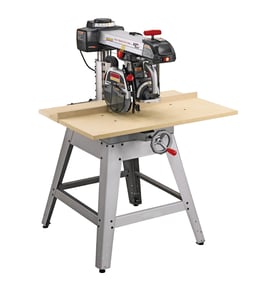

Are radial arm saws worth anything?
Yes. A Delta radial arm saw like model 33-890 is worth something when it’s complete, runs smoothly, and has tight arm and carriage movement; value is driven more by condition and local demand than age alone, with many used saws commonly trading in the low hundreds.
What affects value the most
- Completeness: guard, table/fence boards, yoke and arm locks, and any original accessories
- Mechanical condition: minimal arm play, carriage rolls smoothly, elevation and bevel adjustments hold
- Motor health: starts quickly, no burning smell, no excessive sparking at brushes
- Accuracy potential: can be aligned so the blade tracks square and repeatable
- Cosmetics and rust: surface rust is common; heavy pitting or bent parts lowers value
- Local market: radial arm saws are bulky, so prices vary widely by region
Typical price ranges you’ll see (used market)
| Condition | What it usually means | Typical range |
|---|---|---|
| As-is / incomplete | missing guard or fence, unknown motor | $0 to $100 |
| Working, average wear | runs, needs cleaning and tuning | $100 to $300 |
| Clean, tuned, complete | smooth adjustments, ready to use | $250 to $500+ |
Quick checklist before you buy or sell
- Unplug it and check for side-to-side play in the arm and carriage
- Verify the arm lock and yoke lock actually hold under light force
- Spin the arbor by hand (unplugged) to feel for rough bearings
- Inspect the cord and switch; repair damaged wiring using guidance like how to repair broken or damaged wires video
- Plan on a new blade; a sharp, correct blade improves perceived value and safety
Why it matters
Radial arm saws excel at repeatable crosscuts and dados, but they only feel “worth it” when they can be tuned to cut accurately and when the safety hardware is present. A cheap saw that cannot lock down tightly often costs more in time and parts than it saves.
Last updated: February 2026
What is the significance of 33-890?
On the Delta 33-890 12-inch radial arm saw, 33-890 is the model number. We use it to match the correct parts diagrams, compatible replacement parts, and service information for your exact saw so you do not order the wrong component.
What 33-890 means on this saw
For Delta power tools, a model number is an identifier, not a performance rating or a “special code.” It typically helps us distinguish:
- The exact saw design and production version
- Which motor, switch, and wiring layout your saw uses
- Which guards, yokes, and carriage components fit
- Which hardware (fasteners, springs, bearings) matches your build
- Which parts lists and exploded views apply
Where to find the 33-890 model number
Check these common locations on a radial arm saw:
- The data plate on the arm or column
- A label near the motor housing
- The base or rear frame area
- The electrical plate near the power cord entry
If the tag is worn, clean the plate gently and use a flashlight at an angle to make stamped characters easier to read.
Why it matters when ordering parts
Using the correct model number prevents fit and safety issues, especially on a radial arm saw where alignment and guarding are critical.
| If you use the wrong model | What can go wrong |
|---|---|
| Similar Delta model number | Parts may mount differently or not align |
| Only “Delta radial arm saw” | You can get the wrong switch, cord, or guard |
| Partial number (like “33-”) | You may miss the correct parts breakdown |
Helpful next step
If you are trying to identify the tag or confirm the number before ordering, use our guide: how to find your appliance model number (and what it means for parts).
Why this matters
Radial arm saw parts are often model-specific; even small differences in the carriage, arm, or electrical switch can change compatibility and safe operation.
Last updated: February 2026
Why is 33-890 so powerful?
The Delta 33-890 is considered “powerful” because it’s a 12-inch radial arm saw built to deliver strong cutting performance through its motor, blade size, and rigid arm and carriage design, not because of any special meaning in the number 33. In real use, “power” shows up as smoother cuts, less bogging, and better control in thicker stock.
What “powerful” means on a radial arm saw
When we talk about power on a Delta 33-890, we mean practical cutting capability and stability.
- Motor output under load: a healthy motor maintains blade speed in hardwoods.
- Sharp, correct blade: the right tooth count and hook angle reduce strain and kickback risk.
- Arm and carriage rigidity: less flex helps the blade track straight.
- Proper alignment: a square fence and true arm travel prevent binding.
- Electrical health: good wiring and switches deliver full voltage to the motor.
Quick checks if your saw feels weak (or too aggressive)
These steps help you separate a true power problem from setup or blade issues.
- Unplug the saw and inspect the blade for pitch buildup, missing teeth, or warping.
- Confirm you’re using a blade intended for radial arm saw use (many users prefer a negative or low hook angle for safer crosscuts).
- Check that the carriage rolls smoothly; resistance can mimic a weak motor.
- Verify the fence is straight and the workpiece is supported; twisting stock can cause drag.
- If the motor hums, trips breakers, or smells hot, test electrical components.
For electrical troubleshooting basics, we recommend how to use a multimeter to test electrical parts video.
Common causes and what they look like
| Symptom | Most common cause | What to do first |
|---|---|---|
| Bogging in normal cuts | Dull or wrong blade | Replace or sharpen blade; match blade to cut type |
| Burning marks | Feed rate too slow or misalignment | Re-align fence/arm; increase feed slightly |
| Motor runs hot | Low voltage, worn brushes (if equipped), dirty vents | Check cord/outlet; clean vents; inspect motor |
| Jerky carriage travel | Dirty rails/bearings | Clean and lightly lubricate per safe tool practice |
Why it matters
A radial arm saw that feels “powerful” but is misaligned or using the wrong blade can become harder to control and increase the chance of binding or kickback. Proper blade choice, alignment, and electrical health give you the safest, most consistent performance.
Last updated: February 2026
Why are radial arm saws no longer made?
Radial arm saws (including many 12-inch models like the Delta 33-890) largely faded from mainstream production because most buyers shifted to tools that are simpler to set up and safer for common cuts. Sliding compound miter saws and table saws cover the same jobs with fewer kickback and climb-cut risks when used correctly.
What changed in the market
Radial arm saws are still useful, but the typical homeowner and many shops moved on because newer tools are easier to use for repeatable, accurate cuts.
- Sliding compound miter saws made crosscuts and miters faster to set up
- Table saws became the go-to for ripping with better guarding options
- Many users struggled to keep a radial arm saw aligned (arm, column, fence, and carriage)
- The saw’s “pull-through” cutting action can encourage climb-cutting if technique is off
- Shops preferred smaller footprints and lighter tools for jobsite and garage use
Safety and cut-type considerations
A radial arm saw can be safe and precise, but it demands correct setup and disciplined technique, especially for ripping.
| Task | Radial arm saw | Common replacement tool |
|---|---|---|
| Crosscuts | Strong capability | Sliding compound miter saw |
| Miters/bevels | Capable but setup-heavy | Sliding compound miter saw |
| Ripping | Higher technique sensitivity | Table saw |
| Dados/rabbets | Often capable with proper setup | Table saw (dado stack where allowed) |
Why it matters for Delta 33-890 owners
Because radial arm saws are less common today, keeping a Delta 33-890 running usually comes down to maintenance and correct adjustment. A well-tuned saw cuts cleaner, tracks straighter, and reduces the chance of binding and kickback.
Practical upkeep that helps performance
- Keep the carriage rollers and arm tracks clean and lightly lubricated (as appropriate)
- Verify the fence is straight and securely fastened
- Confirm the blade is sharp and correct for the cut (crosscut vs rip)
- Check that the blade is square to the fence and table before precision work
- Inspect the power cord and switch for wear or heat damage
For general electrical troubleshooting steps and safe testing practices, use our how to use a multimeter to test electrical parts video.
Last updated: February 2026
What is the best brand of radial arm saw?
There is no single “best” radial arm saw brand for everyone; the best choice depends on parts availability, condition, and how you plan to use it. For a Delta 33-890 12-inch radial arm saw, we focus on getting the right model-specific parts and setup so the saw cuts accurately and safely.
What to look for when choosing a radial arm saw brand
A strong brand choice is one that supports accurate alignment, has a solid arm and carriage, and has replaceable wear parts.
- Rigid arm and column with minimal flex
- Smooth carriage travel with no side-to-side play
- Easy-to-adjust yoke and bevel detents that hold position
- Common, replaceable wear items (bearings, brushes, switches, cords)
- Guarding and anti-kickback features in good condition
“Best brand” comparison (what matters most)
Use this quick checklist to compare any two saws you are considering.
| What you’re comparing | Why it matters | What “good” looks like |
|---|---|---|
| Parts support | Keeps the saw repairable long-term | Parts diagrams and compatible replacements exist |
| Alignment stability | Determines cut accuracy | Holds calibration after moving the arm |
| Motor condition | Impacts power and reliability | Starts cleanly, no burning smell, steady speed |
| Carriage/arm wear | Affects smoothness and safety | No binding, no grinding, minimal slop |
Why it matters
Radial arm saw performance is heavily influenced by mechanical condition and calibration. A well-maintained saw from a reputable maker can outperform a “better” brand that has worn bearings, a loose carriage, or electrical issues.
Practical buying and setup tips
These checks help you pick a good saw regardless of badge.
- Verify the model number and exact variant before ordering parts; use how to find your appliance model number (and what it means for parts).
- Inspect the power cord and switch for damage; repair wiring issues before use.
- Confirm the blade guard and return spring work correctly.
- Plan to tune the saw: square the arm, set bevel stops, and align the fence.
- If you need parts beyond what’s listed for model 33-890, search by model on Sears PartsDirect.
Last updated: February 2026