 Installation guide
 Owner’s manual
 Error Codes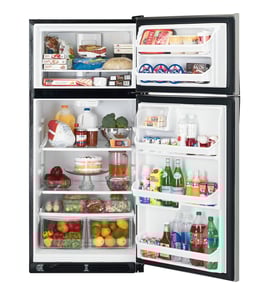



What are the disadvantages of a top mount fridge?
Top-mount refrigerators like the Hotpoint HTR16ABSJRWW are reliable and space-efficient, but the main disadvantages are less convenient fresh-food access (more bending), fewer organization features than many bottom-freezer designs, and fewer built-in dispenser options.
Common drawbacks to expect
- Fresh food is lower: you bend more often to reach everyday items in the refrigerator section.
- Freezer is easiest to access: great for frozen foods, but not ideal if you use fresh foods most.
- Organization can be simpler: fewer drawer and shelf configurations compared with many bottom-mount models.
- Limited dispenser features: many top-mount units do not include an external ice or water dispenser.
- More temperature variation by zone: top areas can run colder; lower crisper areas can run warmer depending on airflow and loading.
Quick comparison: top-mount vs bottom-freezer
| Feature | Top-mount (like HTR16ABSJRWW) | Bottom-freezer (typical) |
|---|---|---|
| Fresh-food access | Lower, more bending | Eye-level, easier access |
| Freezer access | Eye-level | Lower drawer, more bending |
| Storage flexibility | Basic, straightforward | Often more configurable |
| Dispensers | Less common | More common |
How to reduce the impact of the disadvantages
- Put daily-use items on the upper refrigerator shelves to reduce bending.
- Keep heavier items (milk, juice) on a middle shelf, not in the crisper.
- Avoid overpacking; blocked vents reduce airflow and can cause warm spots.
- Make sure the cabinet is level so doors close consistently; leveling guidance is in the HTR16ABSJRWW installation guide.
- If you are missing storage pieces, replacing worn shelves and drawers can restore usability (for example, a damaged crisper can be replaced with the rca refrigerator crisper drawer WR32X1104).
Why it matters
These tradeoffs affect daily comfort, food organization, and temperature consistency. If you prioritize easy access to fresh foods and flexible storage, a bottom-freezer style often feels more convenient; if you want a simpler layout and easy freezer access, top-mount can be the better fit.
Last updated: February 2026
Is top mounted refrigerator better than bottom mounted?
A top-mount refrigerator like the Hotpoint HTR16ABSJRWW is better when you want strong freezer performance, simple organization, and typically lower purchase and repair costs; a bottom-mount is better when you want fresh food at eye level and bend less. The “better” choice depends on how you use your refrigerator.
Quick comparison: top-mount vs bottom-mount
| Feature | Top-mount (freezer on top) | Bottom-mount (freezer on bottom) |
|---|---|---|
| Fresh food access | Lower, more bending | Higher, less bending |
| Freezer access | Easier, at chest/eye level | Lower, more bending |
| Typical cost | Lower | Higher |
| Repair complexity | Often simpler | Often more complex |
| Best for | Frozen-food heavy households | Fresh-food heavy households |
When a top-mount is the better pick
- You use the freezer often and want it at a comfortable height.
- You prefer a simpler layout with fewer specialty drawers and mechanisms.
- You want a refrigerator that is typically easier to move, level, and service.
- You want straightforward temperature control; this model uses a dial with settings 1 (warmest) to 9 (coldest), and we recommend starting at 5 and allowing 24 hours to stabilize.
- You want a design that usually tolerates tight kitchens well when installed with proper clearances.
When a bottom-mount is the better pick
- You access fresh food many times per day and want shelves at eye level.
- You want wider refrigerator drawers and more “grab-and-go” organization.
- You are willing to trade higher cost for convenience and layout.
Why it matters for performance and installation
Airflow and installation clearances affect how any refrigerator runs. For this Hotpoint top-mount style, plan for typical clearances of 3/4 inch at the sides, 1 inch at the top, and 1 inch at the back, and level the front slightly high so doors close easily (details in the HTR16ABSJRWW installation guide).
If you are deciding based on fit
- Measure the opening (width, height, depth) and door swing space.
- Confirm you can maintain the recommended clearances.
- Plan for moving space; keep the unit upright during transport.
For model-specific features and setup details, use the HTR16ABSJRWW owner’s manual.
Last updated: February 2026
What is the upper part of a fridge called?
On the Hotpoint HTR16ABSJRWW top-mount refrigerator, the upper compartment is the freezer. It is designed to keep foods frozen and to help the refrigerator maintain safe storage temperatures by circulating cold air down into the fresh food section.
What the freezer does (and what it is not)
- Freezes and stores items long-term at sub-zero temperatures
- Supplies cold air to the refrigerator section through internal vents/ducting
- Supports ice making (ice trays or optional ice maker setups on some models)
- Is not the “fridge” section; the lower compartment is the fresh food (refrigerator) compartment
Quick terminology guide
| Common name | Correct name | Where it is on HTR16ABSJRWW | Main purpose |
|---|---|---|---|
| Upper part | Freezer compartment | Top | Freezing and frozen storage |
| Lower part | Fresh food compartment | Bottom | Refrigerated (not frozen) storage |
If temperatures seem off between the top and bottom
If the freezer is cold but the refrigerator section is warm, we focus on airflow and door sealing first.
- Confirm the doors close fully and nothing is holding them open
- Avoid blocking vents between compartments with food packages
- Set the temperature control colder and allow 24 hours to stabilize
- Check for excess frost in the freezer (can restrict airflow)
- Inspect door gaskets for gaps or tears
Helpful model-specific reference: HTR16ABSJRWW owner's manual
Why it matters
Knowing the correct compartment name helps you order the right parts (like a freezer door gasket) and follow the right troubleshooting steps for cooling, frost buildup, and airflow issues.
Last updated: February 2026
How do you fix a refrigerator that is not cooling on top?
If your Hotpoint HTR16ABSJRWW top-mount refrigerator is not cooling in the fresh food (top) section, we fix it by restoring airflow and proper temperature control: set the temperature control dial colder (start at 5), clear any blocked freezer air duct, and give the unit a full 24 hours to stabilize (per the HTR16ABSJRWW owner's manual).
Quick checks that solve most “warm top” problems
- Make sure the temperature control dial is not set to 0 (0 stops cooling in both compartments).
- Set the dial one step colder, then wait 24 hours before changing it again.
- Check for packages blocking the air duct/vents in the freezer; that duct feeds cold air to the refrigerator section.
- Confirm the doors close fully and are not being held open by food containers.
- Reduce frequent door openings for a day to let temperatures recover.
Airflow and frost: what to look for
Cold air is made in the freezer and moved into the refrigerator section through an air duct. If that path is blocked by food, ice, or a failed fan, the top section warms up.
| What you notice | Most likely cause | What we do first |
|---|---|---|
| Freezer is cold, top is warm | Blocked freezer air duct or poor airflow | Clear duct, rearrange items, recheck in 24 hours |
| Frost/ice buildup in freezer back wall | Defrost system issue | Inspect defrost components; consider refrigerator defrost heater WR51X10038 |
| Warm temps and dusty back/bottom area | Poor heat release at condenser | Clean condenser area (see manual guidance) |
When a part is commonly involved
If airflow is clear but the top still will not cool, these model-matched parts are common suspects:
- Refrigerator freezer air duct WR17X11891 (cracked, loose, or obstructed ducting)
- Evaporator fan (if you do not hear it running when the compressor is on)
- Defrost system components such as the refrigerator defrost heater WR51X10038
Why it matters
Running warm in the fresh food section can spoil food quickly and forces the compressor to run longer, which increases energy use and can accelerate wear on cooling components.
Last updated: February 2026





