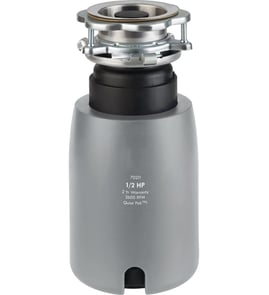

Can you buy parts for a garbage disposal?
Yes. You can buy replacement parts for a garbage disposal, and many repairs are worth doing when the motor still runs and the housing is not leaking. For the Kenmore 17567541 garbage disposal, we recommend matching parts by the exact model number to ensure proper fit and safe operation.
These are the most frequently replaced items on disposals like the Kenmore 17567541:
- Splash guard (sink baffle) to reduce splashing and help quiet operation
- Stopper to block the drain opening when needed
- Reset button and overload protector (built into the unit on many models)
- Power cord kit (if your disposal uses a plug-in connection)
- Mounting hardware (mounting ring, screws, cushion mount) for leaks at the sink flange
- Discharge tube and gasket to stop drips at the outlet
Because garbage disposal parts vary by mount style and outlet orientation, we use the model number as the best match point.
- Confirm the model number is 17567541 on the disposal label
- Identify what is failing (leak, jam, won’t start, loud grinding)
- Compare your existing part visually (shape, mount style, screw locations)
- If the disposal is hardwired, plan for electrical-safe disassembly
- Use our model-based search on Sears PartsDirect to locate compatible parts lists
Many “bad disposal” symptoms are caused by a simple issue.
| Symptom | Often caused by | What to try first |
|---|---|---|
| Hums but won’t spin | Jammed impellers | Turn off power; free the jam from below if your unit has a hex socket |
| Completely dead | Tripped overload or breaker | Press reset; check breaker/GFCI |
| Leaking under sink | Loose connections or worn gasket | Tighten fittings; inspect discharge gasket and mount seal |
| Loud metal noise | Foreign object | Turn off power; remove object with tongs (not hands) |
Using the correct Kenmore 17567541 garbage disposal parts helps prevent leaks, reduces vibration and noise, and avoids electrical or mounting issues that can happen when a part does not match your disposal’s mount system.
Last updated: February 2026
How to know if a garbage disposal is compatible?
A garbage disposal is compatible when it matches your sink’s drain opening and mounting style, your plumbing layout (including dishwasher connection), and your electrical setup. For Kenmore model 17567541, confirm these fit points before you buy or install to avoid leaks, vibration, or poor draining.
- Mounting system: 3-bolt mount vs. other proprietary mounts; the disposal must match your sink flange and mounting ring style.
- Drain opening size: Most kitchen sinks use a 3-1/2 inch drain opening; verify your sink opening and flange type.
- Discharge outlet alignment: The outlet height and direction must line up with your P-trap and drain pipe without forcing the pipes.
- Dishwasher inlet: If you have a dishwasher, make sure the disposal has a dishwasher knockout/inlet and that you can route the hose cleanly.
- Electrical connection: Confirm corded vs. hardwired setup and that power is properly switched and grounded.
- Space under the sink: Check clearance around the disposal body, drain lines, and any water filtration or trash pull-out.
- Look under the sink and identify the mount type (common 3-bolt mount has three evenly spaced “ears”).
- Measure the sink drain opening (most are 3-1/2 inches) and note the flange condition.
- Check where the P-trap sits relative to the bottom of the sink; a deeper disposal can require plumbing changes.
- If a dishwasher is present, confirm the hose can reach the disposal inlet without kinks.
| What you see | What it usually means | Typical fix |
|---|---|---|
| Disposal won’t lock onto mount | Mount style mismatch | Replace mount kit or choose matching mount style |
| Slow draining after install | Outlet height misaligned or partial blockage | Rework trap alignment; clear drain line |
| Dishwasher won’t drain | No inlet or knockout not removed | Use correct inlet; remove knockout and retrieve plug |
| Excess vibration/noise | Loose mount, unbalanced load, or worn components | Re-seat mount; tighten; inspect for damage |
A correct match protects the sink flange seal, prevents leaks at the discharge tube, and keeps the disposal from stressing your drain plumbing. It also helps the motor run smoothly and reduces clogs.
For model-number verification before ordering, use how to find your appliance model number (and what it means for parts).
Last updated: February 2026
What is the average lifespan of a garbage disposal?
Most garbage disposals last about 8 to 12 years with normal use and basic care. For your Kenmore 17567541 garbage disposal, lifespan depends most on what goes down the drain, how often it runs, and whether jams and leaks are addressed quickly.
| Usage pattern | Typical lifespan | What usually shortens it |
|---|---|---|
| Light (small household, careful use) | 10 to 12 years | Corrosion, occasional jams |
| Average (daily use) | 8 to 10 years | Fibrous foods, frequent stalling |
| Heavy (large household, frequent grinding) | 6 to 8 years | Overheating, worn seals, leaks |
- Persistent leaks from the housing or bottom seal
- Frequent resets or humming without grinding
- Grinding plate turns slowly or stalls under light loads
- Loud metal-on-metal noise that returns after clearing a jam
- Strong odors that come back quickly after cleaning
- Run cold water before, during, and 10 to 20 seconds after grinding
- Feed scraps gradually; avoid packing the chamber full
- Skip fibrous and starchy items (celery, corn husks, potato peels) and grease
- If it jams, shut off power first; free the impellers, then test
- Keep the splash guard and sink flange area clean to reduce buildup
A disposal that is worn or leaking can damage the cabinet base and create repeated clogs in the drain line. Replacing a failing unit sooner also reduces the chance of a sudden leak or a motor that will not start.
For general DIY safety and prep before troubleshooting electrical issues, we recommend reviewing are diy appliance repairs safe.
Last updated: February 2026
Why don't plumbers like garbage disposals?
Many plumbers dislike garbage disposals because they often lead to drain clogs, jammed grinding chambers, and leaking connections when they are treated like a trash can. With a Kenmore garbage disposal model 17567541, the safest approach is to grind only small, soft scraps and keep grease and fibrous waste out of the sink.
Garbage disposals can move food waste into the plumbing system, where it can collect and restrict flow. These are the most common troublemakers:
- Fibrous foods (celery, corn husks, onion skins) that wrap and tangle
- Starchy peels and scraps (potato peels, pasta, rice) that turn into paste
- Coffee grounds that settle and build up like sediment
- Grease, fats, and oils that coat pipes and trap debris
- Eggshells and bones that create gritty sludge or jam the impellers
Using the disposal correctly prevents most “plumber problems” and extends motor life.
- Run cold water before, during, and after grinding
- Feed scraps slowly; avoid dumping a full plate at once
- Cut larger scraps into smaller pieces
- Keep grease and cooking oil out of the drain (wipe pans first)
- If the disposal jams, shut off power and clear the jam before resetting
| Category | Usually OK in small amounts | Avoid putting in the disposal |
|---|---|---|
| Soft foods | small leftovers, citrus peels | large volumes at once |
| Fibrous/starchy | none recommended | celery, corn husks, potato peels, pasta, rice |
| Grease/protein | none recommended | grease, fat, bones, eggshells |
Most disposal-related service calls are really plumbing problems: slow drains, backups, and leaks at the sink flange, dishwasher inlet, or drain trap. Keeping the wrong items out reduces clogs and helps your Kenmore 17567541 run quieter and longer.
For more DIY basics and tool prep before troubleshooting, use our guide: must have tools for appliance repair.
Last updated: February 2026