
What is the 4 inch rule for drill press?
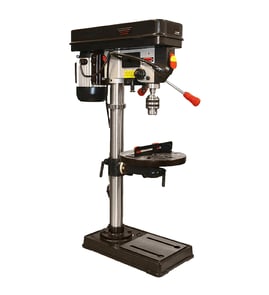
The 4-inch rule for a drill press means we keep our hands and fingers at least 4 inches away from the rotating drill bit and any spinning workpiece. On a Craftsman 113213870 17" drill press, that typically means clamping the material to the table and using a vise or hold-downs instead of holding the work by hand.
- Clamp the workpiece to the drill press table before you start drilling.
- Use a drill press vise for small parts; never “pinch hold” short pieces.
- Keep your hands on the feed handles, not near the bit.
- Remove the chuck key immediately after tightening the bit.
- Stop the machine before measuring, clearing chips, or repositioning the work.
- Use a brush or chip tool to clear shavings; do not use your fingers.
A drill press can grab the material and spin it like a propeller (especially with larger bits, hole saws, or when the bit binds). The 4-inch rule forces safer habits: secure workholding, controlled feed pressure, and keeping hands out of the “grab zone.”
| Task | Safer method | What to avoid |
|---|---|---|
| Drilling small parts | Vise plus clamp to table | Holding the part by hand |
| Drilling sheet metal | Backer board plus clamps | Letting the sheet flex or lift |
| Clearing chips | Brush or chip tool | Wiping chips with fingers |
| Changing bits | Unplug first | Leaving the chuck key in |
For electrical safety checks (cord, switch, motor wiring) and basic troubleshooting habits, we use the same approach shown in how to use a multimeter to test electrical parts video.
Last updated: February 2026
What are the measurements of a drill press?
For the Craftsman 113213870 17-inch drill press, the key “measurement” most people mean is the swing (capacity), plus the machine’s overall footprint and height. A 17-inch drill press has a 17-inch swing (about 8-1/2 inches from spindle center to the column), while overall size varies by stand, table position, and motor setup.
- Swing (capacity): twice the throat depth; tells you the largest circle you can drill from an edge
- Throat depth: spindle center to column (half the swing)
- Max drilling depth (quill travel): how far the bit can feed downward
- Table size and travel: affects work support and clearance
- Base footprint and overall height: determines bench or floor space needed
Because no model-specific dimensions are provided here for the Craftsman 113213870, these are the common ranges for a 17-inch class floor drill press:
| Measurement | Typical range for 17-inch class drill press | What it affects |
|---|---|---|
| Swing | 16 to 18 in. | Max workpiece reach |
| Overall height | 60 to 70 in. | Ceiling clearance, storage |
| Base footprint | 18 x 28 in. to 22 x 30 in. | Floor space |
| Table size | 10 x 10 in. to 12 x 12 in. | Work support |
- Swing: measure from spindle centerline to the column, then multiply by 2.
- Footprint: measure the base left-to-right and front-to-back.
- Overall height: measure from floor to the top of the head (belt cover).
- Working height: set the table where you use it most, then measure floor to table surface.
Getting the right measurements helps you confirm the drill press capacity for your material, plan shop space, and choose compatible accessories like vises, fences, and auxiliary tables.
For more help using our site tools to look up model details and diagrams, see how to find your appliance model number (and what it means for parts).
Last updated: February 2026
What is a good horsepower for a drill press?
A good horsepower (HP) for a drill press depends on what you drill most often. For typical DIY use on a Craftsman 113213870 17" drill press, 1/2 HP to 3/4 HP handles wood, plastics, and light metal well; choose 1 HP or more for frequent larger holes in steel and tougher materials.
- 1/3 to 1/2 HP: light-duty drilling, small bits, softwoods, plastics
- 1/2 to 3/4 HP: most home shops; hardwoods, aluminum, occasional mild steel
- 1 HP and up: regular metalworking, larger hole saws/Forstner bits, step bits, frequent use
- More HP helps most when you need steady torque at low RPM
Horsepower is only one part of “how strong” a drill press feels. These factors often make a bigger difference in real-world drilling:
- Low-speed range: lower RPM reduces overheating and bit dulling in metal
- Pulley and belt condition/tension: slipping belts mimic “low power”
- Sharp bits and correct bit type: brad-point for wood, HSS/cobalt for metal
- Feed pressure: too much pressure stalls the motor; too little work-hardens metal
- Workholding: a vise or clamps prevents grabbing and improves hole quality
| What you drill most | Typical bit size | Good motor range |
|---|---|---|
| Wood projects | 1/8" to 3/8" | 1/3 to 1/2 HP |
| Mixed DIY (wood + light metal) | up to 1/2" | 1/2 to 3/4 HP |
| Frequent steel drilling | 3/8" to 5/8"+ | 3/4 to 1 HP+ |
Choosing the right HP helps you avoid stalling, belt slip, overheated bits, and rough holes. For many users, improving speed selection, belt condition, and drilling technique delivers a bigger performance gain than jumping to a much larger motor.
If you suspect “low power” is really an electrical issue (switch, cord, connections), use how to use a multimeter to test electrical parts video to check basics safely.
Last updated: February 2026
How to use a drill press step by step?
To use your Craftsman 113213870 17" drill press safely and accurately, we set the speed for the material, install and tighten the drill bit, clamp the workpiece to the table, then drill with steady feed pressure and clear chips often. Finish by powering down and cleaning up.
- Prep the area: Clear the table, remove loose tools, and set good lighting.
- Choose the right bit: Use a sharp twist bit for metal/wood, brad-point for wood, or a Forstner bit for flat-bottom holes.
- Set the speed: Slower for larger bits and metal; faster for small bits and wood.
- Install the bit: Seat it fully in the chuck, then tighten evenly (use the chuck key in all holes if your chuck has them).
- Set the table and depth: Square the table to the bit for straight holes; set a depth stop for repeat holes.
- Clamp the work: Clamp the workpiece and back it up with scrap wood to reduce tear-out.
- Drill: Start the motor, lower the quill smoothly, and periodically raise the bit to clear chips.
- Unplug before changing bits, belts, or making adjustments.
- Remove the chuck key before turning the drill press on.
- Wear eye protection; tie back hair and avoid gloves near rotating parts.
- Clamp small parts; never hold the work by hand.
- Use cutting oil for metal to reduce heat and extend bit life.
| Material | Bit size | Typical speed | Notes |
|---|---|---|---|
| Softwood | 1/8" to 1/4" | High | Backer board reduces tear-out |
| Hardwood | 1/4" to 1/2" | Medium | Slower feed helps prevent burning |
| Mild steel | 1/8" to 3/8" | Low | Use cutting oil; clear chips often |
- Hole wanders: Center punch metal, or use an awl on wood; start with a small pilot hole.
- Burning in wood: Reduce speed, increase feed slightly, and use a sharp bit.
- Bit grabs or chatters: Clamp tighter, slow down, and check belt tension.
- Oversized hole: Tighten the chuck properly and check for bit runout.
Correct speed, solid clamping, and controlled feed pressure protect the spindle, chuck, and belts while giving you straighter holes and longer drill bit life.
For basic DIY safety practices before you start, use are diy appliance repairs safe.
Last updated: February 2026