Owner’s manual
 Error Codes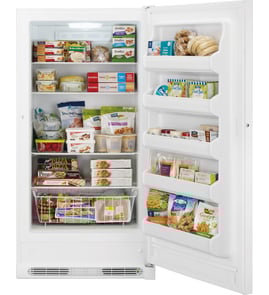

What is the most common size of an upright freezer?
Most upright freezers people buy fall in the 14 to 18 cubic foot range because it balances storage space with a footprint that fits many kitchens, garages, and basements. For your Wc Wood upright freezer model RFA17WCE, use the owner's manual to confirm the exact capacity and required clearances.
Upright freezers are usually grouped by capacity; dimensions vary by brand and design.
- Compact: 3 to 5 cu. ft. (often for apartments or overflow storage)
- Small: 5 to 9 cu. ft.
- Medium (most common overall): 10 to 16 cu. ft.
- Large: 17+ cu. ft. (bulk storage)
| Capacity class | Width (typical) | Height (typical) | Depth (typical) |
|---|---|---|---|
| Compact (3 to 5) | 20 to 24 in. | 31 to 36 in. | 20 to 24 in. |
| Medium (10 to 16) | 24 to 32 in. | 55 to 72 in. | 24 to 30 in. |
| Large (17+) | 28 to 33 in. | 65 to 76 in. | 28 to 32 in. |
Even if two freezers have the same cubic feet, they can fit differently once you include airflow and door swing. The RFA17WCE manual calls out these common clearance needs:
- Plan for about 1 inch of space on each side for ventilation
- Leave at least 1 inch between the back of the cabinet and the wall
- Allow about 3 inches between the top and overhead cabinets
- Add extra room on the hinge side if the door needs to swing past a wall
Choosing the “most common” size is less important than choosing a freezer that can breathe and open fully. Proper clearance helps the freezer maintain temperature, reduces moisture issues, and prevents the cabinet from rubbing walls or cabinets.
Last updated: February 2026
How to defrost woods upright freezer?
Your Wc Wood upright freezer model RFA17WCE uses automatic defrost, so you normally do not perform a full manual defrost to remove thick ice. For routine care, we focus on cleaning and clearing any light frost around the door area; follow the cleaning and care steps in the RFA17WCE owner's manual.
Automatic defrost means the freezer handles normal frost control during operation. Manual defrost steps are only useful for unusual situations like a door left ajar, a bad door seal, or heavy humidity causing abnormal frost.
- Keep the door closed as much as possible to reduce moisture entry.
- Wipe up spills immediately to prevent odors and ice patches.
- Clean the interior about once a month with mild detergent and warm water.
- For odors, use a baking soda solution (2 tablespoons baking soda to 1 quart warm water).
- Dry surfaces thoroughly before reloading food.
If you see heavy frost that is interfering with door closing or airflow, we use a controlled thaw and cleanup process.
- Move food to a cooler to keep it frozen.
- Turn the temperature control to OFF (if equipped) and unplug the unit.
- Leave the door open and place towels to catch meltwater.
- Use a plastic scraper only after the ice softens.
- Wipe water from walls with a towel or sponge.
- Do not use an ice pick, knife, or sharp tool to chip ice.
- Do not use abrasive or harsh cleaners.
- Do not place a fan or any electrical device inside the freezer.
| Situation | Best action | Goal |
|---|---|---|
| Normal operation | No manual defrost | Let automatic defrost manage frost |
| Light frost at door | Clean and dry; check door closure | Stop moisture intrusion |
| Heavy, abnormal frost | Unplug, door open, towels, plastic scraper | Restore airflow and sealing |
Automatic defrost keeps cooling efficient; abnormal frost usually points to warm, moist air getting in. Correct cleaning and safe thawing protect the liner, door gasket, and shelves.
Last updated: February 2026
How much food can a 17 cubic foot freezer hold?
A 17 cubic foot upright freezer like the Wc Wood RFA17WCE holds about 17 ft³ (roughly 480 liters) of space; how much food that becomes depends on packaging, shelf layout, and leaving airflow room. For loading and food-storage guidance, use the RFA17WCE owner's manual.
Cubic feet is volume, not a weight rating. Most households find a 17 ft³ upright freezer comfortably stores a large grocery run plus bulk items when organized well.
- Plan on volume-based storage, not pounds
- Bulky boxes and irregular shapes reduce usable space fastest
- Flat, stackable packages maximize capacity
- Leaving small gaps helps cold air circulate and keeps temperatures even
- Shelves and door bins affect how efficiently you can pack items
| What you are storing | Packs efficiently? | Space impact |
|---|---|---|
| Bagged vegetables, flat-wrapped meats | Yes | Low per item |
| Pizza boxes, bakery trays | No | High per item |
| Large roasts, turkeys | Mixed | High, awkward shapes |
| Meal-prep containers (uniform) | Yes | Low to medium |
- Freeze liquids and meats flat first, then stand them up like files.
- Use same-size bins or baskets to group categories (meat, veg, meals).
- Keep frequently used items near the front to reduce door-open time.
- Avoid packing tightly against interior walls or blocking air passages.
- Label and date packages to prevent forgotten food and freezer burn.
Overpacking an upright freezer can restrict airflow, which causes temperature swings, slower recovery after door openings, and uneven freezing. Organizing by shape and access keeps food safer and reduces frost and odor issues.
Last updated: February 2026