Owner’s manual




How do I reset my GE He sensor dry dryer?
To reset your GE PTD60GBSR0WS sensor-dry (HE) dryer, we recommend ending the current cycle, putting the dryer into idle, then powering it back on to restart the controls. This clears most “stuck” control states without changing your cycle settings permanently.
Quick reset steps (PTD60GBSR0WS)
- Press Start/Pause to pause the cycle.
- Press Power to put the dryer into idle (or “wake” the panel first if it is asleep).
- Wait 60 seconds.
- Press Power again.
- Re-select your cycle and options.
- Press Start with the door fully closed.
For control behavior and normal display messages (like “Sensing” or “Pause”), follow the PTD60GBSR0WS owner’s manual.
If “Sensing” seems stuck (common with sensor dry)
Sensor dry cycles can appear to “hang” while the dryer monitors moisture. Before assuming a fault, check these basics:
- Clean the lint filter before starting the load.
- Avoid mixing very heavy and very light fabrics in the same load.
- Make sure the exhaust vent is not restricted.
- Try Timed Dry as a comparison test.
What you’ll see on the display
| Display/status | What it usually means | What to do |
|---|---|---|
| Sensing | Moisture is being measured | Let it run; check venting and load mix |
| Pause | Cycle is paused | Press Start to resume |
| Dark/asleep panel | Controls are in sleep mode | Press Power to wake |
When a reset does not help
If the dryer still will not start after the reset, these are the most common causes to check next:
- Door not fully closed (the dryer will not start with the door open)
- House breaker tripped (some dryers use two breakers)
- Control panel asleep (press Power)
- Start/Pause not pressed after selecting a cycle
Why it matters
A simple reset restores normal control operation after a power glitch or an interrupted cycle, and it helps you separate a true heating/venting issue from normal sensor-dry “Sensing” behavior.
Last updated: February 2026
What are the most common issues with PTD60GBSR0WS?
The most common issues we see with the GE PTD60GBSR0WS dryer are no heat or poor drying, unusual squealing or thumping noises, and problems starting or staying running. These symptoms usually trace back to airflow restrictions, worn drum support parts, or failed temperature sensing and control components.
Most common symptoms and what they usually mean
- Takes too long to dry: clogged lint screen, blocked venting, or a weak blower wheel
- No heat or low heat: thermostat or thermistor problems, or a gas burner/valve issue on gas models
- Squealing or grinding: worn idler pulley, belt, or drum glide/bearing surfaces
- Thumping or rumbling: drum support wear or a damaged drum component
- Won’t start: door switch not closing, control issue, or motor problem
Quick checks we recommend first
- Clean the lint screen and confirm strong airflow at the exterior vent hood.
- Run a timed dry cycle; compare heat and airflow to normal operation.
- Listen for noise location: front (glides/felt seal) vs bottom (idler/belt) vs rear (bearing area).
- Check the door closes firmly and the latch engages.
Parts that commonly fix these problems (when symptoms match)
| Symptom | Common part to inspect | Example part for this model |
|---|---|---|
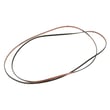
| Squealing, drum not turning | Belt and idler system | GE dryer drum belt WE03X29897, dryer idler pulley WE03X31620 |
| Dryer won’t start when door is shut | Door switch | Dryer door switch WE04X28977 |
| Poor drying, overheating, or temp errors | Temperature sensing | Dryer thermistor WE4M448, dryer heating element control thermistor WE4M398 |
| Weak airflow noise, poor drying | Blower wheel | Dryer blower wheel WH16X34317 |
Why it matters
Dryer problems often stack up: restricted venting makes drying slow, which overheats the dryer and can damage thermostats, thermistors, and drum support parts. Fixing airflow and worn moving parts restores performance and helps prevent repeat failures.
Helpful references
- Use the PTD60GBSR0WS owner’s manual for cycle selection, venting guidance, and basic checks.
- If you’re seeing a code, match it using GE cleanspeak dryer error codes (common for many GE dryer platforms).
Last updated: March 2026
Where to find part number on GE dryer?
On your GE dryer model PTD60GBSR0WS, the model and serial label (used to look up the correct replacement parts) is located on the front of the dryer behind the door. Use that label information when ordering parts so you get the exact match for your dryer.
Where to look on the dryer
Check these common spots first (in this order):
- Open the dryer door and look on the front panel behind the door (most common for PTD60GBSR0WS).
- Check the door opening frame area for a sticker or metal tag.
- Look for a label that lists Model and Serial (sometimes also “M/N” and “S/N”).
- Write the numbers down exactly as shown, including any letters.
For the exact label location reference, use the PTD60GBSR0WS owner's manual.
What “part number” usually means
Most customers mean one of these two things:
| What you need | Where you find it | Example format |
|---|---|---|
| Dryer model number | Rating label on the dryer | PTD60GBSR0WS |
| Replacement part number | On the part itself or parts list | WE03X29897 |
If you are trying to identify a specific replacement part (like the belt), the part number is typically printed on the packaging or listed in the parts diagram. For example, this model uses a GE dryer drum belt WE03X29897.
Why it matters
GE often makes similar-looking dryers with different components. Using the exact model number from the label helps us match the correct items like the drum belt, door switch, thermistor, or idler pulley for PTD60GBSR0WS.
Last updated: February 2026