Owner’s manual

Can you use an 8 inch blade on a 10 inch table saw?
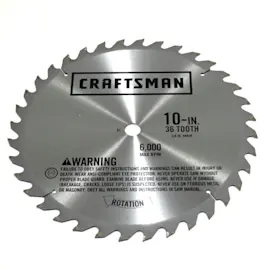
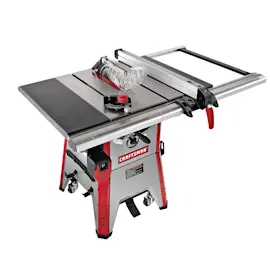
Yes. On the Craftsman 315349720 table saw, you can use an 8-inch blade as long as it has the correct arbor hole, is rated for the saw’s speed, and its kerf thickness stays within the limits stamped on the riving knife. Your saw’s maximum blade capacity is 10 inches. See the owner's manual for blade and riving-knife requirements.
What to check before installing an 8-inch blade
- Arbor hole size: Use only blades with the correct size hole for the arbor (never “make it fit”).
- Blade speed rating: The blade must be rated at or above the saw’s operating speed.
- Kerf thickness: Kerf must fall within the thickness range stamped on the riving knife.
- Washer and bolt fit: Use the correct blade washers and blade bolt for safe clamping.
- Guarding compatibility: Keep the blade guard, anti-kickback pawls, and riving knife in place for through cuts whenever possible.
8-inch vs 10-inch blade: what changes
| Item | 10-inch blade | 8-inch blade |
|---|---|---|
| Max cut depth | Deeper cuts | Shallower cuts |
| Best use | General ripping and crosscuts | Non-through cuts (common for dado-style work) and lighter-depth cuts |
| Setup sensitivity | Standard | More sensitive to alignment and riving-knife/guard fit |
Why it matters
Using a smaller blade is usually safe on a 10-inch saw, but the wrong arbor hole, an under-rated blade, or a kerf that does not match the riving knife increases kickback risk and can prevent proper guarding. Matching the blade to the riving knife and hardware keeps cuts accurate and the saw safer.
Recommended next steps
- Confirm the blade’s arbor hole and speed rating on the blade label.
- Verify kerf compatibility using the riving-knife stamp and the blade packaging.
- If you are changing blades, follow our guide: how to replace a table saw blade.
Last updated: February 2026
How to get rid of an old table saw?
If your Craftsman table saw model 315349720 still runs safely, the best way to get rid of it is to sell or donate it; if it’s damaged or unsafe, recycle it as scrap metal or use a local bulky-item drop-off. Before moving it, unplug it and remove the blade and accessories per the 315349720 owner's manual.
Best options (from easiest to most responsible)
- Sell it (local pickup): working saws, fences, miter gauge, and stands often have value.
- Donate it: only if it operates safely and includes key safety parts (blade guard, riving knife).
- Give it away: list it as “free, pickup only” and clearly state condition.
- Recycle as scrap metal: many recycling centers accept power tools; remove non-metal add-ons if requested.
- Municipal bulky-item or recycling event: good for broken tools when scrap drop-off is not convenient.
Safety steps before disposal or transport
The manual emphasizes safe handling and avoiding accidental starting. Use these steps:
- Unplug the saw and keep the switch in OFF.
- Remove the blade guard and blade (package the blade so teeth cannot cut through cardboard).
- Secure moving parts (rip fence, miter gauge, extension/outfeed supports) so they cannot slide.
- Lift with help; keep the saw close to your body and lift with your legs.
- Do not transport it loose in a vehicle; strap it down to prevent tipping.
What to do with common table saw items
| Item | Best disposal route | Notes |
|---|---|---|
| Saw body and stand | Scrap metal or bulky-item drop-off | Remove loose accessories first |
| Saw blade | Metal recycling (if accepted) | Wrap and label as sharp |
| Power cord | Leave attached unless recycler requests removal | Do not cut live cords; keep unplugged |
| Accessories (fence, miter gauge) | Sell, donate, or recycle | Often reusable even if saw is not |
Why it matters
A table saw is heavy and has sharp components; securing the saw and removing the blade reduces injury risk during lifting and loading. Recycling also keeps metal out of landfills.
Last updated: February 2026
What are the common table saw mistakes?
Common table saw mistakes on the Craftsman 315349720 involve skipping key safety devices and using unsafe cutting techniques, which increases kickback risk and puts hands in the blade path. Following the setup and operating steps in the 315349720 owner's manual prevents most avoidable injuries and bad cuts.
Most common mistakes we see
- Not wearing eye protection and appropriate PPE.
- Running the saw without the blade guard and riving knife when the cut allows it.
- Cutting freehand (not using the fence, miter gauge, or a proper jig).
- Standing directly in line with the blade (poor body position increases injury risk during kickback).
- Letting hands get too close to the blade; not using a push stick when required.
- Using a blade that is dull, dirty with resin buildup, or the wrong type for the cut.
- Using a blade kerf thickness that does not match the riving knife limits.
Quick “do this instead” checklist
| If you are about to… | Do this instead | Why it matters |
|---|---|---|
| Rip a board | Use the rip fence plus riving knife and guard (when possible) | Helps keep the kerf open and reduces kickback |
| Make a crosscut | Use the miter gauge (not freehand) | Keeps the work controlled and square |
| Push a narrow piece | Use a push stick or push block | Keeps hands out of the blade path |
| Adjust or change anything | Unplug the saw and confirm the switch is OFF | Prevents accidental starting |
Why these mistakes matter (kickback and blade-path control)
Kickback happens when the blade binds or stalls and throws the workpiece back with force. Most “beginner mistakes” are really control mistakes: removing the riving knife, reaching over the blade, standing in the line of fire, or trying to guide the wood by hand instead of using the fence or miter gauge.
Safer setup and operating habits for this model
- Mount the saw securely to a firm workbench or approved leg stand; never operate it on the floor.
- Keep the work area well lit and clear of obstructions before cutting.
- Use only recommended accessories and follow their instructions.
- Make practice cuts in scrap wood and verify alignment with a framing square before finish cuts.
For technique refreshers and safe cutting basics, use our DIY guide: how to use a table saw safely.
Last updated: February 2026