 Owner’s manual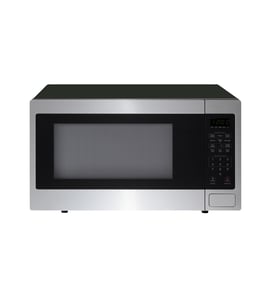

How to reset a Sharp microwave oven?
To reset a Sharp microwave like model R-1210, we unplug it (or switch off the breaker), restore power, then press STOP/CLEAR to clear the display and re-enter the clock. This clears interrupted programs and restores normal operation.
Quick reset steps (R-1210)
- Unplug the microwave, or turn off the circuit at the breaker.
- Wait about 5 minutes.
- Restore power.
- Close the door fully.
- Press STOP/CLEAR.
- Set the clock again (the R-1210 uses a 12-hour clock).
For the exact button sequence and display prompts, use the R-1210 owner's manual.
What a reset fixes (and what it does not)
A reset is most helpful after a power interruption or when the control seems “stuck.” It will not fix a heating failure caused by a component problem.
| Symptom | Reset likely helps? | What to do next |
|---|---|---|
| Display shows odd characters or flashing after power returns | Yes | Press STOP/CLEAR, then set clock |
| Cooking program disappeared mid-cycle | Yes | Re-enter settings and start again |
| Runs but does not heat | No | Use why is my microwave not heating |
| Time counts down unusually fast | Sometimes | Check and cancel Demonstration Mode per manual |
Why it matters
The R-1210 control is designed to erase cooking programs after an electrical interruption; pressing STOP/CLEAR and resetting the clock restores normal day-to-day use and prevents confusing display behavior.
Last updated: February 2026
What are the parts of the microwave?
A Sharp R-1210 microwave is made up of the cooking cavity and door system, the turntable system, the control panel, and the internal heating and safety components that generate and manage microwave energy. For the exact component names and locations, use the R-1210 owner's manual.
Main microwave components (what they do)
- Cooking cavity: The metal interior where food sits and energy is contained.
- Door and interlock switches: Prevent operation when the door is open.
- Turntable and turntable support: Rotates food for more even heating (the manual notes not to operate without these).
- Control panel and electronic control: Lets you set time, power level, and cooking modes.
- Magnetron: Creates the microwave energy (you may hear it cycle on and off at lower power levels).
- High-voltage section: Typically includes a high-voltage transformer, capacitor, and diode that power the magnetron.
- Cooling fan and vents: Move air to keep components cool; vents must not be blocked.
Quick “outside vs. inside” breakdown
| Area | Common parts you can see | Common parts you usually cannot see |
|---|---|---|
| Exterior | Control panel, door, handle, power cord | Door interlock switches, wiring harness |
| Interior | Cooking cavity, turntable, turntable support | Waveguide cover, magnetron, high-voltage components, cooling fan |
Why it matters
Knowing the major parts helps you troubleshoot symptoms faster. For example, “runs but doesn’t heat” often points to the magnetron or high-voltage section, while “won’t start” often points to the door interlock system or a fuse.
Related troubleshooting and repair help
- Use why is my microwave not heating if the unit runs but food stays cold.
- Use how to replace a microwave fuse if the microwave is completely dead or goes dead when starting.
- Use never do these things with a microwave to avoid common causes of arcing, overheating, and damage.
Last updated: February 2026
What parts can be salvaged from a microwave?
From a Sharp R-1210 microwave, you can salvage some useful non-cooking components (like switches, motors, and hardware), but we do not recommend salvaging or reusing high-voltage parts because they can store or generate dangerous voltage even after the unit is unplugged. For safe handling rules, use the R-1210 owner's manual.
What’s typically worth salvaging (safer items)
These parts are commonly reusable for repairs, projects, or spares:
- Door interlock switches and mounting brackets
- Turntable motor (if your model uses a turntable) and coupler pieces
- Cooling fan motor and fan blade
- Interior light socket and lens cover
- Power cord, strain relief, and cord grommet
- Screws, clips, and non-melted plastic trim pieces
Parts we do not recommend salvaging (high-voltage)
Microwaves contain a high-voltage circuit used for heating. These components can be hazardous to handle and are best left to qualified service:
- High-voltage capacitor
- High-voltage transformer
- High-voltage diode
- Magnetron
Quick safety comparison
| Component type | Examples | DIY salvage recommendation |
|---|---|---|
| Low-voltage / mechanical | switches, motors, fan, cord | OK if unplugged and handled carefully |
| High-voltage | capacitor, transformer, diode, magnetron | Not recommended |
Why it matters
The R-1210 manual emphasizes basic microwave safety like avoiding combustible materials in the cavity and shutting off power if something ignites. That same safety mindset applies to teardown: the high-voltage section is the main risk area, and it is not a typical DIY salvage project.
If you’re salvaging because the microwave is not heating
If the unit runs but doesn’t heat, the issue is usually in the high-voltage heating circuit or door interlock system. Use our troubleshooting overview in why is my microwave not heating to narrow down symptoms before deciding whether to repair or retire the microwave.
Last updated: February 2026
Where to find serial number on Sharp microwave?
On the Sharp R-1210 microwave, the serial number is on the nameplate label inside the oven cavity. Open the door and look along the cavity frame area for the model and serial label; we use that number for parts lookup and service.
Where to look on the unit
Check these common nameplate locations on the R-1210:
- Inside the oven cavity, on the cavity frame (visible with the door open)
- Along the door opening edge area (not on the glass)
- On a label that lists both MODEL and SERIAL
- Near the cooking cavity opening, not on the outer cabinet
For the exact label location and how Sharp references the nameplate, use the R-1210 owner's manual.
What the serial number label looks like
Most Sharp microwave nameplates include the same core fields:
| Label field | What it’s used for |
|---|---|
| Model number | Identifies the exact product version (R-1210) |
| Serial number | Identifies your specific unit for service history and support |
| Electrical ratings | Confirms voltage/wattage requirements for safe installation |
Why it matters
We use the serial number to match the correct replacement parts and service information, especially when a model has multiple production runs with small internal changes.
Quick tips before you write it down
- Copy the serial number exactly as printed (include letters and dashes if shown)
- Take a clear photo of the nameplate for your records
- Record the purchase date alongside the serial number for future service
Last updated: February 2026
Why does my Sharp microwave just stop working?
If your Sharp microwave model R-1210 suddenly stops working, the most common causes are a power interruption (outlet, breaker, or cord), a door not fully latching, or an internal safety device such as a fuse opening. Start with basic power and door checks before moving to service-level diagnostics.
Quick checks we recommend first
- Confirm the display is on; if it is blank, check the home circuit breaker and try a different outlet.
- Make sure the door closes firmly and evenly; a misaligned door or latch can prevent operation.
- Unplug the microwave for 2 to 3 minutes, then plug it back in to reset the control.
- Run the built-in heat test: heat 1 cup of water for 1 minute on HIGH (100%).
- Listen for the cooling fan and watch for turntable rotation during the test.
What the 1-cup water test tells you
The R-1210 manual’s pre-service checklist uses these observations to narrow the problem. Use this table to interpret what you see (and what to do next).
| What happens during the test | What it usually points to | What to do next |
|---|---|---|
| No display, no light, no fan | No power to the unit | Check outlet, fuse/circuit breaker, and power connection per the R-1210 owner's manual |
| Display works but nothing runs | Door interlock/latch issue | Recheck door alignment and latching; inspect for visible damage and stop using if the door is bent |
| Runs (fan/light/turntable) but water stays cool | Heating circuit problem | Stop and schedule service; internal high-voltage components require professional handling |
| Countdown runs abnormally fast | Demo mode enabled | Turn off demonstration mode per the R-1210 owner's manual |
Why it matters
A microwave can appear “dead” when a safety interlock or fuse opens, and it can also appear to “run” while not heating if the magnetron or related high-voltage components are failing. The 1-cup water test quickly separates a power/door issue from a heating-system issue.
Safety notes we follow
- Do not operate the microwave if the door is misaligned, seals are damaged, or latches feel loose.
- Do not attempt internal microwave repairs yourself; high-voltage parts can retain a dangerous charge.
- If you suspect a blown fuse and you are qualified to test electrical parts, follow a proven procedure such as how to replace a microwave fuse.
Last updated: February 2026


