 Installation guide
 Owner’s manual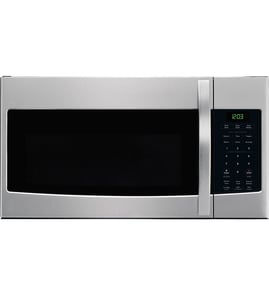






Are all range hood microwaves the same size?
No. Most over-the-range (range hood) microwaves are built to fit a standard 30-inch cabinet opening, but overall height and depth vary by model. For Kenmore model 40185042210, the installation guide confirms it installs in a 30-inch-wide space over ranges up to 30 inches wide; use the 40185042210 installation guide to confirm your exact clearances.
What is “standard” for over-the-range microwaves?
Most units are designed around common kitchen cabinet and range widths, so they look similar, but they are not interchangeable without checking measurements.
- Most are intended for a 30-inch cabinet opening
- Height and depth can differ enough to affect cabinet fit and door swing
- Mounting plate hole locations can vary by brand and model
- Venting style matters (recirculating vs outside top/back exhaust)
- Required clearance above the cooktop must be met
Model 40185042210 fit requirements we use for planning
The Kenmore 40185042210 installation instructions specify key “fit” constraints that help you decide if a replacement will drop in.
| Fit item | What to plan for | Why it matters |
|---|---|---|
| Cabinet opening width | 30 inches wide, unobstructed | Ensures the microwave can physically fit between cabinets |
| Range width below | Up to 30 inches wide | Keeps the microwave aligned over the cooking surface |
| Cooktop-to-cabinet bottom clearance | 30 inches or more | Helps protect cabinets and supports safe use |
| Installation type | Recirculating or outside venting | Impacts duct routing and whether you need an upper duct |
Why it matters
Even when two over-the-range microwaves are both “30-inch models,” differences in depth, mounting pattern, and venting can turn a simple swap into cabinet work or duct changes. Verifying the opening, clearances, and venting path first prevents rework.
Last updated: January 2026
Can I change the way my microwave door opens?
No. On the Kenmore 40185042210 microwave/hood combo, the door swing is not designed to be reversible, so you can’t change the hinge side to make it open the opposite direction. If the door isn’t closing or latching correctly, focus on alignment and latch components instead.
What you can do instead
- Confirm the microwave is installed level; an out-of-level cabinet or mounting can affect door alignment.
- Check for cabinet trim or an overhang that interferes with a level install.
- Inspect the latch area for cracks, looseness, or binding.
- Make sure the door closes smoothly without needing to lift or push hard.
- If the door won’t latch, stop using the microwave until the latch issue is corrected.
Installation and alignment checks (common causes of “door won’t close right”)
The installation instructions for this style of over-the-range microwave emphasize that the unit must be level. If your cabinets have a front overhang, the mounting plate position may need to be adjusted so the microwave sits level.
| Symptom | Likely cause | Best next step |
|---|---|---|
| Door rubs or feels “twisted” | Microwave not level | Re-check leveling steps in the 40185042210 installation guide |
| Door closes but won’t latch | Latch/switch area misaligned or worn | Inspect latch housing and interlock area |
| Microwave won’t run with door shut | Door interlock not engaging | Have the interlock system checked by a technician |
Why it matters
A microwave/hood combo relies on the door interlock system to operate safely. If the door is misaligned or the latch is worn, the microwave may not start, may stop mid-cycle, or may behave inconsistently.
Last updated: January 2026
What are the electrical requirements for an over-the-range microwave?
For the Kenmore 40185042210 over-the-range microwave/hood combo, plan on 120 volts AC, 60 Hz power with a properly grounded 3-prong outlet on a separate (dedicated) 20-amp branch circuit. The installation instructions list a 13.5-amp product rating and a 1.5 kW load.
What you need at the cabinet
The outlet is typically installed in the cabinet above the microwave so the factory power cord can reach it.
- 120V AC, 60 Hz supply
- Standard 3-prong grounded receptacle
- Dedicated 20-amp branch circuit (single outlet)
- Correct wire size per National Electrical Code (NEC) and local code
- Ground continuity verified before installation
Quick spec summary
| Item | What to plan for | Why it matters |
|---|---|---|
| Voltage / frequency | 120V AC, 60 Hz | Prevents nuisance trips and poor performance |
| Circuit | Separate 20A branch circuit | Avoids overload when other kitchen loads run |
| Plug/outlet | 3-prong grounded | Reduces shock risk and supports safe operation |
| Load | 13.5A, 1.5 kW (rated) | Helps an electrician size wiring and circuit |
Safety and installation notes we follow
Microwaves contain high-voltage components; electrical work should be done with power off at the breaker.
- Turn off the house fuse or open the circuit breaker before starting
- Do not use an adapter or defeat the ground prong
- If the outlet box is not properly grounded, have a qualified electrician correct it
- Keep the microwave level and follow the mounting and clearance requirements
Why it matters
A dedicated, grounded 20-amp circuit helps your Kenmore 40185042210 run reliably (heating and vent fan) without tripping breakers, and it reduces electrical shock risk during everyday use.
For the exact electrical and outlet-location requirements for your installation, use the 40185042210 installation guide.
Last updated: January 2026
What are the parts of a microwave oven?
A Kenmore microwave like model 40185042210 is built from a cooking cavity and door system, a control system, a turntable system, and a high-voltage heating system (the parts that actually create microwave energy). In a microwave/hood combo, it also includes a vent fan and grease filtration.
Main microwave systems (what they do)
- High-voltage heating system: creates microwave energy to heat food (magnetron, transformer, capacitor, diode)
- Door safety system: prevents operation with the door open (interlock switches, latch components)
- Controls and power: runs the display, keypad, and cooking programs (control box, noise filter, wiring)
- Airflow and cooling: moves air to cool components and vent cooking fumes (fan motor, ducting)
- Turntable drive: rotates the tray for more even heating (turntable motor and coupler)
Common parts you may replace on this model
The parts list for Kenmore 40185042210 includes many of the most common service items:
| System | Example part | What you’ll notice when it fails |
|---|---|---|
| Heating | Magnetron (OM75P-21-ESGN) | Runs but does not heat, or heats poorly |
| Heating | High-voltage diode (DE91-70063D) | No heat, loud hum, may blow fuse |
| Heating | High-voltage capacitor (DE96-00269A or 2501-001011) | No heat, buzzing, intermittent heating |
| Safety | Door interlock switch (3405-001034) | Won’t start, stops when door moves |
| Venting | Grease filter (DE63-00196A) | Greasy odors, reduced airflow |
Installation-related parts (microwave/hood combo specific)
Because this is an over-the-range unit, you’ll also see installation and venting components such as the mounting plate, upper duct, exhaust adaptor, and hardware. The installation instructions also cover key fit and safety details like cabinet drilling, power cord clearance, and using at least one wood screw into a wall stud.
- Follow the templates and hole locations in the 40185042210 installation guide
- Confirm your ventilation type: recirculating (ductless), outside top exhaust, or outside back exhaust
- Use proper mounting support (at least one fastener into a stud)
Why it matters
Knowing which system a part belongs to helps you troubleshoot faster. For example, “runs but won’t heat” points to the high-voltage heating system, while “won’t start” often points to the door interlock system or controls.
Last updated: January 2026


