Owner’s manual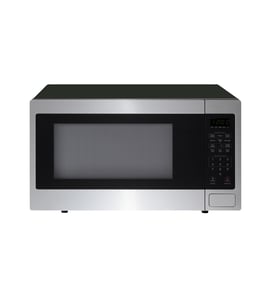

Can I put a microwave on a quartz countertop?
Yes, you can set a Sharp R-305KS countertop microwave on a quartz countertop as long as you keep the bottom vents clear, allow airflow around the unit, and avoid placing it where heat and steam from other appliances can build up. Follow the placement clearances in the R-305KS owner's manual.
Quartz is durable, but the bigger risk is trapped heat from blocked ventilation or nearby heat sources. For the Sharp R-305KS, we recommend:
- Leave at least 2 inches (50 mm) of clearance on the sides, top, and rear for air circulation.
- Keep the rear vents unblocked; do not push the microwave tight against a backsplash.
- Do not place the microwave next to or above a gas/electric range or above a wall oven (heat and steam can damage microwave components).
- Plug into a properly grounded outlet; avoid routing the cord where it can be pulled or tripped.
- If you must use an extension cord, use a 3-wire grounded cord rated 115-120V, 15A or higher.
A thin, heat-resistant pad or silicone mat is a smart add-on when:
- The microwave runs for long cook times (batch cooking, repeated reheats)
- The countertop area is tightly enclosed (limited airflow)
- You notice the countertop feels warm after use
| Item to check | What “good” looks like | Why it matters |
|---|---|---|
| Clearance | 2 inches on sides/top/rear | Prevents overheating and protects electronics |
| Location | Away from range/oven steam | Reduces heat and moisture damage |
| Venting | Back vents open | Keeps internal temperatures controlled |
| Power | Grounded outlet (3-prong) | Reduces shock risk and nuisance failures |
Microwaves like the Sharp R-305KS rely on airflow to cool internal components (including the magnetron). Poor ventilation can overheat parts, shorten component life, and transfer unnecessary heat to the quartz surface.
Last updated: February 2026
Can you replace a built-in microwave with a countertop?
Yes, you can replace a built-in microwave with a countertop model, but we only recommend doing it if the cabinet opening, ventilation, and electrical setup match what the countertop microwave requires. For the Sharp R-305KS, you must keep vents clear and maintain required air space around the unit.
A countertop microwave is designed to sit on an open counter, not be enclosed like a built-in. Before you install one in a built-in opening, make sure you can meet these basics:
- Keep at least 2 inches (50 mm) of clearance on the sides, top, and rear for air circulation.
- Do not block the rear vents; blocked vents can cause overheating and poor performance.
- Use a properly grounded 3-prong outlet (no ungrounded adapters as a permanent solution).
- Avoid locations exposed to heat and steam (for example, next to or above a range or wall oven).
- Ensure the cord can route safely without being pinched, stretched, or draped where it can be pulled.
For the exact placement and electrical guidance for this model, follow the owner's manual.
| Item | Built-in microwave | Countertop microwave (like R-305KS) |
|---|---|---|
| Venting | Designed for enclosure airflow paths | Needs open airflow; rear vents must stay clear |
| Mounting | Uses trim kit/brackets | Sits on a surface; not meant to be “framed in” |
| Clearances | Specified for cabinet install | Typically needs open space on sides/top/rear |
| Power | Often dedicated circuit | Standard grounded outlet; avoid cord hazards |
Microwaves move a lot of heat while running. If you enclose a countertop unit without the required clearances, you can trap heat, block vents, and stress components like the magnetron and controls. That can lead to nuisance shutdowns, weak heating, or premature failure.
- Convert the opening to a shelf that leaves open air space around the microwave.
- Choose a microwave that is specifically rated as a built-in (or uses an approved trim kit).
- If you are unsure about grounding or outlet type, have a qualified electrician correct the receptacle.
Last updated: February 2026
What is the standard size of a countertop microwave?
A “standard” countertop microwave size varies by capacity, but your Sharp R-305KS has an outside size of 20 1/2 in. wide x 12 1/4 in. high x 17 in. deep and a 1.0 cu. ft. oven capacity. Use these measurements to confirm countertop fit and ventilation clearance.
Most countertop microwaves fall into these common ranges:
- Capacity: about 0.9 to 2.2 cu. ft.
- Width: about 19 to 25 in.
- Height: about 11 to 15 in.
- Depth: about 14 to 20 in. (varies with handle and rear clearance)
The R-305KS manual calls for airflow space around the cabinet.
- Leave at least 2 in. on the sides, top, and rear for air circulation
- Place it where you have counter space on at least one side for safe handling
- Avoid locations next to heat or steam sources (range, wall oven)
| Item | Sharp R-305KS | Typical countertop range |
|---|---|---|
| Outside width | 20 1/2 in. | 19 to 25 in. |
| Outside height | 12 1/4 in. | 11 to 15 in. |
| Outside depth | 17 in. | 14 to 20 in. |
| Capacity | 1.0 cu. ft. | 0.9 to 2.2 cu. ft. |
Microwaves need breathing room. If the cabinet is squeezed into a tight shelf or corner, heat buildup can shorten component life and cause performance issues. Using the model-specific dimensions plus the required clearance helps prevent overheating and nuisance shutdowns.
For the exact specs and placement guidance, use the R-305KS owner's manual.
Last updated: February 2026